
Rosh Hashanah literally means “the Head of the Year.” It’s about pointing us from the top-down or from the source, the fountainhead, to courses beyond.
This summer, my family and I took a trip out west to explore a number of national parks. Our travels took us along hundreds of miles of the Colorado River, from the Rockies down to Arizona. We were amazed that this iconic river — one that over millions of years could create a geological formation as wonderous as the Grand Canyon — was so modestly small near its source.
Our encounter with the Colorado reminded me of a walk I’d taken a few months prior in Baltimore County to the source of a stream I know well. My family and I live near the Jones Falls, for which the Jones Falls Expressway was named. The waterway originates far north of Baltimore and empties into the Patapsco River at Baltimore’s Inner Harbor.
My walk was an unplanned excursion after taking my car to a mechanic on Reisterstown Road. With time to kill, I went exploring and discovered two things. First, Baltimore County is not set up for pedestrians; I walked along the shoulder of Garrison Forest Road stepping into drainage ditches or bushes to avoid oncoming traffic.
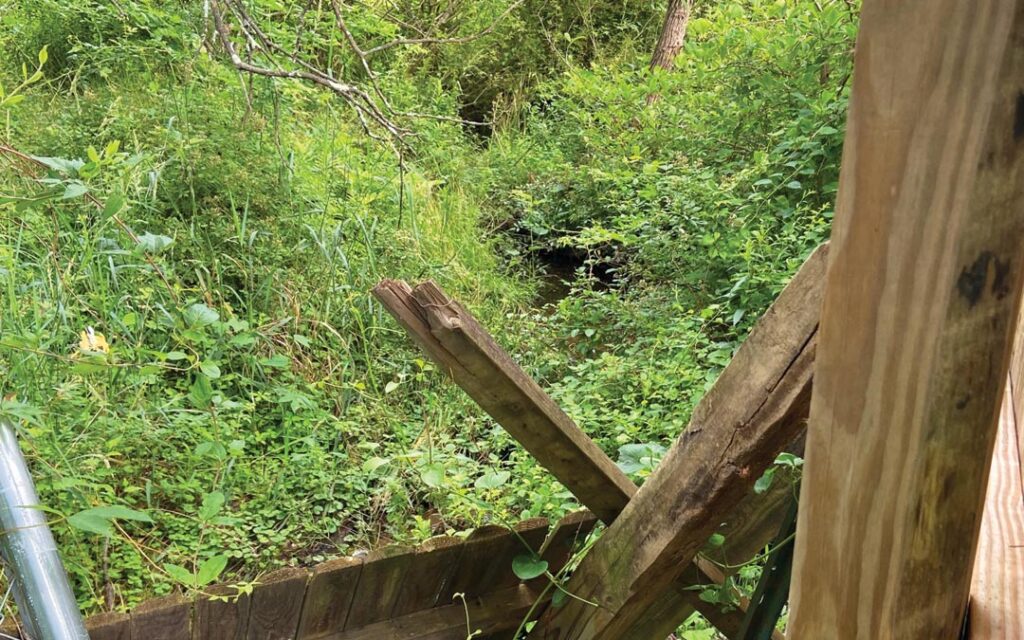
The second thing is that my neighborhood stream originates near the intersection of Caves and Garrison Forest roads. In an insignificant trickle of water bubbling under a tiny road aptly named Sprinkle Lane, the Jones Falls gurgles through overgrown brush past a dilapidated fence and creeps east and southward toward the city.
A number of branch streams join the Jones Falls along its 18-mile route. One of them was dammed in 1865 to form a boat lake five years after Druid Hill Park was established on 746 Acres of land formerly occupied by the Native Susquehannock and later the Nicholas Rogers family estate. In 1863, the Baltimore City Council approved a loan to construct a billion-gallon capacity reservoir in the new park.
The stream flowing from the boat lake used to snake its way through a yawning ravine into the river valley. This geological feature made it possible to create a vast reservoir. When completed in 1871, the earthenware dam that produced Druid Lake was the largest of its kind in the world. The resulting reservoir covered 55 acres averaging 30 feet deep (with a maximum depth of 94 feet!).
Recently, our Reservoir Hill community and the other surrounding neighborhoods of Druid Hill Park have been engaged in a visioning process to reimagine Druid Lake, the result of a post-9/11 security requirement requiring the city to bury two enormous holding tanks (one setting a new world record) for the city’s drinking water supply under one-third of the lake’s previous footprint. We’re sad to lose so much of the lake, but new possibilities have emerged. Ideas range from arts and performance spaces to swimming, boating, perched wetlands and walkways that take pedestrians over the water.
One exciting concept includes creek restoration, retrenching the stream that used to run from the northwest into the old ravine. I took a walk along the old creek bed and imagined how fun it would be to take a kayak (or gondola) from the original boat lake (now the Maryland Zoo’s Waterfowl Pavilion, where Beth Am regularly holds its summer “Services in the Park”) along the re-sourced stream to Druid Lake.
The park’s history includes racial segregation, slavery and displacement of native populations. Worthy discussion around urban renewal means being mindful of that history, even as we enjoy the city’s many amenities. For example, reinvigorating the park requires we mindfully invite surrounding neighborhoods previously cut off from the park back into our city’s premiere urban oasis. (A recent recommendation to convert “The Big Jump” pathway into a permanent cycle and pedestrian track along Druid Park Lake Drive — based on a DOT evaluation — is an important step in this direction).
Likewise, resourcing Druid Lake should include reestablishing some of that which was suppressed a century-and-a-half ago in the name of beauty and progress.
Rosh Hashanah asks us to look backward to move forward. So, too, we might consider the origins and paths of the mighty Colorado River — and the less mighty but still iconic Jones Falls. Restoration of a modest Druid Hill Park stream could help visitors to better appreciate the history and natural topography of one of America’s oldest city parks.
Right now, the park is enjoyed by foot, car and bike. Meandering through tree stands and grasses from one boating lake to another could be very exciting indeed.

Rabbi Daniel Cotzin Burg is spiritual leader of Beth Am Synagogue in Reservoir Hill, where he lives with his wife, Rabbi Miriam Cotzin Burg, and their children, Eliyah and Shamir. This column and others also can be found on The Urban Rabbi. Each month in Jmore, Rabbi Burg explores a different facet of The New Jewish Neighborhood, a place where Jewish community is reclaimed and Jewish values reimagined in Baltimore.

At its annual meeting this year, the Baltimore Jewish Council will honor the late Harford County educator and longtime Holocaust education champion.

The former Colt, who passed away on May 25 at age 93, achieved immortality during a cold December day in 1958, writes Michael Olesker.

A new biography on the creator of "Doonesbury" misses the mark, writes Michael Olesker.
What does it mean to be fully present with each other and the sacred, asks Maryland-born cultural anthropologist Alanna E. Cooper.