
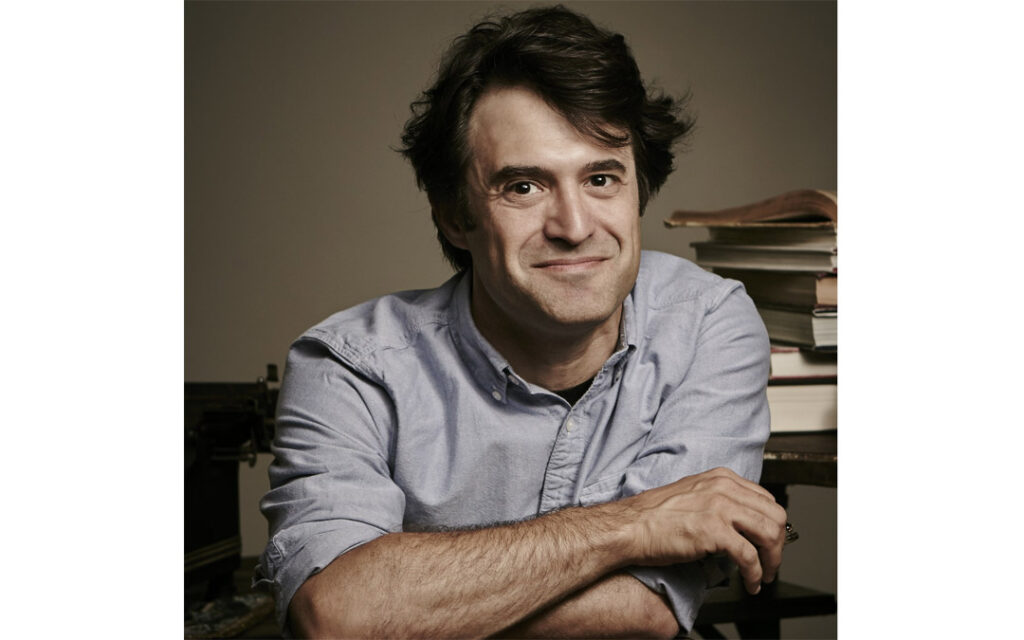
Fans of Tablet magazine’s Jewish news and culture podcast “Unorthodox” are accustomed to hearing smart, witty banter between Mark Oppenheimer, a veteran Jewish journalist, author and professor, and his cohosts. It’s part of what makes “Unorthodox” the number one Jewish podcast on iTunes.
But Oppenheimer’s forthcoming book “Squirrel Hill: The Tree of Life Synagogue Shooting and the Soul of a Neighborhood” (Penguin Random House) is a serious work about the deadliest attack on Jews in U.S. history, which took place on Oct. 27, 2018, killing 11 and wounding six.
Oppenheimer, who has written about religion for such publications as the New York Times, Harper’s and the Wall Street Journal, will speak with author Saima Sitwat about “Squirrel Hill” as part of the Baltimore Festival of Jewish Literature on Nov. 2. The live event will take place at the Gordon Center of Performing Arts, 3506 Gwynnbrook Ave. in Owings Mills.
Oppenheimer recently spoke with Jmore about his new book, his own family’s ties to Squirrel Hill and “Unorthodox.”
Jmore: Where were you when you when you first heard about the Tree of Life Synagogue massacre?
Oppenheimer: I was in my car outside of a large Conservative synagogue in Newton, Massachusetts. I had driven my eldest daughter, Rebekah, from New Haven to Newton to attend the bat mitzvah of a friend of hers from summer camp. We had been inside the synagogue all morning without our phones and at lunch afterwards. When we got back out to my car, I took out my phone and saw all these text messages saying, ‘Did you hear what’s happened in Pittsburgh? Did you know anyone there? Are you going to Pittsburgh?’ There were messages from editors saying, ‘Is there anything to be written about this? Do you know anything?’ And I had no idea what had gone on in Pittsburgh, so I quickly opened up a news app and saw there had been a shooting in Squirrel Hill.
Your reaction?
[The news] hit home not only because it was another mass shooting and not only because it was at a synagogue — which is doubly terrifying for someone who’s a synagogue-goer — but also because it was in Squirrel Hill, which is where my dad grew up and his father and his father before him. My dad was the fifth generation to live in Pittsburgh. He lived there from birth to 18 years old, and I still have family there. It made it feel very personal. I’ll never forget it.
Were any of your family members at the synagogue that day?
No, our family has never belonged to Tree of Life. They were principally members of Rodef Shalom, which is a large Reform temple, about two miles away on the western edge of Squirrel Hill.
How did you go about writing the book?
Well, it began as an episode of my podcast. Immediately after the shooting, Tablet got an Airbnb and sent a bunch of people to Pittsburgh and they were writing stories. The people who work on the podcast were gathering tape, interviewing people, getting audio. I was home in Connecticut helping to produce the [podcast] episode.
We all leapt into action and produced a special episode very, very quickly. And that was very rewarding.
But I did not feel that my reporting there was done. I hadn’t been [to Squirrel Hill] yet. I felt I should go. As somebody who’s covered religion as a journalist for 25 years and has Squirrel Hill family connections, it felt like I was called to write something bigger about this. I made my first trip about four weeks after the shooting in late November, and that was the first of 32 trips to Pittsburgh I made over 18 months. I would just fly in about once a week and interview as many people as I could who had any connection whatsoever to the shooting. I interviewed shopkeepers, clergy, police officers, anyone I could find. Slowly, the book began to emerge from those interviews.
What were a couple of the most compelling stories you heard?
One of the most moving and unforgettable interviews was with a group of firefighters at the Engine 18 firehouse in Squirrel Hill. These were firefighters who knew David Rosenthal, one of two adult intellectually disabled brothers who were both killed in the shooting.
For years, David Rosenthal used to hang out at the firehouse and help them sweep up and share food with them. One of the firefighters told me that he kept replaying in his mind the question of whether if he had been on shift that morning, David would have stopped by. Maybe then, David would have hung out long enough that he never would have gone to synagogue and it would have saved his life. We can’t torture ourselves with those kinds of what ifs. But he was very torn up about David’s death and the firefighters went to the funeral and went to the shiva and made David an honorary firefighter and gave his parents a Jewish translation of the Bible from the firefighter’s union. So that was so emblematic of how Squirrel Hill envelops its people and how they treat each other as family, Jews and gentiles. You know, people from different economic classes, people from different backgrounds.
Another story that will never leave me is how when a group of Jews were performing the tahara — the washing of the corpses to prepare for burial — a woman knocked at the door of the funeral home. This was late at night, so they were a little scared about who would be knocking at the back door of a funeral home a couple of days after this mass killing of Jews. They opened the door and a woman was standing there. She stuffed a bunch of money in their hands and said, ‘This is for the couple.’ They assumed she meant [the money was] for [the family of] the Simons, a married couple who were murdered. She wouldn’t give her name and then she just disappeared into the night. People wanted to do something, they wanted to reach out and help the extended Jewish community, however they could. It went way beyond the Jews. It also went way beyond Pittsburgh. There were people who donated money from around the world, millions of dollars. That was all pretty moving.
You’ve had a very prolific career in Jewish journalism. But these days, there’s so much talk about the end of journalism and print media.
Book sales are higher than ever. But local media is suffering very, very deeply, and that’s a huge crisis, not just for democracy but also for our quality of life. Life is much, much better when we have robust thick local newspapers (or online publications) that connect people to what’s going on at the city council, at the school board, the local houses of worship. And we’ve shed thousands of those reporter jobs at small and medium-sized local papers over the past 20 years, and that’s extremely sad.
Podcasts, on the other hand, are thriving. Tell us about “Unorthodox” and how it started.
About six years ago, I saw that podcasts were continuing to skyrocket in popularity, and it seemed that there was no good English language podcast about Jewish news and culture that was grabbing people. I felt there could be a market for a podcast that allowed American Jews and allies and the ‘Jew-curious’ to listen in on the conversations that we had around the table at Tablet magazine, where we talked frankly and candidly and irreverently about all sorts of things. So we started ‘Unorthodox’ and it has grown steadily ever since. We’ve had, I think, about seven million total downloads so far. Our audience is extremely supportive, very evangelical for us, sees us through different times of life. Three of the three hosts have had babies since the podcast started; one of us has gotten married. We’ve gone through a lot with our audience and it’s a very intimate connection.
I thank the audience in the acknowledgements to the book because I think that without them, there would have been no podcast episode of about Squirrel Hill and without the podcast episode, I’m not sure there would have been a book.
For information about the Baltimore Festival of Jewish Literature, visit https://jcc.org/gordon-center/BJ-LitFest.
The BCO, founded in 1984, will perform the works of Frank Zappa, Beethoven, Mason Bates and Karena Ingram.
Led by local Israel-American cellist Amit Peled, the Mount Vernon Virtuosi aims to inspire people beyond musical enjoyment.

Container vegetable gardening is a terrific option for people with limited space and/or time. Rebecca Brown and Norman Cohen share some tips.
Filmmaker Justin Schein looks at wealth and inequality through the very real story of his late father.