

In their concern with lofty spiritual matters, rabbis often seem to inhabit a higher realm far removed from the everyday issues that occupy the laity. But it’s worth remembering that they are flesh-and-blood creatures, too.
Perhaps no Baltimore area rabbi in recent memory epitomized this more than Rabbi Mark G. Loeb, the longtime, beloved spiritual leader of Pikesville’s Beth El Congregation.
Rabbi Loeb was a larger-than-life presence – an intellectual powerhouse, a compelling orator and a true spiritual guide to his congregants.
But one of the things that almost everyone remembers about him is how much he loved to eat.
When the recently retired rabbi passed away in October of 2009 at the age of 65, just after enjoying a hearty meal at a restaurant in Milan, his passion for food and wine became even more closely tied to his legacy.
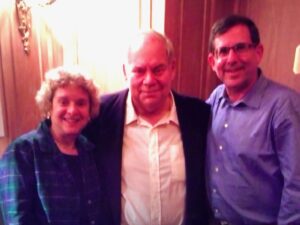
Rabbi Steven Schwartz became Beth El’s assistant rabbi in 1998 and took over as senior rabbi when Rabbi Loeb retired after nearly three decades there. He told me Rabbi Loeb had a “deep, resonant voice and he was hyper-bright, certainly one of the smartest people I’ve ever met. And as a single guy, he spent much of his disposable income on travel and fine dining.”
Rabbi Loeb ate with abandon. He enjoyed multiple course meals and heavy food, like French dishes made with butter and cream sauce.
At that time, there were few kosher restaurants in Baltimore, so for Jewish delicacies Rabbis Loeb and Schwartz would repair to Suburban House for the smoked fish and bagels.
They would also make pilgrimages to New York and enjoy lox, eggs and onion at Barney Greengrass on the Upper West Side or chopped liver, brisket and a potato knish at the old 2nd Avenue Deli in the East Village.
Rabbi Loeb also made a Passover seder each year, “and he cooked at least part of the meal,” Rabbi Schwartz noted. “He made wonderful tzimmes.” Yet despite his love for fine dining, Rabbi Loeb essentially “was a meat-and-potatoes guy,” he said.
Food and Community
Beth El, whose membership doubled during Rabbi Loeb’s tenure, acquired the reputation as the “shul that eats,” Rabbi Schwartz said.
Rabbi Loeb upgraded the food at congregational kiddushes out of the understanding that “food is an important way to build community,” Rabbi Schwartz said.
Rabbi Loeb frowned on having just cookies for the post-services repast on Shabbat mornings, insisting instead on serving bagels, egg salad, tuna salad and the like, whether or not there was a simcha being celebrated that day.
Rabbi Loeb also brought a strong social justice component to his pulpit at Beth El. In part, that was an outgrowth of the years that the Boston-born rabbi spent growing up in central Florida in the 1950s, where there were still separate hospitals, hotels, restaurants and water fountains for Blacks and whites.
His social activism extended, in particular, to the realm of food. Rabbi Loeb became national board chair of Mazon: A Jewish Response to Hunger in the 1990s; his congregants brought packaged food every Yom Kippur to be distributed to the needy.
Nor was Rabbi Loeb afraid to talk about his own journey to the rabbinate and the role that food had played in it. One notable sermon, Rabbi Schwartz said, centered on Rabbi Loeb’s experience as a young man going into a restaurant on Yom Kippur and eating a ham-and-cheese sandwich.
“He wanted his congregants to understand that many Jews, including rabbis, start out very far from religious observance and ultimately come to appreciate the value of Judaism,” he said.
Rabbi Joshua Z. Gruenberg of Pikesville’s Chizuk Amuno Congregation was assigned to Rabbi Loeb as his senior sermon advisor during rabbinical school at the Jewish Theological Seminary. He recalled once walking into Rabbi Loeb’s apartment in Manhattan, where opera was playing softly on the stereo.
Rabbi Loeb asked him to put away his speech and presented two glasses of red wine, one Merlot and one Pinot Noir. He told Rabbi Gruenberg that before he could assume religious authority, he needed to be cultured and learn how to distinguish one type of wine from the other.
Wherever he dined, Rabbi Loeb needed everything to be just so or he could not enjoy his meal. Rabbi Eric B. Stark, who served as assistant rabbi at Temple Oheb Shalom in Pikesville from 1999-2004, once had lunch with Rabbi Loeb at a restaurant in Baltimore’s Little Italy. Rabbi Loeb didn’t like the music playing in the background.
“It sounded off-key to him, so he asked them to turn it off,” Rabbi Stark said. “His knowledge of and love of food were legendary!”
Beyond Menus
A longtime colleague and friend of Rabbi Loeb, Rabbi Gustav Buchdahl served Temple Emanuel from 1963 until its merger with Baltimore Hebrew Congregation in 2016.
He said Rabbi Loeb had a joie de vivre that was exemplified by his love for food. On a trip to Amsterdam, he recalled that he and his wife visited a restaurant recommended by Rabbi Loeb, and “mentioning his name was like, open sesame. They didn’t give us a menu. They just kept bringing one course after another.”
Because of their common Germanic roots, Rabbis Buchdahl and Loeb frequently compared recipes for sauerbraten and schnitzel.
“We were worried when he came for dinner that it wouldn’t meet his standards,” Rabbi Buchdahl recalled. “But we enjoyed going out to Chinese restaurants with him. He would do all the ordering, and he knew what was authentic.
“Dining with Mark was a gastronomic and intellectual experience — it wasn’t just eating.”
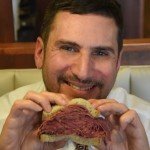
Ted Merwin is the author of “Pastrami on Rye: An Overstuffed History of the Jewish Deli” (NYU Press). He lives in Pikesville with his wife and three daughters.
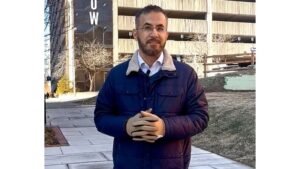
Mansoor Shams is known for carrying around a sign proclaiming, “I’m a Muslim and a U.S. Marine. Ask anything.” Now the Baltimore County Department of Recreation and Parks community engagement and outreach officer is running for Baltimore County Executive.

Baltimore native Susan Landsman recently celebrated her rite of passage surrounded by family, friends, fellow residents and staff.

Founded by Marci Yankelov, Julie Kichline, Elizabeth Miller and Lila Perilloux, the Bmore Community Fridge Network serves a crucial role in feeding the hungry.
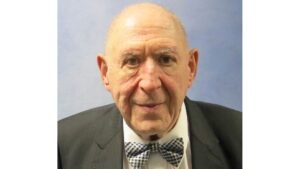
The German-born rabbi, scholar and activist, who served Temple Emanuel from 1963 to 2000 , was a prominent figure in the local Jewish community for more than six decades.