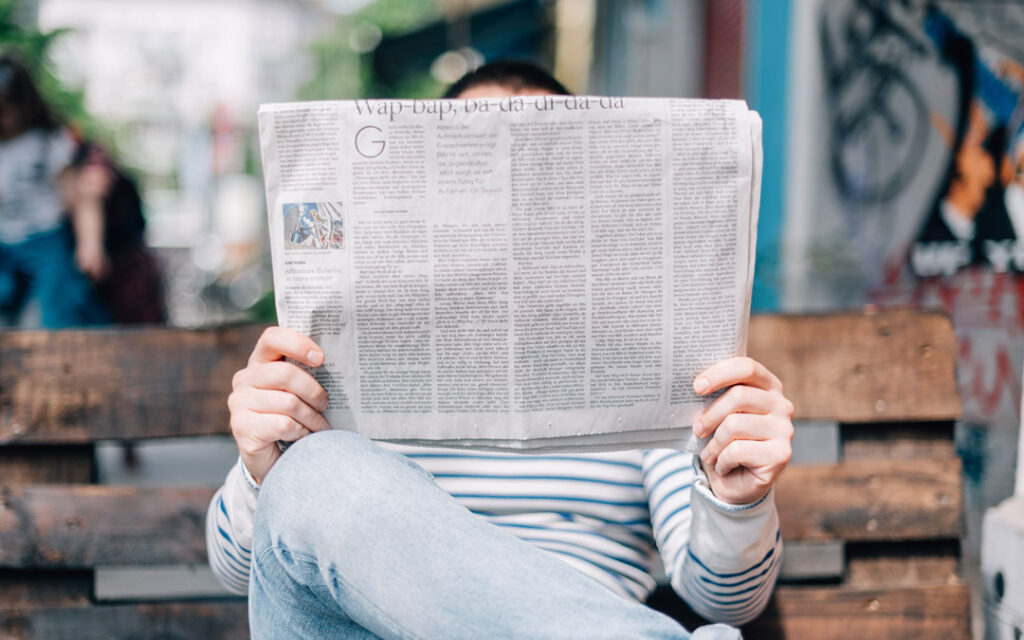
There’s an old Peanuts cartoon, kept in my desk (and in my heart) for more than half a century now, where the fussbudget Lucy eyes a spider and screams at Charlie Brown, “Kill it! Kill it! Hit it with a newspaper!”
“I haven’t got a newspaper,” says Charlie Brown.
“Then subscribe to one!” cries Lucy.
Good luck with that.
Fifteen years ago, we had 9,000 newspapers across America: big-city dailies, suburban weeklies, small-town runts, all of them giving a sense of identity to the communities they covered. One-quarter have now been silenced. Over those 15 years, the number of reporters and editors in American newsrooms has been cut by 50 percent.
In Baltimore, where we once had three daily newspapers — The Sun, The Evening Sun and The News American — we’re down to The Sun, which is now on life support. Its print circulation is barely one-tenth of what it once was. A newsroom that once swelled with more than 400 people has been reduced to about 70, and its advertising has vanished like some puddle in the Sahara.
And the new bosses, the vulture capitalist Alden Global company, has barely begun its murderous cutting of newsroom resources.
But things have already gotten grimmer at The Sun. With the year barely a week old, four of the paper’s top newsroom veterans jumped ship. They took positions with the “new kid in town,” before the kid’s even been born.
That’s The Baltimore Banner, the nonprofit dream of hotel magnate and former state legislator Stewart Bainum and the late Ted Venetoulis. The Banner’s expected to debut, strictly online, sometime this coming spring.
This is not a fly-by-night effort. They’re intending to have a newsroom staff comparable in size to The Sun’s. They’ve already brought in a respected editor-in-chief, Kimi Yoshino, who gave up her job as a top editor at the Los Angeles Times to come here. And now they’ve embraced some of the most respected names from The Sun. More are likely to follow.
In other words, The Banner is shaping up as a smart mix of top-flight talent from across the country combined with some of the savviest Baltimore news veterans — and enough money to give it financial legitimacy.
This leaves us asking: Can The Banner attract enough readers to keep it afloat? Bainum’s millions will guarantee life for the next few years, but then what?
Fifteen years ago, a Carnegie Corporation report titled “Abandoning the News” said 39 percent of respondents under the age of 35 expected to use the Internet in the future when looking for news. Only 8 percent said they’d rely on a newspaper.
Well, the future has now arrived, and it’s not only newsprint that’s fading.
As newspapers die, local TV news quietly goes through its own problems. Almost nobody’s watching, and advertising dollars are therefore drying up.
What happens when nobody’s reading newspapers, and nobody’s watching TV news? We lose our sense of who we are. When we talk about the hometown, we deal in verbal shorthand, in clichés — and in ignorance.
In such a void, the city’s image becomes no more than the sum of its homicides, a caricature, a fearful, foreign place to suburbanites reluctant to come downtown ever since Freddie Gray. Are dangerous streets all that’s left of the city that was once the social and economic and cultural heart of the entire state?
We’re no longer sure, because we no longer have voices offering us perspective, telling us how the city and the suburbs are linked, examining neighborhoods and schools, touting the whole metro area’s cultural highs to balance all the blistering coverage of its criminal lows.
We’re coming to the end of an old way of telling stories. That’s a dangerous thing in the life of any community, and in the life of democracy itself.
That is, unless the old way is replaced by something even better. There’s a lot riding on the success of The Baltimore Banner, and a lot riding on the willingness of the Baltimore area to embrace the new kid, and nurture it past its formative growing years.

Michael Olesker’s newest book, “Boogie: Life on A Merry-Go-Round,” will be published this spring. It’s the life story of Baltimore legend Leonard “Boogie” Weinglass,an original “Diner” guy who grew up to create the Merry-Go-Round clothing chain and donate millions to charity.

What does it mean to be fully present with each other and the sacred, asks Maryland-born cultural anthropologist Alanna E. Cooper.
As millions mourn the passing of Stephen Colbert from the airwaves, Michael Olesker looks back on the "institution" of late-night TV.

As he gets ready to leave for California, Rabbi Daniel Cotzin Burg looks back on his time in Baltimore and his 10 years writing for Jmore.