
By Sam H., Eighth Grade Student, Krieger Schechter Day School of Chizuk Amuno Congregation
When many schools look to reduce expenses, the arts are often the first to go.
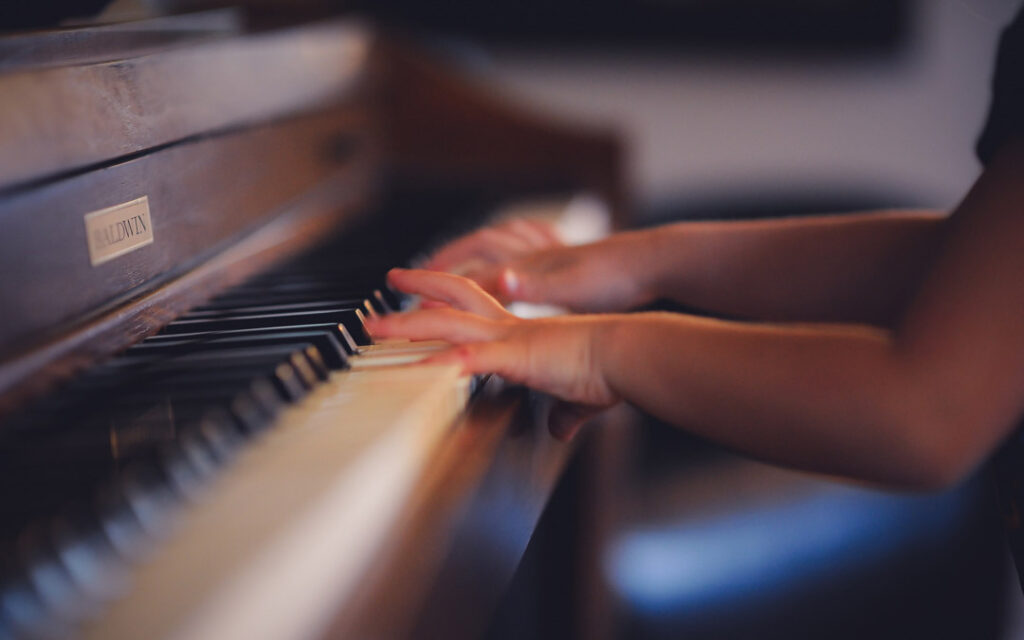
Instrumental music classes can be particularly expensive because of the cost of instruments. The three most popular instruments are the piano, guitar and violin. An upright piano can cost upwards of $3,000, and guitars and violins can cost upwards of $500.
Given how expensive these instruments are, schools often opt to cut these classes. However, are they making a mistake? Do the benefits of music make it a vital part of students’ learning?
According to Tzipora Wecker, a music, math and Hebrew teacher at Krieger Schechter Day School of Chizuk Amuno Congregation, the academic edge that some music students have can be seen as early as middle school.
“There is a lot of overlap between students in the [top] math and music classes,” said Wecker, who studied music in college and plays mostly string instruments.
Wecker believes that instrumental music helps children learn and that “everyone can benefit from learning some music.”
She is a supporter of KSDS’s decision to make music classes mandatory in fifth grade and implores students to keep playing even after that.
Micah L., an eighth grade student at KSDS, is an honors student who also plays the piano. Micah believes he has been subconsciously using his music skills in the classroom.
“I believe that I am a very strong student in the area of math and science, and I believe that is correlated with my playing piano,” he said.
A 2019 study published by Science Daily found that students who played a musical instrument throughout their school years were, on average, an academic year ahead of their non-musician peers.
Furthermore, according to a 2020 article in USA Today, “Though art and music are designated ‘specials’ rather than ‘essentials,’ they are particularly vital to the overall success of students.”
This confirms the importance of music education and makes a case of why music classes should not be cut from schools’ budgets.
However, it is important to keep in mind that there is a difference between causation and correlation. The students who played an instrument had time to practice, which probably means they had time to study for tests and complete all homework assignments on time.
On the other hand, students who did not have time to play instruments may have had other out-of-school commitments or jobs.
Given this, it is still plausible that the students who took music excelled because they played an instrument. This is demonstrated by the fact that many high-achieving students continue to play even after high school while studying at Ivy League and other top colleges.
In fact, according to the Massachusetts Institute of Technology’s website, approximately 14% of students at MIT, a leading math, science, and engineering college in the United States, are enrolled in music programs, demonstrating that a significant number of the students accepted to MIT are musicians.
Furthermore, Harvard University, an Ivy League school, has nine orchestras. Yale University, another Ivy League school, has its own separate music school with 200 students, while Stanford University boasts 104 music teachers.
In addition, the California Institute of Technology has about 30 smaller music groups, such as trios, quartets and small ensembles, as well as a 70 piece full orchestra. All of these colleges are ranked in the top 10 in the country by U.S. News & World Report.
Both teachers and students confirm the advantages of music and its connection to academics. It is a mistake to think that music education is a waste of time.
Sam H. is an eighth grade student at Krieger Schechter Day School of Chizuk Amuno Congregation.

Grades can ‘make kids feel judged as Jews,’ according to an organization dedicated to improving and innovating Jewish day schools.

Schools in Montgomery County have recently experienced a wave of antisemitic incidents.

CCBC Honors scholars are discovering a level of academic rigor and opportunity typically associated with elite four-year institutions.

For 35 years, the late Deborah Brodie, aka Bubbie Cookie, amassed a collection of over 200 Jewish ritual objects, which she used to teach her Hebrew school students with special needs.