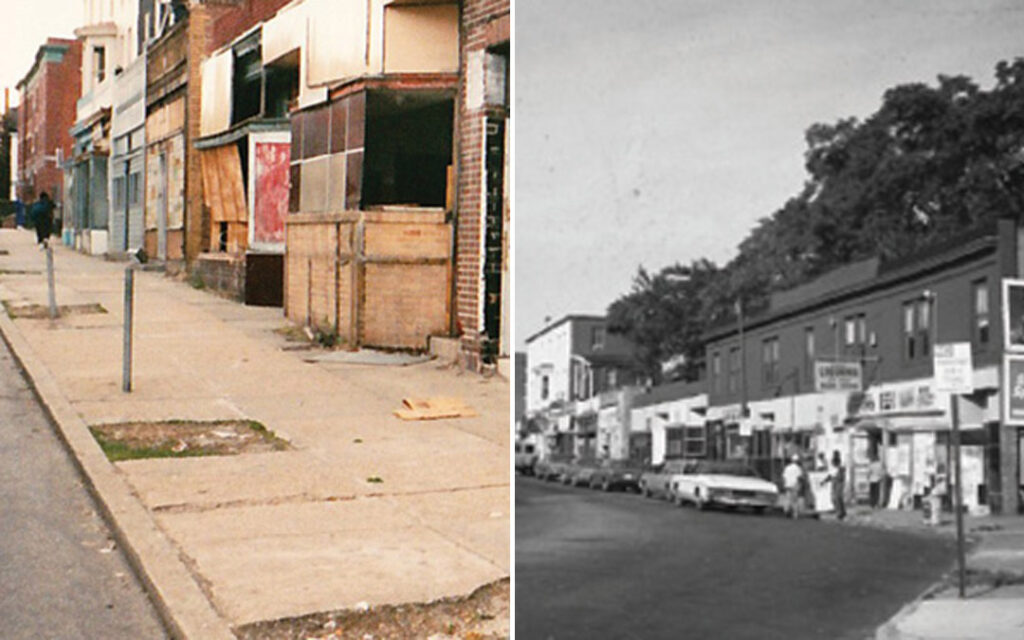
The next time you’re in Reservoir Hill, take notice of a barren stretch of curved road between Linden and Brookfield avenues known as Whitelock Street. You might not know it but you’re standing in what was once a thriving and vibrant Jewish shopping district.
Unfortunately, these blocks eventually became known as a center of unrest during the 1968 riots in the aftermath of the assassination of Dr. Martin Luther King Jr. In the following years, businesses gradually reopened but the exteriors of the buildings themselves looked like they had been through a war, with their gated doors, bricked-up windows and multiple vacancies.
Whitelock Street became a bit of an eyesore for the mostly African- American residents of Reservoir Hill and an open drug market besotted with violence.
But it was not always that way. From the 1920s through the early 1960s, Jewish merchants lined Whitelock Street on both sides, especially the 900 block of the thoroughfare.
Familiar names in local Jewish history such as Holzman’s Bakery, Surosky’s kosher meats, Saler’s dairy store and Wasserman & Lemberger kosher meats all had locations on Whitelock Street before moving elsewhere.
Reba Phillips, a women’s fashion store, opened in 1948 at 818 Whitelock before eventually relocating to Pikesville.
There were other various groceries, clothing stores and pharmacies, in addition to the abundance of kosher butchers and bakeries.
Albert Surosky’s small kosher butcher shop was located at 703 Whitelock in 1921 and moved to 954 Whitelock three years later. He later relocated to 919 from 1935 through 1966, being one of the last Jewish merchants to remain open in the area.
Meanwhile, other family members under the name of Surosky Bros. opened a kosher market at 935 Whitelock from 1926 through 1933, and then moved two doors down from Albert at 923 from 1933 to 1940.
At least the competition was all in the family!
Now located at 7006 Reisterstown Rd. in Pikesville, Wasserman & Lemberger kosher meats began at 964 Whitelock in 1950 and relocated to the Pimlico area a decade later.
During the 1920s through the 1940s, there was also a small cluster of stores in the 700 block of Whitelock that featured a handful of Jewish-owned groceries, as well as Gold’s Bakery.
As Jewish residents gradually moved away from the area and toward Northwest Baltimore during the late 1950s and early 1960s, African-Americans moved into neighborhood. The spacious, one-family houses of Reservoir Hill that once inhabited affluent German Jews were now largely divided into apartments.
The Jewish-owned stores that survived the exodus were mostly gone by the time of the ‘68 riots. Many had stayed in the neighborhood to serve the remaining Jews and others who lived at the Emersonian, Esplanade and Temple Gardens apartments facing Druid Lake Drive.
Whitelock Street is now a verdant area of parks and the Whitelock Community Farm, where residents grow their own vegetables.
What they generally do not know is that the land they are using for healthy eating today once brimmed with Jewish grocery stores and other merchants.
Steve Liebowitz is a Baltimore-based freelance writer and author of “Steel Pier, Atlantic City: Showplace of the Nation” (Down the Shore Publishing) and “Steel Pier” (Arcadia Publishing).
What does it mean to be fully present with each other and the sacred, asks Maryland-born cultural anthropologist Alanna E. Cooper.
As millions mourn the passing of Stephen Colbert from the airwaves, Michael Olesker looks back on the "institution" of late-night TV.

As he gets ready to leave for California, Rabbi Daniel Cotzin Burg looks back on his time in Baltimore and his 10 years writing for Jmore.