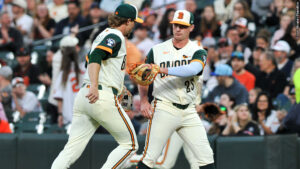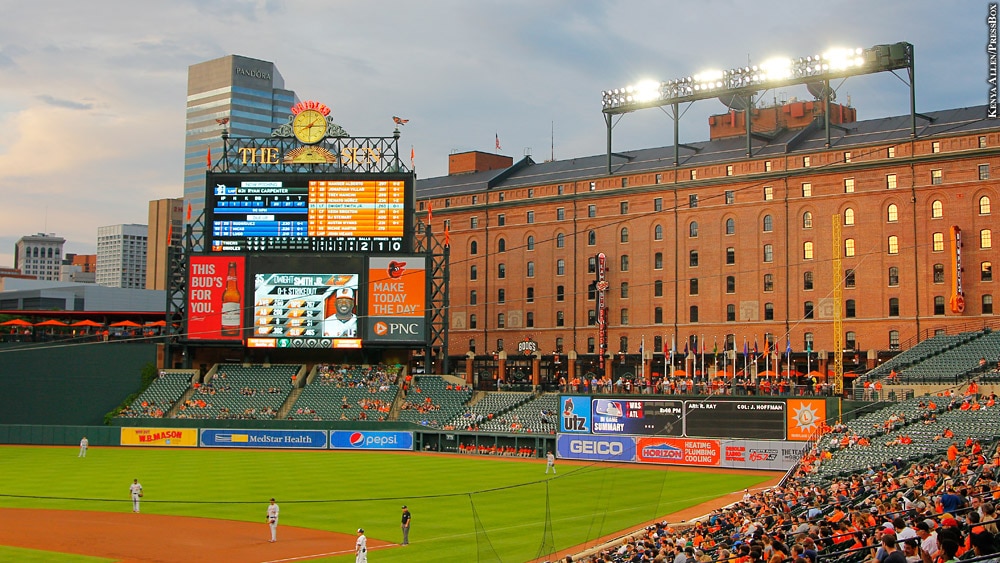
In a sweeter time than this, Peter Angelos sat in his luxury suite high above home plate at Oriole Park and reflected on the heroic figure he should have become.
It was an April night in1994, six months after Angelos purchased the Orioles and light years from our current moment, in which the Angelos sons drag their father’s baseball team into a court of law and threaten to return everyone to a state of anxiety we imagined we’d left behind.
Who will assume ownership of the Orioles, and will they keep the team in Baltimore?
It was Peter Angelos who purchased the Orioles when Baltimore was at its most nervous. The football Colts had bolted town, and so had the basketball Bullets. Out-of-town money was angling to buy the Orioles, which meant we’d be vulnerable once more to pro sports abandonment.
Does history repeat itself?
Three decades ago it was the Baltimorean Angelos who saved the day, buying the team at auction for a previously unimaginable $173 million. (For a little perspective, recall that the Orioles had been sold roughly a dozen years earlier for a piddling $12 million.)
“I didn’t care how high the bidding went,” Angelos said on that spring night in 1994. “In my mind, I knew I would go higher. I mean, I was thinking, ‘When is this SOB gonna give it up?’ But until he did, I wasn’t leaving.”
But he’s leaving us now, and as he does, the sons Louis and John go to court to fight over the Orioles’ future.
As the 92-year-old patriarch copes with a variety of health issues, Louis, 52, sued John, 54, last week in Baltimore County Circuit Court. Also named as a defendant is their 80-year-old mother, Georgia Angelos.
At stake is the baseball team, and millions in other family assets — and the civic pride of a Baltimore area clinging to its remaining symbols of big league status, and the binding, healing qualities pro sports bring.
As owner of the Orioles, Peter Angelos had plenty of flaws, easily identifiable by the club’s record on the field. They’re last in the America League’s Eastern Division. It’s a familiar position, and ownership inevitably bears plenty of responsibility.
But Angelos understood Baltimore’s sense of insecurity, and whatever issues he had with the town — including the awful attendance figures of recent years — he never issued any threats about pulling up stakes.
Are we facing that possibility now?
Not likely, despite next year’s conclusion of the lease linking the Orioles to the ballpark at Camden Yards. The big shots who run Major League Baseball don’t like teams jumping from city to city, especially teams with rich histories. Baseball places great value on tradition, on nostalgia, on shared memory.
But the Angelos family has been talking about selling the club for at least the last three years. For a community wary of out-of-town ownership, the question becomes: Is there any Baltimorean with deep enough pockets, and a desire to own a baseball team, ready to step forward?
Three decades ago, Peter Angelos was a hero for saving baseball in Baltimore. Let’s not lose sight of that. As his family battles it out in some dreary court, this is not the finish anyone would want.

Michael Olesker’s newest book, “Boogie: Life on A Merry-Go-Round,” was recently published by Apprentice House. It’s the life story of Baltimore legend Leonard “Boogie” Weinglass, an original “Diner” guy who grew up to create the Merry-Go-Round clothing chain and contribute millions to charity.
What does it mean to be fully present with each other and the sacred, asks Maryland-born cultural anthropologist Alanna E. Cooper.
As millions mourn the passing of Stephen Colbert from the airwaves, Michael Olesker looks back on the "institution" of late-night TV.
As he gets ready to leave for California, Rabbi Daniel Cotzin Burg looks back on his time in Baltimore and his 10 years writing for Jmore.