
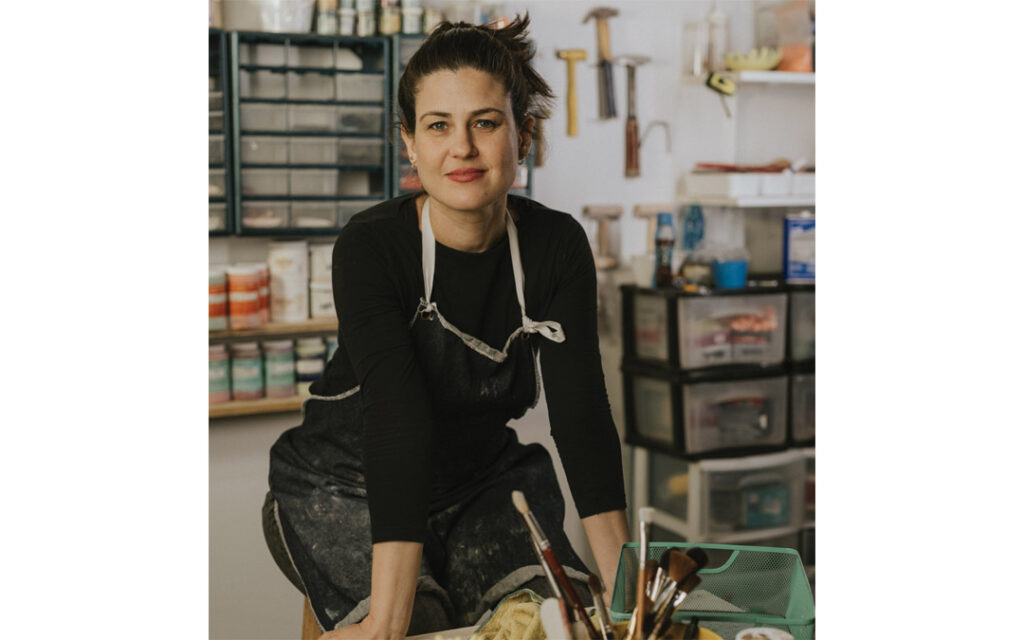
Artist Zemer Peled has her hands full these days. The Israeli-born Bolton Hill resident is nine months pregnant, has an active toddler at home, and she’s putting the final touches on a sculptural installation that’s part of “EX-tend EX-cess: Metamorphosis in Clay,” a major exhibition that opened at Towson University’s Center for the Arts Gallery on Aug. 26.
The show will run through Dec. 10.
“It was crazy,” says Peled of installing her piece for the exhibit, “because I was, like, climbing on ladders and building this installation. … I hope I make it to the reception [a week before her baby is due]!”
“EX-tend EX-cess: Metamorphosis in Clay” is the first ceramics-only show in the gallery’s history. It also marks the first time Peled — who has exhibited at galleries including Sotheby’s and Saatchi in London, and whose work is part of the collections at the Museum of Fine Arts, Boston and others — will show her work in Baltimore, where she settled in 2018.
Before that, Peled moved around a lot. She grew up on a kibbutz alongside her older brother, Baltimore-based cellist and Peabody Institute professor Amit Peled.
After serving in the Israeli army, Peled attended college at Bezalel Academy of Arts and Design and began focusing on visual art. During college, she spent a semester abroad at Maryland Institute College of Art, an experience she says was “incredible.”
Peled earned her master’s degree in ceramics at the Royal Academy of Art in London. She then served as artist-in-residence at venues in Montana and Los Angeles. She moved to Baltimore to be close to her brother and his family and to start her own studio in East Baltimore.
“A year after I moved here, I met my husband, and now we have all these babies,” she jokes. “It was the best decision of my life.”
It was during graduate school that Peled began making art from shards and porcelain.
Working with shards was “a way for me to look back into my own history and the shards in Israel,” she says. “We used to have and we still have an archaeological site on the kibbutz and as a child, I used to go and dig in the ground and look for shards all the time. I was always obsessed with shards.
“Ceramics was like looking at my own history. Since then, I’m breaking, reconstructing and demolishing all the time. I’m trying to build my own language with the shards, but in a way it’s always broken in pieces.”
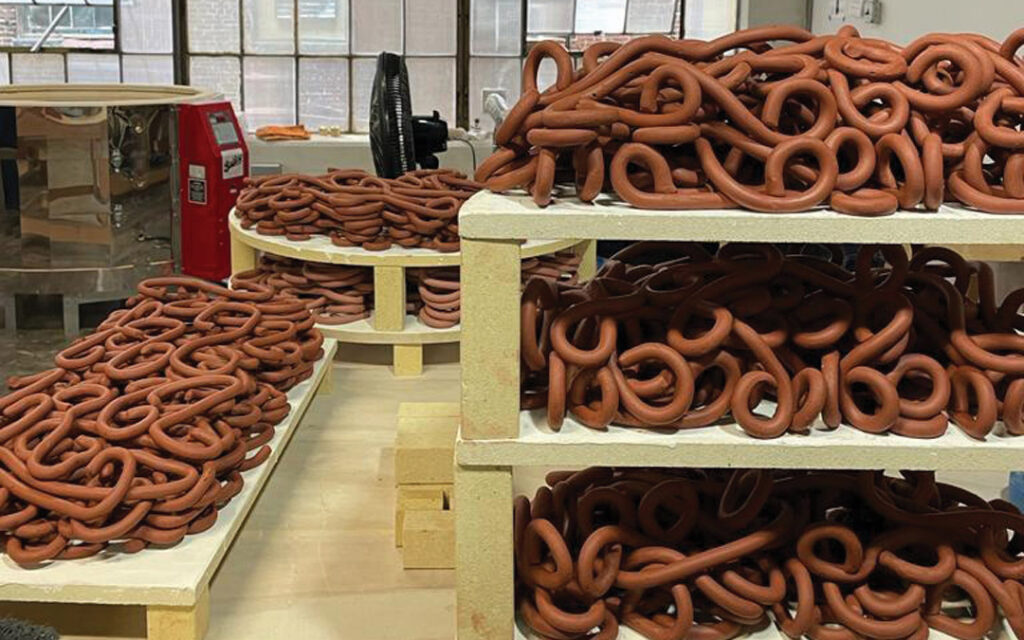
Peled’s early work portrayed colorful flowers and underwater creatures made of shards. But the piece for “EX-tend EX-cess” is different, she says. “It’s a new piece built with pieces [of clay] that are hooked to each other and it’s all about gravity and this tension of when the piece will break. It’s a wall piece — a big installation on the wall and it’s in two different locations at the gallery. When I build a piece, it’s very stressful because it can all break in a second because of the weight of the clay. That’s what I’m looking for all the time in my work — this tension with ceramics in weight and fragility. And so that’s what interests me in the work.”
Peled is pleased with how the new work came together and curious about how gallery visitors will respond to it.
She says her work — the tension of when something will break — is a metaphor for life, and particularly for life in Israel.
“I live quite well with this tension, I think, because I’m from Israel. We always live in tension.”
Jews and Israelis are well represented in “EX-tend EX-cess.” Co-curators J. Susan Isaacs of Towson University and Sagi Refael, an independent curator and artist are both Jewish, as are exhibiting artists Rotem Reshef, Martha Rieger and Gabriela Vainsencher. The exhibition and related programming are being co-sponsored by Baltimore Hebrew Institute of Towson University
Peled will be lecturing about her work on Dec. 1 at TU’s art lecture hall. The lecture will include a musical introduction by cellist Amir Peled. For information about “EX-tend EX-cess” visit events.towson.edu.

Rabbi David Wolpe looks at the recent interest in Hollywood productions about King David and why the story is resonating now.

Directed by Johanna Gruenhut, the production is based on of the 1998 novel and 2003 film of the same name.
In "The Future is Peace," Aziz Abu Sarah and Maoz Inon say there is still hope for coexistence between Arabs and Jews.

In his new memoir, piano man Marc Shaiman tells a showbiz story shaped by Jewish humor.