
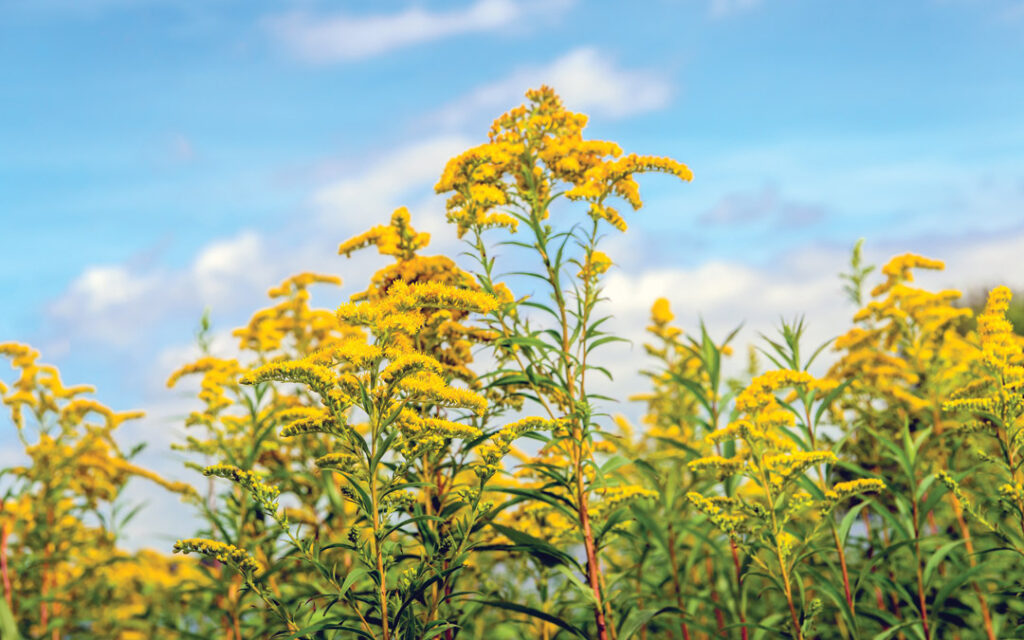
Shorter days, cooler temperatures and wilting summer flowers can bring feelings of sadness. But don’t despair. Fall foliage and late-season perennials create a colorful landscape that’s almost certain to boost your mood.
Chrysanthemums (aka, mums) are a popular choice to add fall color. But they’re not the only choice. Late-flowering Maryland native perennials such as asters are a great way to extend the aesthetics of containers, flowers and shrub beds.
Easily grown in clay-heavy Maryland soil, asters come in a variety of colors with light conditions from shade to sun. They are purchased and transplanted in late April/early May and serve as a source of nectar for pollinators, especially the monarch butterfly. Given the space, asters will spread readily.
Several years ago, asters were divided by taxonomists into two groups, European and North American. The European group maintained the name aster, and North American received Latin names (i.e., the common name, white wood aster, originally Aster divaricatus is now Eurybia divaricate).
The most readily available asters are:
• White wood aster (Eurybia divaricata), grows in partial light to full shade; 0.5 to 2 feet in height; color: white
• White heath/frostweed (Symphyotricum ericoides), grows in sun to partial shade; 0.5 to 4.5 feet in height; color: white
• New England aster (Symphyotricum novae-angliae), grows in sun to partial shade; 1.0 to 6 feet in height; color: purple
• New York aster (Symphyotricum novi-belgii), grows in sun to partial shade; 1.0 to 4.5 feet in height; color: blue
In New England and New York, you can buy various cultivars that vary in height and shades of purple and blue. Many nurseries and box stores sell potted asters in bud or bloom. Give the astersa wide berth for air circulation.
You may also wish to consider Helenium autumnale, commonly named dogtooth daisy/ yellow sneeze weed. Helenium was named by 18th-century Swedish botanist Carl Linnaeus after Helen of Troy. Best planted in sun, Helenium can also tolerate partial shade to shade; 1.5 to 5 feet in height; its colors range from red to mahogany to yellow. Many cultivars have heights less than two feet and the species comes in various colors.
Another staple for fall flowering is goldenrods. Over 10 species of goldenrods are native to our area, and goldenrod is an important source of nectar for butterflies, bees, and other beneficial insects. To purchase goldenrods, it’s best to use the common name as well as the Latin name, Solidago. Through the ages, goldenrod has been known for its medicinal properties. We make no claim as to their effectiveness, but the flowers are said to be beneficial in their treatment of urinary tract infections, kidney stones and pain caused by arthritis.
Goldenrod in our area come in several types:
• Blue-stem goldenrod, Solidago caesia, grow in sun to partial shade to filtered light, O.5 to 2.5 feet in height with horizontal habit
• Showy or slander goldenrod, Solidago speciosa, grow in sun to part shade, 2 to 4 feet, hundreds of small flowers on 12-inch-long stems. Cut them back after flowering to prevent reseeding.
• Sweet goldenrod, Solidago odora, grow in sun to part shade, 1.5 to 4 feet, sun to partial shade, anise-flavored
One word of caution: do not plant Canadian goldenrod, Solidago canadensis. This is a plant of fields and is quite aggressive.
Happy Autumn!
Rebecca Brown began her career as a horticulturalist more than 25 years ago and studied at the New York Botanical Gardens. She has been a University of Maryland-Baltimore County master gardener for eight years and is a backyard beekeeper.
Norman Cohen is a retired chemist. He has been gardening for 39 years and has been a UMBC master gardener for 13 years. Cohen also provides gardening education to the public at local farmers markets.
Duke Zimmerman and Lori Gale will talk at Towson University about their new book "People Get Ready" and the role played by Globe Posters in the civil rights movement.

The new exhibition revisits and updates a previous show about ritual hair covering in the observant community.
The Pikesville resident's latest offering "There's a Dragon in the Tree House and He Won't Come out!" was co-written with her grandsons.

A new biography captures the intensity and magic of the musical theater giant, writes Michael Olesker.