
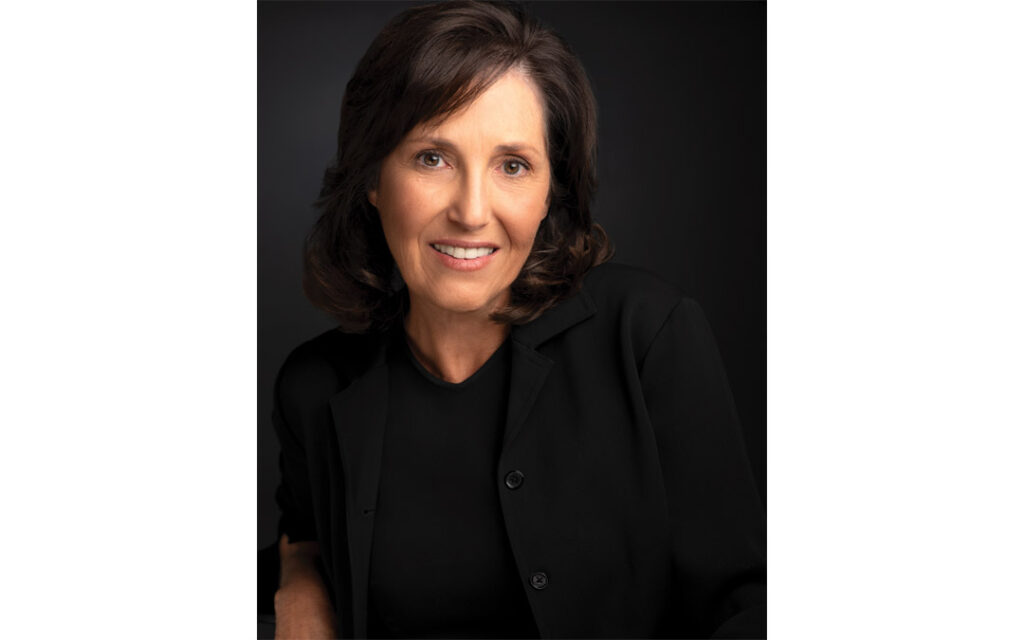
Like many children of Holocaust survivors, Anna Salton Eisen grew up feeling something was different about her family.
There were no relatives and practically no photographs in her family’s Potomac home. Her parents rarely spoke about their backgrounds, and it wasn’t until she was an adult that Eisen learned her Polish-born father, George Lucius Salton, survived 10 concentration camps.
Eisen’s German-born mother, Ruth Salton, now 101, is also a survivor who worked for the Brichah, an underground movement that helped Holocaust survivors escape Europe and move to Palestine after World War II.
Co-written with her son Aaron, Eisen’s new memoir/travelogue, “Pillar of Salt: A Daughter’s Life in the Shadow of the Holocaust” (Mandel Vilar Press), tells her late father’s story and explores her own life as a second-generation Holocaust survivor.
A documentary, “In My Father’s Words,” about Eisen, her father and a reunion with families of other Holocaust survivors, is in production and expected to be released in 2023.
Eisen, 62, a psychotherapist and resident of Westlake, Texas, recently spoke with Jmore about the book. She also discussed the Jan. 15 hostage-taking crisis at Congregation Beth Israel in Colleyville, Texas, a synagogue co-founded by Eisen in 1998.
Jmore: How did you first learn about the Holocaust?
Eisen: When I was about 8 or 9, I came across some watercolor paintings I found in a drawer signed by a name I didn’t know — L.S. Salton. One was a ghetto scene. One was a young man on his knees at a pit surrounded by Germans and dogs and about to be shot. I kind of put them back and knew enough not to bring it up, like I found something I shouldn’t find. So I began to know a little bit.
I started learning on my own in secret, going to school and looking it up in the library. I didn’t even know my parents had different names [before relocating to the United States]. I didn’t know anything about my father’s past when I moved to Texas in 1984. They had a Holocaust museum in Dallas. I went there, and everything was available to me. I learned about what happened in 1933, the boycott, the burning of books, the fire of the Reichstag, Kristallnacht …
I even became a docent at the museum. I would walk around and just internalized and became kind of an expert on the facts. Then, I went on to do some interviews for the Shoah Foundation. It was in the process of doing the interviews that I realized I needed to be the one asking my father what happened to him. It shouldn’t be some stranger, and I didn’t want to watch it on a tape. So I confronted him and two weeks later, we were on a plane to Poland.
What was that like?
It was great because he was my father and also our guide and teacher and very kind in the way he shared it, not brutal. We went to all the main places — to Auschwitz, Warsaw, Kraków-Płaszów, the ‘Schindler’s List’ camp where he was imprisoned. Then we went to Zasloff, where he had been in the ghetto, to his town and into his house. I made this trip twice, once with my brothers and parents, and a second time when I went with my parents again but brought my children and a grandchild.
There were times when we would sit in a cafe at night and just be glad to be together, to be alive, to be able to say we could come back here, to say Kaddish for his family and all the others, and we were not beaten down. Knowing the story allowed me to grieve. That was the purpose of writing the book.
How did you first hear about the hostage crisis at your synagogue?
It was just a regular Saturday, and I remember looking at my phone and there was a text from someone saying, ‘A gunman is in the synagogue and he’s holding the rabbi and others hostage.’ I looked at it and was just like, ‘Is this real?’
I called the person and they were hysterical. ‘Get on Facebook.’ So I got on the livestream and you could see the pulpit. You could hear the conversation going on, and it went on for about two hours. I could hear the rabbi talking in a soothing, calm voice and I could hear the gunman. He sounded a little bit agitated at times.
How did this affect you?
I was sitting in front of the computer and thought, ‘Oh my God!’ I wanted to turn it off and walk away, but every moment was just pregnant with the possibility that I would hear a gunshot. It just went on for so long.
I had to go and tell my mom, and it was really hard. I thought to myself, ‘Don’t cry.’ But I started crying and had to say, ‘Mom, there’s a gunman in the synagogue, and he has the rabbi and some other members, and he’s holding them hostage, and he says he has a bomb and he’s going to kill them.’
Her eyes just filled with tears. We watched CNN all day and then I got an email from the congregation that said everyone is out and they’re all free. So I was able to tell my mom and we were just so relieved.
Two days later, we went to a healing service and I sat on the stage next to the rabbi. It was so great to give him a hug and be with everyone.
The Pikesville resident's latest offering "There's a Dragon in the Tree House and He Won't Come out!" was co-written with her grandsons.
A new biography captures the intensity and magic of the musical theater giant, writes Michael Olesker.

Emma Snyder, owner of The Ivy Bookshop, offers recommendations for must-read titles for adults and children.

Schwab currently serves as president of Cumberland's historic B'er Chayim Congregation.