
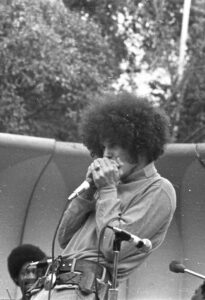
In one of the biggest hits of the ‘70s, “Why Can’t We Be Friends?” by the funk-rock band War, harmonica player Lee Oskar sang in a halting, humble voice, “Sometimes I don’t speak right/but yet I know what I’m talking about!”
These days at 74, the Danish-born Oskar is prone to expressing himself in a decidedly forthright, occasionally profane manner. For instance, don’t get him started about why War has not yet been inducted into the Rock & Roll Hall of Fame. “It’s all [expletive] politics,” he said.
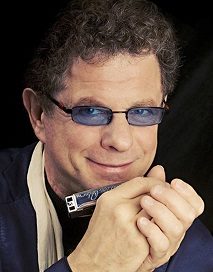
And when asked his all-time favorite harmonica player, Oskar doesn’t miss a beat. “Myself,” he recently told Jmore. “Too many players play too fast and sound like absolute [expletive]. It’s terrible. To me, my achievement is about the feeling, not just the technique.”
Without a doubt, Oskar is a man of confidence and passion, and not only regarding music. Born and raised in Copenhagen and now a resident of Everett, Washington, he is the son of a Holocaust survivor, something he’s grappled with his entire life.
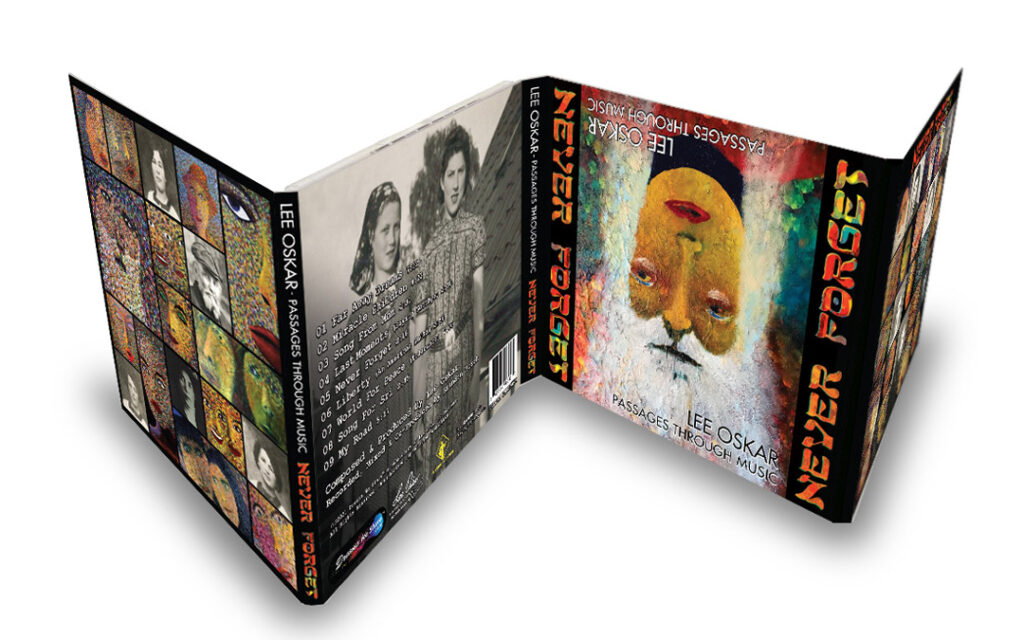
That struggle of the soul manifested itself on his latest album “Passages Through Music: Never Forget” (Dreams We Share), an all-instrumental collection of Oskar compositions related to the horrors of the Shoah, during which more than 140 members of his family were murdered.
Oskar calls “Never Forget” — his first studio album in a quarter-century — a “musical memoir,” and the album’s styles range from haunting klezmer-like melodies to classical orchestrations to exotic interludes featuring flamenco guitar and oud, all anchored by Oskar’s ethereal harmonica.
In a review for PopMatters, Steve Horowitz called “Never Forget” “lush and rich. Oskar’s harmonica playing is front and center on every one of the nine tracks. … His latest record shows he has not given up the fight against aggression.”
Even during his glory days with War — known for such major soulful hits as “Low Rider,” “The Cisco Kid” and “Summer” — Oskar, the only white member of the group, admits he tended to play down his Jewish roots.
“The terrible fear I had of antisemitism started in my childhood,” he said. “My [Lithuanian-born] mom [Rachel] survived the killing camps and escaped a death march with my Aunt Judy in the cold of winter. They came to Denmark and were slaves to a Nazi woman who thought they were Russian girls, and then they were rescued by the Red Cross.
“My mom was liberated but she lived with a lot of fear, and it carried on to me,” Oskar said. “I was afraid for people to know I was Jewish when I was young. Even when I took a streetcar to religious school, my parents told me, ‘Don’t tell anyone you’re going to Jewish religious school.’ And it has filtered down to my kids and grandkids, because of my behavior.”
But sprinkled throughout his nine acclaimed solo albums have been songs about the immigrant experience and the need for universal love and healing, especially on such offerings as “I Remember Home (A Peasant’s Symphony)”and “My Road Our Road.” Still, it wasn’t until a few years ago that Oskar, who’s also a prolific visual artist, decided to tackle the specter of the Holocaust head-on with a concept album.
“I realized I had a responsibility as an artist,” he said. “If I had not done my memoir and expressed my feelings, these demons, I would’ve been ashamed to go to my grave as an artist. I’ve kind of dealt with it in the past, but this was really to open the door and let people know. Hopefully, it serves people well who are going through it as well.”

The nine tracks on “Never Forget” include the poignant, sweeping opening “Far Away Dreams” and “Last Moments (Saying Goodbye),” which deals with the remembrance of family tragedies and hope for the planet’s future.
“It’s all about life, humanity, dignity,” Oskar said of “Never Forget,” which he produced and illustrated the cover and 16-page insert booklet. “It’s horrendous what humanity does to each other. It’s the same [expletive] that goes on today, everywhere.”
A Cardiac Yid
Born Oskar Levitin, the musician grew up in a Yiddish-speaking home that observed kosher dietary laws. During World War II, his father, Joseph, a first-generation Danish Jew, served in the resistance that famously ferried more than 7,200 of Denmark’s Jews out of the country during the Nazi occupation. Oskar and his brother Rolf attended a Jewish day school and studied under Bent Melchior, who became Denmark’s chief rabbi.
“I grew up going to synagogue on the High Holidays. I respected the rituals, but today I don’t go to synagogue at all,” Oskar said. “I call myself a ‘cardiac Yid.’ I take so much to heart about what it means to survive. I respect where I come from.”
At age 6, Oskar received the gift of a harmonica from a relative visiting from the United States. “Every kid in Denmark back then had a harmonica, and I loved music,” he recalled. “I fell in love with the harmonica. You just breathe and you’re playing it. You don’t play the harmonica, it plays you. I was always artistic and musical. I listened to everything on the radio — Louis Armstrong, opera, the blues, you name it. To me, it’s all just music.”
After turning 18, Oskar grabbed his harmonica and little else, hopped on a ship and came to New York in 1966 to start a career in music. He spoke only a few words of English.
“It still baffles me,” he said. “I only knew a couple of people in New York, and I kind of lived on the streets and eventually made it to [San Francisco’s] Haight-Ashbury. But I needed to get away, from all that dread and nervousness that the war had done to my family. Even in Denmark, there was a fear of antisemitism. I had to step away and make it in the music business. It was all about ambition.”
In 1969, Oskar met British blues-rocker Eric Burdon at a North Hollywood club not long after the breakup of his band, The Animals. They soon joined forces with members of a group called Nightshift that would become the nucleus of War, and in 1970 released the album “Eric Burdon Declares War” featuring the Latin rhythm-infused classic “Spill the Wine.”
Burdon moved on after the group’s sophomore effort, “The Black-Man’s Burdon,” but War — with its pioneering funk-soul-R&B-jazz stylings — continued to churn out hits and became one of the biggest bands of the ‘70s. Oskar’s knack for interweaving infectious horn lines with saxophonist Charles Miller contributed greatly to War’s success. Oskar left the band in 1993 over a trademark dispute.
“The magic was that all of us were individuals and owned whatever we did, and the chemistry was what it was,” Oskar said. “We were always jamming and never told each other how to play. I just wanted to be part of a band, to be connected and playing melody lines. … I still love playing ‘Gypsy Man’ and ‘The World is a Ghetto.’”
On A Quest
Despite his success in music, Oskar said he was constantly frustrated with the quality of his chosen instrument. “I was on a quest to find a factory to make harmonicas because back then, only one out of every 10 harmonicas were worth playing,” he said.
During a tour of Japan with War, Oskar met an elderly man in a hotel room playing a harmonica made by Tombo, a Japanese instrument manufacturer founded in 1917. “I made arrangements to meet the people at Tombo and they liked my first solo album, and one thing led to another, we negotiated and collaborated, and the rest is history,” Oskar said.
Since its inception in 1983, the high-end, Tombo-manufactured Lee Oskar Harmonica line has revolutionized its industry, with customers including Mick Jagger, Bruce Willis, the late Junior Wells, Taj Mahal and Charlie Musselwhite.
“Next year is my 40th year, and it’s been a dream come true to have an instrument that lived up to my demands,” Oskar said. “Other companies try to mimic what I’ve done, but the instrument has changed the landscape because the quality and consistency are there. And my son [Nathan Oskar] recently joined the business to continue the legacy. It’s an amazing feeling.”
Meanwhile, Oskar is busy putting finishing touches on his next album titled, “A Lonely Waltz (Til We Met).” “I have 11 tracks, and I’m still mixing and marinating,” he said. “They’re all different compositions written at different times in my life. A lot of beautiful melodies and hook lines.”
But the essence and message of “Never Forget” remains close to his heart, and he hopes the album will be his lasting legacy.
“I’m hoping it gets a Grammy Award, to help promote the album and feel the love,” Oskar said. “People have been very kind and told me it’s blown their minds. Every day, I get positive messages from people. It’s connecting with people no matter what kind of music they like. I’m just so happy it’s moved people.”
For information, visit dreamsweshare.com/product/lee-oskar-passages-through-music-never-forget-cd.

Jewish Community Services' upcoming "Future-Ready Workplace" event will feature a keynote address from workplace expert and bestselling author Liz Fosslien.
The BCO, founded in 1984, will perform the works of Frank Zappa, Beethoven, Mason Bates and Karena Ingram.
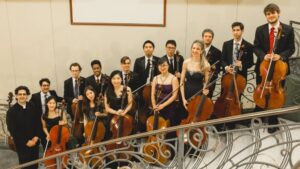
Led by local Israel-American cellist Amit Peled, the Mount Vernon Virtuosi aims to inspire people beyond musical enjoyment.

A former college campus activist, Veksler will speak at Chizuk Amuno on June 8 at the Ruth and Jay Lenrow Visiting Scholar-in-Residence for Combating Antisemitism.