
“Keep the gate open for us
At the time when it is closing
For the day is coming to an end”
— Yom Kippur Liturgy
I’ve been thinking about gates lately. Yom Kippur was just last month. “Neilah” (gates closing and locking) imagery is potent on that day.
Also, Beth Am just completed construction of our brand-new courtyard, the first time we’ll have had real programmable outdoor space at our 100-year-old building. As we were designing the courtyard, I emphasized the importance of a low fence and an easily opening gate. Inspired by our congregational aspiration to exist “in, for and of” our neighborhood, I wanted to make sure the courtyard was welcoming to neighbors, a new pocket park of sorts.
Looking up the grade from Chauncey Avenue, our courtyard feels accessible, inviting. The fence and gate are aesthetic and practical; they help contain the energy and the children. This is a membrane, not a wall.
“Something there is that doesn’t love a wall,” writes Robert Frost. But in the poem, the neighbor responds with generational dogma. “Good fences make good neighbors,” he says. But Frost isn’t satisfied.
Why do they make good neighbors? Isn’t it
Where there are cows? But here there are no cows.
Before I built a wall I’d ask to know
What I was walling in or walling out,
And to whom I was like to give offense.
Questioning assumptions is at the heart of the “New Jewish Neighborhood” concept, noticing the gap between is and ought where justice is found.
Recently, I went for a walk on Shabbat. My daughter’s school had a program in the afternoon. She was interested in going, so after services and kiddush lunch, we put on some good walking shoes and took a long stroll down to Mount Vernon where her school is located.
On the way back, I was in no hurry so I took a slight detour off Eutaw Place to Bolton Street. I walked past State Center and the Maryland Museum of Military History. I crossed Dolphin and headed into Bolton Hill, the neighborhood immediately to my neighborhood’s south.
Bolton Street, in both neighborhoods, is lovely, with aging shade trees, intermittent brick sidewalks and historic Baltimore homes. The leaves were changing and falling, blanketing the ground with browns, yellows and reds. I had walked this street many times, but for some reason that day I was so caught up in the magic of my Shabbat afternoon stroll, I forgot what I would find at the place where Bolton Street meets North Avenue.
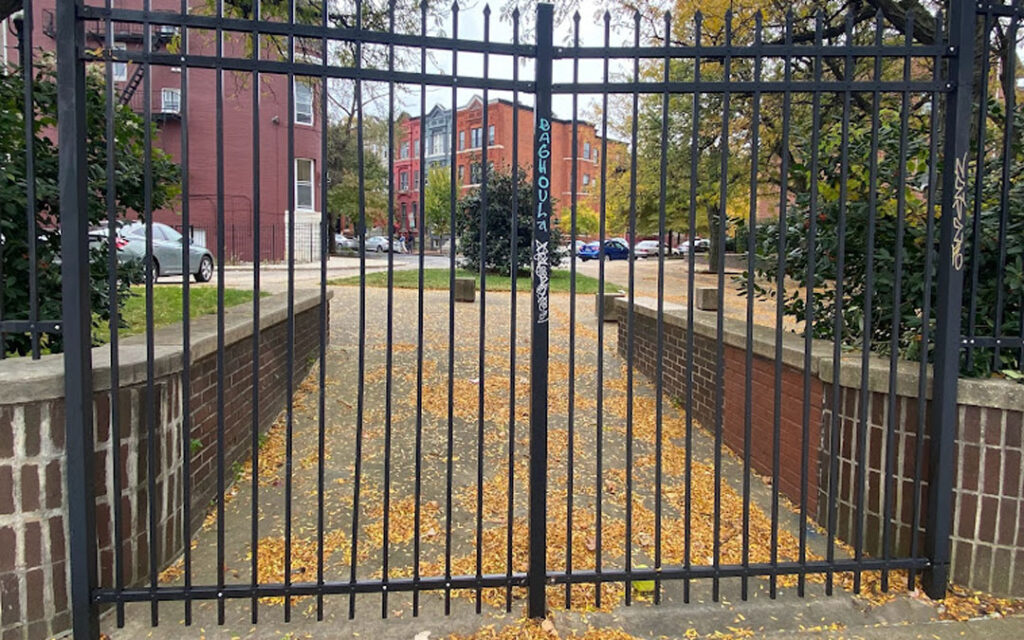
A fence. A gate. Not even a gate. A place where a gate may have once stood, but having been closed and locked for so long, was eventually replaced with a nondescript metal fence.
I had also forgotten in that moment what I had written a few years back about journalist and urbanist Jane Jacob’s concept of “border vacuums” that separate communities, often along racial and/or socioeconomic lines. I wrote then: “… to our South we have North Avenue, once a vibrant commercial corridor that marked the city/county line. But (recently demolished) Madison Park North, an ill-conceived ‘superblock’ of mid-20th century urban planning, stymied pedestrian and car traffic on Bolton Street between Reservoir Hill and Bolton Hill. The Spicer’s Run development returned the favor decades later by carving out a new superblock, adding brick walls and iron fencing to underscore the vacuum between the two neighborhoods.”
So here I was standing in front of that fence wondering what possible good it could serve to make it so difficult to step from one neighborhood to the next. I became obsessed with that gate-turned-fence.
Bolton Hill is not a gated community, after all, there are other places to enter. Why not there? I wondered just how inconvenient it was to walk around. I rode my Onewheel down the next day to time it. It took me three-and-a-half minutes (at 10-15 mph) to ride around to the other side. I looked at a map. In one direction, it was 3/10 of a mile. In the other, 4/10.
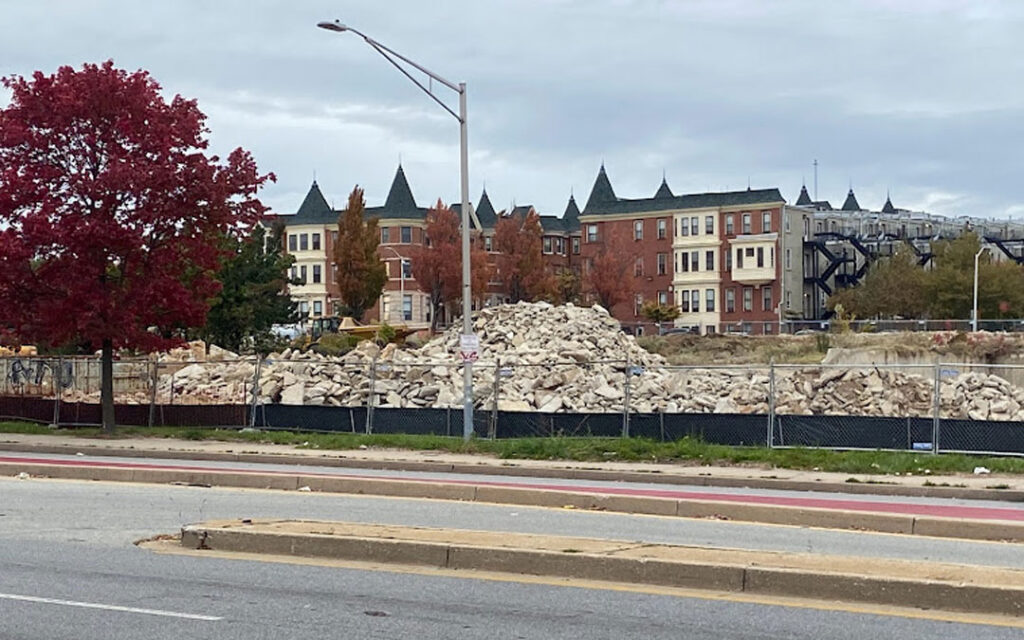
After years existing as a pile of rubble, redevelopment has begun for Madison Park North. In recreating a real city block, architects hope to rethread city streets, creating membranes and portals where there have been barricades and fences. The plans call for mending Bolton Street, bringing its Reservoir Hill span back in contact with its Bolton Hill portion.
One can only hope. Or pray.
As the Yom Kippur liturgy does: “The day will end. The sun will set. Let us come into your gates.”

Rabbi Daniel Cotzin Burg is spiritual leader of Beth Am Synagogue in Reservoir Hill, where he lives with his wife, Rabbi Miriam Cotzin Burg, and their children, Eliyah and Shamir. This column and others also can be found on The Urban Rabbi. Each month in Jmore, Rabbi Burg explores a different facet of The New Jewish Neighborhood, a place where Jewish community is reclaimed and Jewish values reimagined in Baltimore.
At its annual meeting this year, the Baltimore Jewish Council will honor the late Harford County educator and longtime Holocaust education champion.
The former Colt, who passed away on May 25 at age 93, achieved immortality during a cold December day in 1958, writes Michael Olesker.

A new biography on the creator of "Doonesbury" misses the mark, writes Michael Olesker.
What does it mean to be fully present with each other and the sacred, asks Maryland-born cultural anthropologist Alanna E. Cooper.