
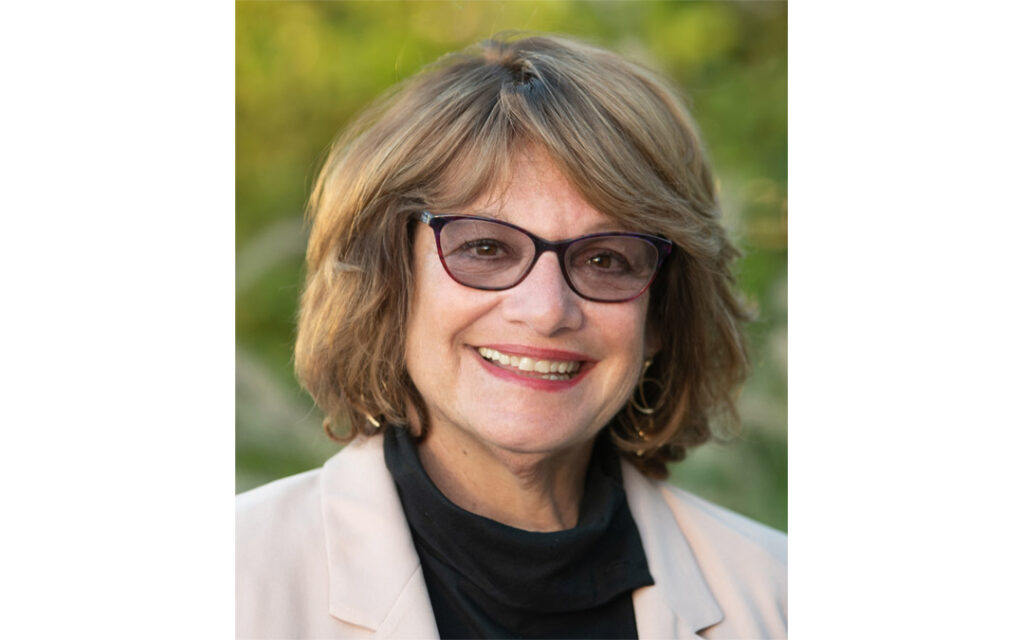
One morning, soon after she and her business partner sold their legal staffing company in 2000, attorney, entrepreneur and then 40-something author Laura Black sat down in her newly converted home office and looked around.
“I had the new computer, the printer and the files, pads and staplers. I was playing around on the computer looking for business ideas and the internet went out. I didn’t know what to do,” Black recalls. “I unplugged the router, plugged it back in, and I had this thought ‘how am I going to operate without an IT department? How am I going to manage without an assistant?’ And then the worst thought was ‘manage what?'”
Black, who lives in Baltimore’s Inner Harbor, wrote her new memoir, “Climbing Down the Ladder: A Journey to a Different Kind of Happy” (Laura Black LCB Ventures, LLC) to help other middle aged-plus women face the later stages of their lives with hope and gratitude.
Easier said than done? Black is the first to admit it.
“I still can’t say the R-word,” she says of retirement.
Black’s book doesn’t begin with middle age. Rather, it starts with vignettes from her childhood, adolescence and young adulthood. Black was overweight in a family and community in which girls and women were expected to conform to a particular standard of beauty. The fact she wasn’t able to meet that standard was a source of shame, overshadowing her considerable assets.
“As women, we are so hard on ourselves,” says Black. “The book talks a lot about looking back and seeing what motivated us. In my case, I grew up in South Florida [where beauty and fitness were especially valued]. had a gorgeous, glamorous mother and a businessman father.”
Since Black didn’t feel she could be “gorgeous” and “glamorous” like her mother, she sought her parents’ approval by excelling in business. Black’s fear of losing that approval when she retired threw her into an identity crisis.
“When you don’t have a business card, who are you?” she asks in her book.
For the 20-plus years after she sold her business, Black, a motivational speaker, consultant and volunteer, tried to find peace with her new status as an empty nester and former executive. During those years, Black also dealt with aging parents, young adult children, becoming a mother-in-law and a grandmother. She tried to stay productive by working with nonprofits and volunteering in Baltimore’s Jewish community, but she was plagued by feelings of inadequacy. Black’s struggles will resonate with many women living through what she calls “the second, third or fourth acts.”
“As baby boomers — there’s almost 30 million of us — it’s a struggle and there’s a lot of loss,” says Black. “[As we age and retire] we lose our identity. We lose status. At the same time, if we have children, they’ve moved out of the house. If we have parents, they’re aging and we’re dealing with their health or we’ve lost our parents, we lose friends. And we experience marginalization. My technological skills are really poor. And when my kids are talking about different music groups and different pop culture, I do feel marginalized. I’m out of it. I’m not sure what to wear sometimes. Are pantyhose still in?”
Indeed it’s Black’s self-deprecating and poignant sense of humor — her first book is titled “Big Butts, Fat Thighs And Other Secrets to Success” — that makes “Climbing Down the Ladder” so relatable and such a quick and satisfying read.
Black goes beyond bemoaning the difficulties of mid and later life transitions. She also advises other women how to appreciate this unique time of life. Black learned this the hard way after a health crisis forced her to slow down.
“Out of nowhere, my colon burst and I became septic and they weren’t sure if I was going to make it through the night,” Black recalls.
“So, I was forced not to be productive as I used to define productive. I had a lot of downtime; I was able to do a lot of thinking. I was so grateful to be alive, and I realized there’s such a sacred space between the time when we do leave the workforce. Shame on us if we don’t maximize it. It’s about redefining productivity. I also realized when we are so goal-driven, it’s like we’re wearing blinders because everything is going toward the goal. And [I saw] how much I missed on the periphery.”
For example, Black says, “I was sitting on a balcony one day and I was looking out at the water and a big bird. I realized it wasn’t flapping its wings much. It was sort of soaring and only flapping once in a while. So, two things: One, I’d never watched a bird fly and two, I was always flapping my wings; I wasn’t soaring.”
Black advises that women in midlife and beyond visualize their lives as a wheel with spokes or a pie with slices.
“Career was one big piece of our wheel,” says Black.
“We don’t have to replace that piece but all the other wedges can become larger. For example, one of my wedges was relationships and community. When we’re so busy working and child rearing and all those other things, it’s hard to cultivate new friendships and to give as much as we can to those we care about and to our community.”
Other slices or spokes can be spirituality, health and wellness, hobbies and learning, Black says.
“Learning is huge. There are so many areas I never learned anything about. For example, art. Not that I know a lot now, but I do have time to go through a museum and look at a picture. Our life fills up. It’s a beautiful time of life. But we have to give ourselves permission to know we are enough.”
For more information about Laura Black, visit laurablack.net.

The BCO, founded in 1984, will perform the works of Frank Zappa, Beethoven, Mason Bates and Karena Ingram.

Led by local Israel-American cellist Amit Peled, the Mount Vernon Virtuosi aims to inspire people beyond musical enjoyment.

Container vegetable gardening is a terrific option for people with limited space and/or time. Rebecca Brown and Norman Cohen share some tips.

Filmmaker Justin Schein looks at wealth and inequality through the very real story of his late father.