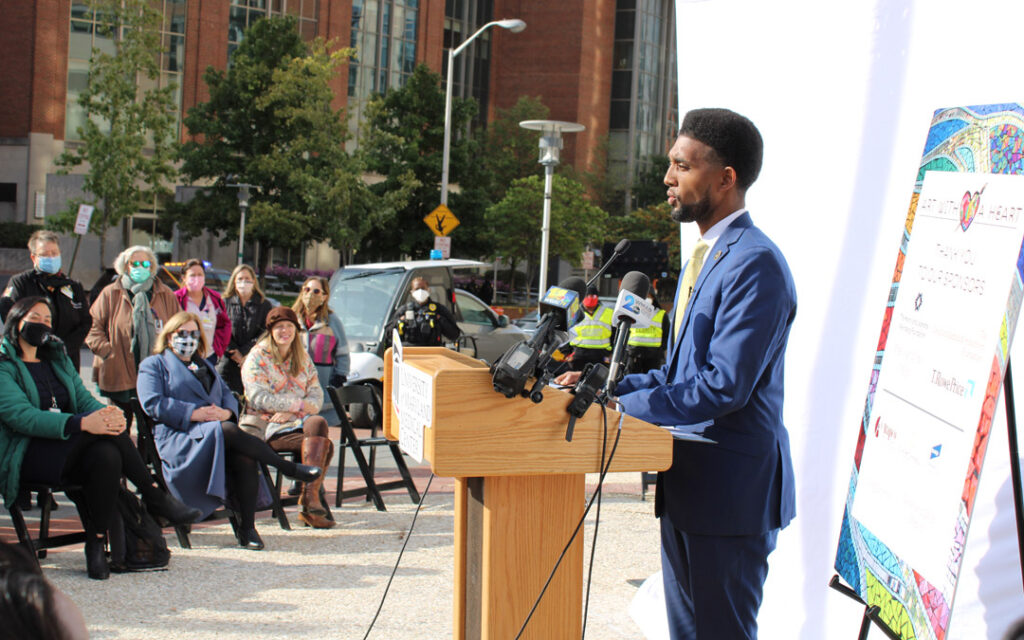
Among the saddest of this past weekend’s sights was the mayor of Baltimore, Brandon M. Scott, standing with his top police officials to declare he will stop allowing young people on the streets of the city after dark.
Well, good luck with that.
Scott said this on Sunday night at Harborplace, an area we once associated with the city’s rebirth. How ironic to make such a sad declaration on the night of Easter Sunday, which Christians associate with a different kind of rebirth.
And how sad to make the announcement on a Baltimore weekend otherwise filled with so much joy.
This was a weekend in which the Orioles, a few blocks from Harborplace, drew about 100,000 people for their series with the Yankees, and didn’t have an ounce of off-field disturbance.
And the nearby, newly renovated CFG Bank Arena packed in thousands more to see Bruce Springsteen, and not a single gunshot was fired.
But at Harborplace there was fighting in a crowd of about 200 young people, and and there were gunshots, and on Sunday evening two teenagers were wounded right there in the 400 block of East Pratt St. Both kids were hospitalized. One is listed in critical condition; the other, critical but stable.
This is unlike some areas of the city that are listed as critical but unstable.
And so we had Mayor Scott, wearing a designer sweatsuit and accompanied by Police Commissioner Michael S. Harrison, reaching once more for a solution to the city’s violence.
“We’re going back to the old days,” Scott said, “of a youth curfew policy requiring those younger than 14 to be home by 9 [at night] and those 14 to 16 by 11 p.m.” between Memorial Day and the end of August.
“We’re not going to let this happen,” Scott said. “When that streetlight comes on, you have to have your butt at home.”
The mayor’s intentions are good, but maybe not his sense of history.
It’s not up to the city of Baltimore to assume parental responsibility of children — it’s up to the children’s parents. And in too many cases, we have young people growing up in homes where one parent is missing, and sometimes two, and who’s to tell these kids they’re restricted to their rooms?
I go back to an earlier time when the city tried a curfew for young people: the riots of 1968, and a streetcorner in East Baltimore where the cops were stopping scores of young people during a newly imposed curfew.
The conversation between the cops and the kids — the same conversation, repeated countless times — was this:
Cops: Where you going?
Kid: My mother’s.
Cops: Where you coming from?
Kid: My father’s.
In half a century, the conversation would be much the same: Who’s got a full set of parents raising these kids?
The mayor’s heart’s in the right place, but maybe not his sense of history.
Michael Olesker’s latest book, “Boogie: Life on A Merry-Go-Round,” was recently published by Apprentice House. It’s the life story of Baltimore legend Leonard “Boogie” Weinglass, an original “Diner” guy who grew up to create the Merry-Go-Round clothing chain and contribute millions to charity.
What does it mean to be fully present with each other and the sacred, asks Maryland-born cultural anthropologist Alanna E. Cooper.
As millions mourn the passing of Stephen Colbert from the airwaves, Michael Olesker looks back on the "institution" of late-night TV.

As he gets ready to leave for California, Rabbi Daniel Cotzin Burg looks back on his time in Baltimore and his 10 years writing for Jmore.