
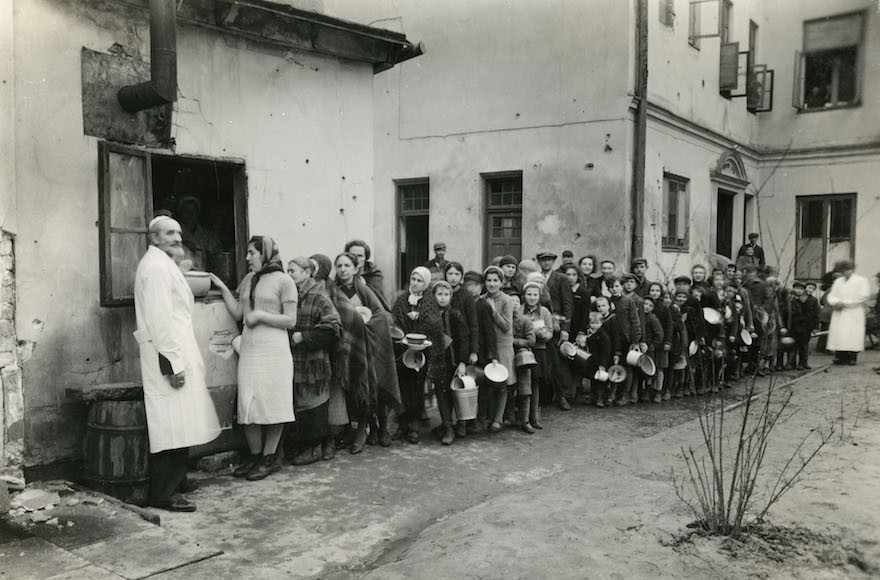
If there’s one thing Cantor Joel I. Lichterman knows for certain, it’s that the truth is always stranger than fiction.
The director of the b’nei mitzvah programming at Pikesville’s Chizuk Amuno Congregation, the South African-born cantor recalls being intrigued as a youngster by his father’s unlikely and heroic story of survival during the Warsaw Ghetto Uprising.

Cantor Lichterman will serve as keynote speaker on Monday, Apr. 17, at the Jewish Federation of Howard County’s annual Holocaust Remembrance Day commemoration. The theme will be “The Bravery of Resistance: The 80th Anniversary of the Warsaw Ghetto Uprising.”
The program, which begins at 6 p.m., will be held at Temple Isaiah, 12200 Scaggsville Rd. in Howard County’s Fulton community.
In his presentation titled “My Teacher, My Mentor, My Hero, My Father,” Cantor Lichterman, a father of two and grandfather of four, will talk about his late father Cantor Jakub Lichterman’s story of resistance and triumph.
Jmore: What was your father’s life like before World War II?
Cantor Lichterman: My dad was born in Warsaw in 1909 and sang from a very early age. He was highly musical and sang in what was the Tlomacka (Great Synagogue) of Warsaw. He studied intensively at the Warsaw Conservatory of Music and became the hazzan at the Nożyk Synagogue, [Warsaw’s] second largest synagogue and probably the venue for weddings.
He would officiate at eight to 12 weddings in a weekend. It was a real spectacle. He was very fortunate to have worked with the most fabulous people who helped shape his career and his musical capacity.
What was his life like during and after the war?
The war broke out in [September of] 1939, and within a short time the Nazis began to concentrate the Jewish population into Warsaw [and] created the Warsaw Ghetto. My dad came face to face with [Nazi leader and Holocaust architect Heinrich] Himmler in January of 1943.
My dad fought in the Warsaw Ghetto Uprising, was wounded in the leg, was captured and transported in a cattle truck to Majdanek [concentration camp]. He survived through incredible hardship [but] was never liberated. He survived a final ordeal by breaking ranks and escaping with a few friends whilst on the death marches in January of 1945.
Fast forward [later] in 1945, my dad was walking through the ruins of what was the Warsaw Ghetto. There was nothing left. Only his synagogue stood, very badly damaged. He found a shofar, pulled the shofar out of the ruins and kept it. It’s the shofar that my father blew in services, on which he taught my brother [Cantor Ivor Lichterman] and me, on which he blew at the newly liberated ‘Wailing Wall’ in Jerusalem in 1967, and which I continue to use in services.
Did he tell you about his wartime experiences?
My dad never shared his entire story with us. It came out in small doses, as if each dose served as a new life lesson.
When he would tell us pieces of the story, we were aghast, fascinated, in disbelief.
How did he keep the Jewish musical traditions alive?
He was absolutely committed. And he was driven to commit this vast storehouse of musical knowledge that he had — this fantastic Jewish musical tradition, the synagogue traditions, the culture of Poland, particularly of Warsaw. And he began writing all this music down by heart.
And that’s from which we began training with my dad, from these manuscripts. He consolidated many of his own compositions and some of the great pieces into a master work. It is from that book that I still lead services today.
My dad was the senior hazzan of the Beth Hamedrash Hechodash, the United Orthodox Hebrew Congregation in Cape Town, South Africa.
Have you ever been to Warsaw?
My brother and I returned to Warsaw twice – first in 1997 with our mother after the Nozyk Synagogue suffered an arson fire, and then in 2009 as part of the Cantors Assembly mission to Poland that was made into a widely acknowledged [documentary], ‘100 Voices: A Journey Home.’
This year’s theme at Howard County’s Holocaust commemoration is ‘the Bravery of Resistance.’ What does that mean to you?
I think the bravery of resistance comes in a number of forms — it’s the physical bravery. Am I going to resist? Am I going to fight? The bravery of resistance was doing whatever you could, as my father did in the Warsaw Ghetto and in the concentration camps.
Another form of resistance is keeping Judaism alive in spite of everything that happened. My dad wrote about his experience so that others know and remember — that is resistance.
What does the 80th anniversary of the Warsaw Ghetto Uprising mean to you?
My dad went back to Warsaw on the 40th anniversary of the uprising. That’s his generation. Now 40 years later, I have been honored with the task of sharing some of his story. In the Psalms, it’s written, ‘Arbaim Shana Akut b’Dor,’ — a generation is 40 years.
My generation, who are descended from Holocaust survivors, carry a specific privilege of responsibility. We can try and give perspective on events that for most people are confined to the dust of history books.
As we now are sitting on the 80th year since the uprising, my message has to be to the next generation, ‘What [is] the significance of the Warsaw Uprising is in our lives, not only as Jews but as a message to the world?’ Humanity always triumphs in the end.
For information about Howard County’s Holocaust Remembrance Day event, visit jewishhowardcounty.org/yomhashoah.
In addition, the Baltimore Jewish Council and The Associated: Jewish Federation of Baltimore will hold the annual community event of Holocaust remembrance on Sunday, Apr. 16, at 4 p.m. at Beth El Congregation, 8100 Park Heights Ave. This year’s commemoration will also highlight the Warsaw Ghetto Uprising and features a keynote address from historian Judy Batalion, author of “The Light of Days: The Untold Story of Women Resistance Fighters in Hitler’s Ghettos.”
For information, visit baltjc.org/event/yom-hashoah-commemoration-2023/.
Anna Lippe is a Washington, D.C.-based freelance writer.
Mansoor Shams is known for carrying around a sign proclaiming, “I’m a Muslim and a U.S. Marine. Ask anything.” Now the Baltimore County Department of Recreation and Parks community engagement and outreach officer is running for Baltimore County Executive.
The Tower of David Jerusalem Museum is collecting photographs of the Western Wall ahead of an exhibition next year marking the 60th anniversary of the Six Day War.
Baltimore native Susan Landsman recently celebrated her rite of passage surrounded by family, friends, fellow residents and staff.
Founded by Marci Yankelov, Julie Kichline, Elizabeth Miller and Lila Perilloux, the Bmore Community Fridge Network serves a crucial role in feeding the hungry.