
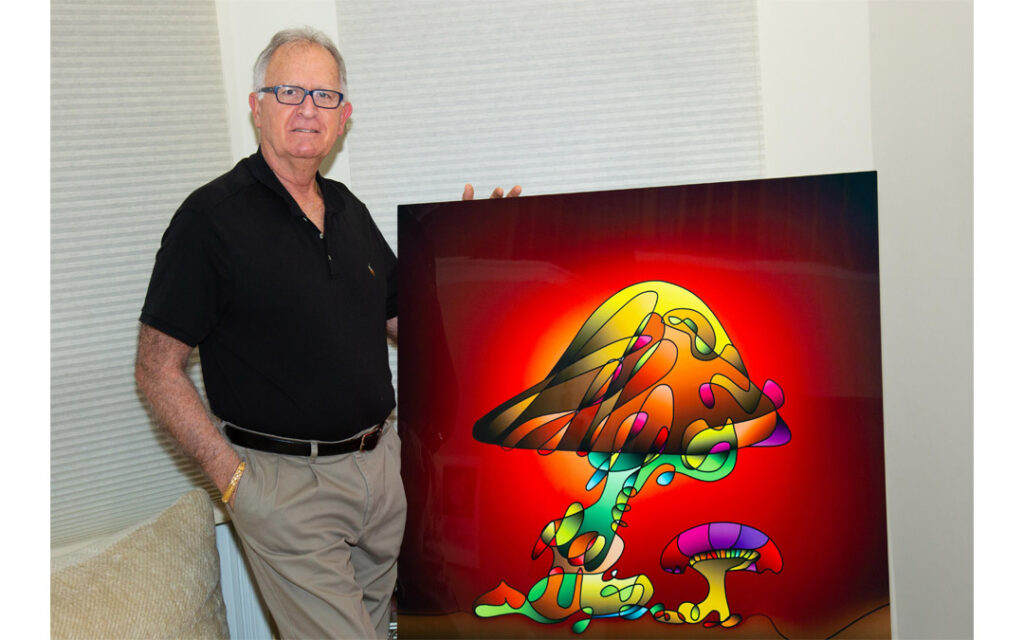
For more than 45 years, Israeli-born Shlomo Cohen has worked as an award-winning photographer, shooting local weddings, b’nai mitzvah, and commercial and corporate events. But at the start of the pandemic, he decided the time was right to take a deeper dive into the world of digital art to translate his creative visions into colorful designs and drawings.
A Northwest Baltimore resident, Cohen recently celebrated the opening of his exhibition “Dream in Color” at the Gordon Center for Performing Arts’ Meyerhoff Art Gallery. “Dream in Color” — which incorporates abstract, modernist, surreal, impressionist and cubist styles — will be on display through June 25 at the recently renovated gallery on the Owings Mills Jewish Community Center campus.
Jmore recently spoke with Cohen about the exhibition.
Jmore: How did ‘Dream in Color’ come about?
Cohen: My good friend works at the Gordon Center, and for all the months and years I’ve been working on my art, she’s been telling me, ‘You should display it at the Meyerhoff Gallery.’ My friend saw the vibrance of the beautiful images. She thought it would be great for our exposure and good for the community of the JCC.
Is this your first art exhibit?
Yes, it is my first art exhibit, and we are excited to share a different art form with the community.
After so many decades as a professional photographer, why did you decide now to pursue your passion for art?
Well, my father was a photographer. I grew up in the photography business, and I always had a passion for art. I pursued it by studying graphic design for four years in high school. I took sculpturing, drawing, photography [and] ceramics, and the last two years of high school I had to make the decision of which route to take, and I went with graphic design.
During the pandemic, the photography business slowed down, my grandchildren played with me on Photoshop and the bulb lit up when I saw something.
I continued work on this idea of drawing on the computer instead of just drawing by hand. The computer is the tool instead of a piece of paper and pencil.
Do you see a direct correlationbetween photography and digital art?
I enjoy creating drawings on the computer. It gives me satisfaction when you finish one image. However, it does not take away from being creative in photography. I will continue doing photography. When you capture an image in photography, you plan it, you see it and the camera is just a tool. Same thing with the drawing. You start with it, look at it, see what comes out and then you start to improve the image by adding colors and a creative touch. The way you feel inside, you bring it out to the computer. You use the computer stylus as a tool to create.
Sometimes I do something, I don’t like it and start all over again until something pops up. When something pops up, and I feel the excitement inside in my heart, it means that something positive will come out of the drawing. If I don’t feel it from the beginning, I scratch it out and start over again. There is a connection between photography and computer art. In photography, before you photograph you look at the scenery, the composition, lighting before you create, and the same thing with the drawing. The composition is important and the colors.
Where do your inspirations come from?
Sometimes from my drawings from the past of old cities — Jaffa, where I was born, and other old cities in Israel such as Acre up north. I like animals, and you can see it in a lot of my drawings. Horses are exotic, birds are a sign of freedom. I don’t have a specific line of subjects. Sometimes I dream in my mind when I’m holding the stylus pen and let my hand glide around the tablet, and when I see something I continue working on it.
Also, if I have an engagement photo session, when I see a love story between couples, it gives me inspiration to bring the love into my art.
How did you learn to create digital art?
I have been doing digital photography for many, many years on Photoshop, and since I learned the tools that are available to me, I started to create digital art.
Do you feel that digital art is different from what might be called ‘normative art’?
It is definitely different from normative art. You have the capability to move things around, to add and subtract without ruining anything. You have more flexibility to do a lot more with the tools in Photoshop. However, it is similar because you are still drawing and painting. Instead of a brush on a canvas, I use the stylus pen on a Wacom tablet.
Do you feel there is a common theme in your artworks?
The vibrant colors are in most of my pieces. I play a lot with lightness and darkness of those vibrant colors to create a three-dimensional feel. All of my pieces are connected, but the subjects are different.
How does being a Sabra and having served in the Israeli army influence you as an artist?
I served as a paratrooper in the Israeli army, and this was the inspiration for one of my pieces which commemorates the fallen soldiers from the Yom Kippur War. Some of my friends lost their lives in the war, and I wanted to honor them in this drawing. I put together a tank, a paratrooper, Jerusalem and the Wailing Wall. The piece is called ‘Hero’s Memorial.’
What does Israel’s 75th anniversary personally mean to you?
That that little country in the Middle East, with all the wars that she went through, survived for 75 years. To know the story of my parents who survived the Holocaust and moved to Israel to run away from the chaos in Bulgaria, and to start a new life and give birth to two children in Israel and to see what came out of it after 75 years — it means a lot.
What kind of reactions have you received so far from your exhibit?
Most people, when I spoke to them during the opening reception [on Apr. 25], their reaction was, ‘Wow.’ The next question was, ‘How do you do that? How do you get those vibrant colors?’ That gave me a great feeling that I moved them.
What in general do you hope visitors get from your artwork?
I want people to see my art live, printed on metal or metallic photo paper, because the internet does not do it justice. I want to move people’s hearts, feelings. I want to touch their hearts with the vibrant colors by looking at them hanging on the wall. They may feel relaxed, happy, love. There is something behind every image, and the more you look at it, the more you see and feel something different.
Shlomo Cohen’s work can be viewed at visionsartistry.com. For information about the Meyerhoff Gallery, visit jcc.org/meyerhoff-art-gallery.

The 16-year-old sophomore succumbed to injuries sustained in a car crash last week in Cockeysville.

Schools in Montgomery County have recently experienced a wave of antisemitic incidents.

CCBC Honors scholars are discovering a level of academic rigor and opportunity typically associated with elite four-year institutions.
Filmmaker Justin Schein looks at wealth and inequality through the very real story of his late father.