
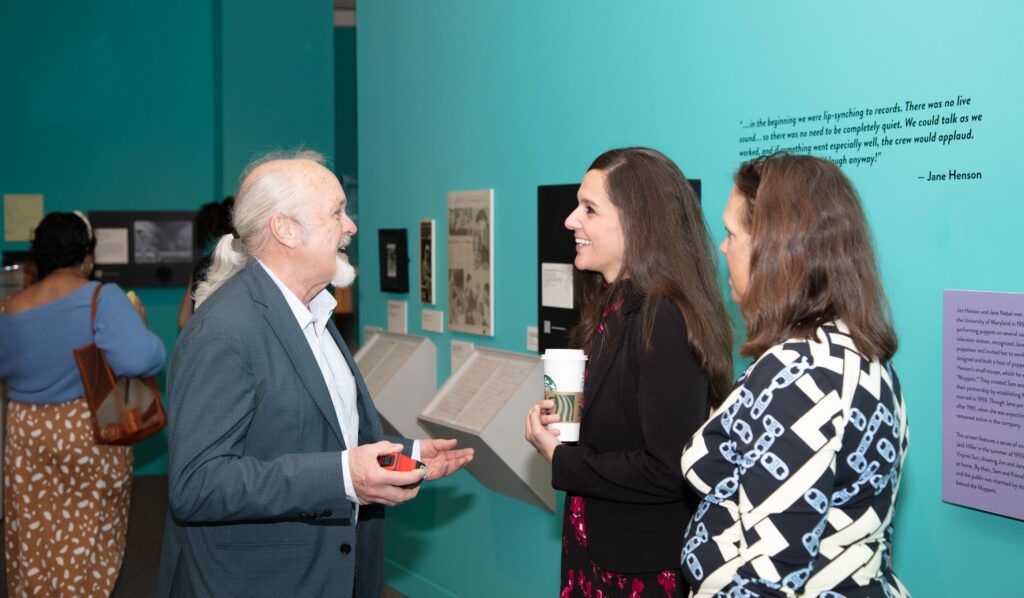
Bonnie Erickson loves to schmooze. But the celebrated puppet, costume and toy designer can’t find the right words to describe what it’s like bringing laughter to millions of people around the world.

“People come up and say, ‘You really made me happy and gave me a lot of joy,’” said Erickson, whose most famous creation is Miss Piggy, the temperamental-yet-treife diva of Muppets fame. “The truth is we all worked very hard together as a group. Thanks to Jim, it was a great collaborative spirit. Jim was a very positive person who wanted to do a lot of good in the world. He was very generous, and if he chose you to work for him, he trusted and valued you.”
A Brooklyn, New York, resident, Erickson, 81, was on hand during a recent media preview for “The Jim Henson Exhibition: Imagination Unlimited” at the Maryland Center for History and Culture.
The exhibition will be on view at the MCHC (formerly the Maryland Historical Society), at 610 Park Ave. in the Mount Vernon neighborhood, from May 26 to Dec. 30.
The exhibition — originally curated by New York’s Museum of the Moving Image — brings to life Henson’s groundbreaking, visionary contributions to entertainment and education through such works as “Sesame Street,” “The Muppet Show,” “Fraggle Rock,” “Labyrinth” and “The Dark Crystal.”
Spanning more than 5,000 square feet, the exhibition — which has traveled to 10 other venues across the nation, including the Contemporary Jewish Museum in San Francisco — features sketches, scripts and storyboards, costumes, puppets and interactive activities exploring performance, art, engineering, film and TV, and more.
The exhibition also examines Henson’s local roots. Although a native of Greenville, Mississippi, Henson — who died in in 1990 at age 53 — moved to Hyattsville in Prince George’s County when he was 9 and considered Maryland his home.
He developed early prototypes for the Muppets while a student at Hyattsville’s Northwestern High School and attending the University of Maryland, College Park, of which he graduated in 1960. Henson received his big broadcasting start at local TV stations.
After the airing of “Sesame Street” in late 1969, Henson became a household name and industry powerhouse, hailed for ushering in a new era of media entertainment and educational programming.
“With his gently subversive humor, restless curiosity, and innovative approach to puppetry, Henson built the Muppets into an enduring international brand, contributed beloved puppet characters to Sesame Street, and made movies that applied his vivid imagination to stories for the big screen,” the MCHC posted on its website.
“This exhibition explores Henson’s unique contributions to the moving image, and how he and a talented team of designers, performers, and writers created an unparalleled body of work that continues to delight and inspire people of all ages.”
Barbara Miller, the exhibition’s curator and deputy director for curatorial affairs at the Museum of the Moving Image, said it’s difficult to pinpoint the multi-generational allure of Henson’s oeuvre.
“Everyone can tell you so much about Kermit the Frog — how did [Henson] manage that?” Miller said at the media preview. “Those puppets are so human and relatable and appealing to people of all ages, and this exhibition shows how it all came together. Also, Jim really knew how to pick a team. He was a leader, but he inspired camaraderie within his team.”
Miller acknowledged that Henson was a product of his era and generation. “He was looking at the youth culture, but at the same time he wasn’t anti-establishment or into drugs,” she said. “He was attracted to the concepts of togetherness and love and that ethos of the ‘60s. He looked like a hippie, but he really wasn’t on the inside.”
Most importantly, Henson was attracted to good storytelling and character conceptualization, said Miller.
“He was never just a puppeteer but a visual storyteller,” she said. “He wanted to tell stories on screen. ‘The Muppet Show’ showed that puppets weren’t just children’s stories but they told all kinds of stories, and you can find that in all of his work. And that had an appeal to kids and to others.”
Perhaps that appeal was manifested itself best in the green form of Kermit, the soft-spoken, ‘everyman’ amphibian whom Henson considered his alter ego of sorts.
“He’s shy, retiring, but he wants to make things happen,” Miller said of Kermit. “He had a vulnerability and a relatability.”
Katie Caljean, the MCHC’s president and CEO, believes Henson “just had a knack for communicating in a way to make us all feel connected. His work is transcendent — it transcends all generations and ethnicities and walks of life. …
“We really hope this exhibition helps bring people back together again. We all need to engage again after the pandemic,” she said, adding with a chuckle, “Everyone needs a little Muppet in their life.”
Bonnie Erickson said she has visited the exhibition around the country on numerous occasions, but continues to be “blown away by it. Now we’re here in this area where Jim grew up. I think he would be very pleased.”
Erickson believes Henson’s creations continue to resonate with generations of viewers and live on around the world because they touch a universal chord.

“Jim did puppetry in a way it was never done before,” she said. “For one thing, the puppeteers could see themselves performing on the monitors, and that made a real difference. The actors were doing all of the work — the voices, the performing — and there was an engagement factor. As a result, the puppets have taken on a real personality. People really believe them.”
A perfect example, said Erickson, is the inimitable, terminally self-absorbed Miss Piggy, who was loosely inspired by the jazz chanteuse “Miss Peggy” Lee. (Erickson grew up in Lee’s home state of North Dakota.)
“She’s sassy, cocky, glamorous, very confident … but she’s also vulnerable and insecure,” Erickson said of Miss Piggy. “It’s ironic — she’s a pig but she just thinks of herself as a fascinating woman. People feel like they know her, and I’m just proud to have given her her start.”

The BCO, founded in 1984, will perform the works of Frank Zappa, Beethoven, Mason Bates and Karena Ingram.

Led by local Israel-American cellist Amit Peled, the Mount Vernon Virtuosi aims to inspire people beyond musical enjoyment.

Container vegetable gardening is a terrific option for people with limited space and/or time. Rebecca Brown and Norman Cohen share some tips.

Filmmaker Justin Schein looks at wealth and inequality through the very real story of his late father.