

Here’s another death blow to the written word: I’m down at Penn Station over the weekend, waiting for an incoming train, and I walk into the little newsstand and candy shop there to get a newspaper to read.
And they have no newspapers.
“Sold out?” I ask the lady behind the cashier.
“Sold out?” she replies. “No, we don’t sell ‘em anymore.”

But I’ve been buying newspapers at the Baltimore train station ever since I was a youngster heading out of town or awaiting folks coming in.
“When did this happen?” I ask.
“Three weeks ago,” she says. “Distributor stopped bringing them in.”
“But why?” I ask, though I already know the answer.
“Folks weren’t buying ‘em. We might sell 10 or 12 in a whole day. For all of ‘em.”
Meaning, the local paper and those from out of town. Ten or 12, total. This, at a place that once sold stacks of The Sun, The Evening Sun, The News-American, The Washington Post, The New York Times, the Daily News, the Wall Street Journal, The Daily News, and on and on, an absolute reader’s delight.
Now, nothing.
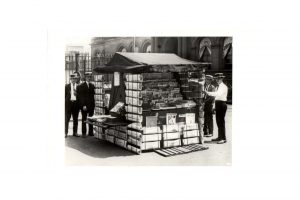
As everybody knows, this is part of a pattern, which is known as the death of print. Used to be, when I’d take the train up to New York and stroll through Manhattan, there were these wooden newspaper kiosks on just about every corner.
When I was there last month and strolled through what felt like miles of the city, I saw none at all. For me, it changed the outdoor atmosphere of the city, the street patter, the give-and-take energy.
As someone who spent most of my professional life in the newspaper trade, all of this is painful to witness. As a citizen, it’s even worse. For our entire lives, the fullest accounts of the day’s news always came from newspapers. TV news was surface stuff; radio news was mostly rip ‘n’ read headlines from the wire services.
You can argue that people today get their news from websites, but where do you think the websites get most of their news?
They get it from newspapers — except that, now, the newspapers all over America have only a fraction of the reporting staff they once had, which means they’re digging up only a fraction of the actual news they once reported.
And it means communities everywhere know only a fraction of what they used to find out about the important events that affect all of our lives.
We’re now more than a decade into the death rattle of print. There’s a whole generation that’s grown up with only the vaguest notions of what daily newspapers used to mean.
In fact, over the weekend, I’m buying a few groceries at an outdoor food market on Old Court Road near Falls Road, and I bump into former Baltimore County Executive Don Hutchinson.
As we’re checking out, there’s nobody else in line. The two people at the cash register are smiling, polite kids, around 20 years old, so I decide to impress them.
“Do you know who this man is?” I say, pointing to Hutchinson. “He used to be the Baltimore County executive.
The kids look respectful and suitably impressed.
“And you know who this is?” Hutchinson tells them, pointing at me. “He was a newspaper guy.”
“They don’t even know what a newspaper is,” I tell Hutchinson.
“No,” the young man says, shaking his head in agreement. “But I heard of them.”
“Yes,” the young lady says, “they carried comic strips, right? That must have been a lot of fun to work there.”
Oh, it was, once upon a time.

Michael Olesker’s latest book, “Boogie: Life on A Merry-Go-Round,” was recently published by Apprentice House. It’s the life story of Baltimore legend Leonard “Boogie” Weinglass, an original “Diner” guy who grew up to create the Merry-Go-Round clothing chain and contribute millions to charity.
What does it mean to be fully present with each other and the sacred, asks Maryland-born cultural anthropologist Alanna E. Cooper.
As millions mourn the passing of Stephen Colbert from the airwaves, Michael Olesker looks back on the "institution" of late-night TV.

The BCO, founded in 1984, will perform the works of Frank Zappa, Beethoven, Mason Bates and Karena Ingram.

As he gets ready to leave for California, Rabbi Daniel Cotzin Burg looks back on his time in Baltimore and his 10 years writing for Jmore.