
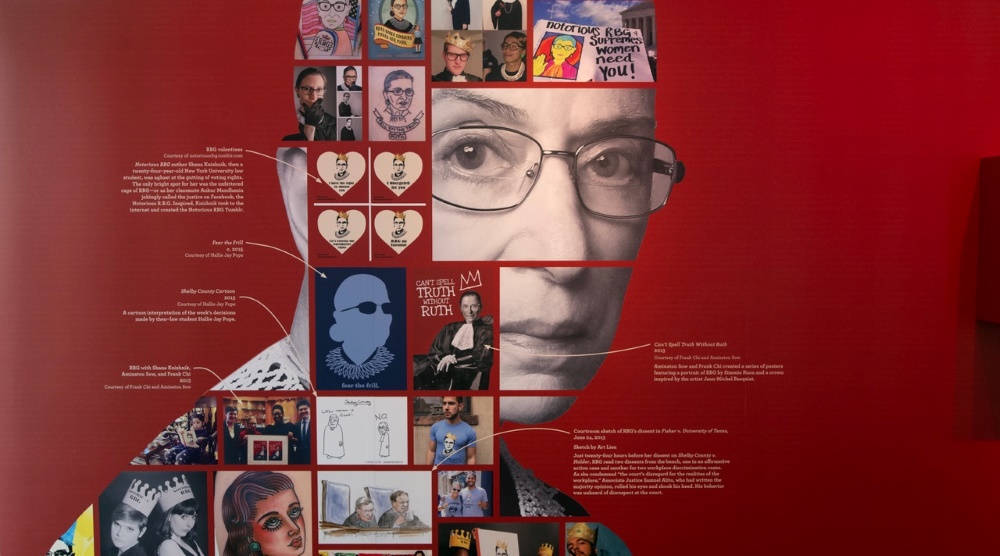
A new Jewish museum located only an hour’s drive from Baltimore features at least two “notorious” women from history.
One is Ruth Bader Ginsburg, the first Jewish woman to serve as a Supreme Court justice and dubbed “The Notorious RBG” late in life by a cluster of fans. When opening in northwest Washington, D.C., later this week, the Lillian and Albert Small Capital Jewish Museum will launch with Ginsburg, who died in 2020, at its center when a traveling exhibit on her life has its final stop there.
The other is 19th-century figure Eugenia Levy Phillips, whom the museum characterizes as “notorious” without any trace of irony. “One of DC’s most notorious Confederate sympathizers, Eugenia Levy Phillips (1891-1902) came to town in 1853 with her congressman husband, Philip Phillips (1807-1884) of Alabama,” one of the exhibits says. “Eugenia, a spy, delivered Union military plans and maps to Confederate President Jefferson Davis.”
Another description of Levy Phillips, a native of Charleston, South Carolina, in the museum is more straightforward — “SPIED for the CONFEDERACY,” it says below her photo.
The Supreme Court justice and the Confederate spy are just two of an assemblage of notable Jews who grace the Capital Jewish Museum, which opened Friday, June 9, in D.C.’s Judiciary Square neighborhood, which was a center of Jewish life more than a century ago.
Showcasing the warts-and-all history of Jews in and around the nation’s capital — both prominent officials and ordinary denizens — is the museum’s objective, its directors say.

“Jews are a Talmudic people, we like to argue, we like to look at different sides of a story,” said Ivy L. Barsky, the museum’s interim executive director, at a recent media tour.
Curator Sarah Leavitt invoked the Jewish concept of makhloket l’shem shamayim, Hebrew for “an argument for the sake of heaven” — in other words, for sacred purposes.
“We’re telling the story in this museum in a Jewish way,” Leavitt said. “It’s not just that we might not agree, but actually the disagreement is important and preserving those disagreements is important.”
Barsky, who previously served as CEO of the National Museum of American Jewish History in Philadelphia, said in relating the history of Washington’s Jews, the new museum fills a crucial gap.
Unlike Baltimore and many of the nation’s other longstanding Jewish communities, Washington attracted Jews not because it was a port but because the city was the center of the federal government. Like the district’s broader community, Jews in the area have been prone to transitioning in and out of the city.
“Lots of our stories start in other places, with folks who end up in D.C.,” Barsky said. “This is a unique community, especially because the local business is the federal government.”
Changing Fortunes
Jews have lived in Washington since the district was established in 1790, and the area now includes some 300,000 Jews, according to a 2017 study.
The museum chronicles that community’s expansion from the capital to the Maryland and the Virginia suburbs, driven at times by Jews joining “white flight” and other times by restrictions that barred Jews from certain areas.
Larger historical events have also at times played a role: The Jewish population in the city grew in the 1930s and ‘40s because of the expansion of government during President Franklin Delano Roosevelt’s New Deal and World War II.
An exhibition asks visitors “Who are you?” and features a diverse range of Washington Jews, past and present, as well as others with quirky biographies, including Tom King, a CIA spy who became a comic book writer.
The changing fortunes of American Jewry are embedded in the date the museum opens, June 9. On that date in 1876, Ulysses S. Grant was the first president to attend synagogue services when he helped dedicate the new building of the Adas Israel congregation, then at 3rd and G streets.
Fourteen years earlier, Grant as a Union general infamously expelled the Jews of Paducah, Kentucky, accusing them of being war speculators. President Abraham Lincoln rescinded General Order No. 11, described as “the most sweeping anti-Jewish regulation in all of American history,”
Esther Safran Foer, the museum’s president, said Grant’s presence in 1876 in the Adas Israel building was emblematic of the upward trajectory of American Jewry.
“He sat here for more than three hours in the heat, no air conditioning, and he even made a generous personal contribution,” said Foer, former executive director of the city’s historic Sixth & I Synagogue.
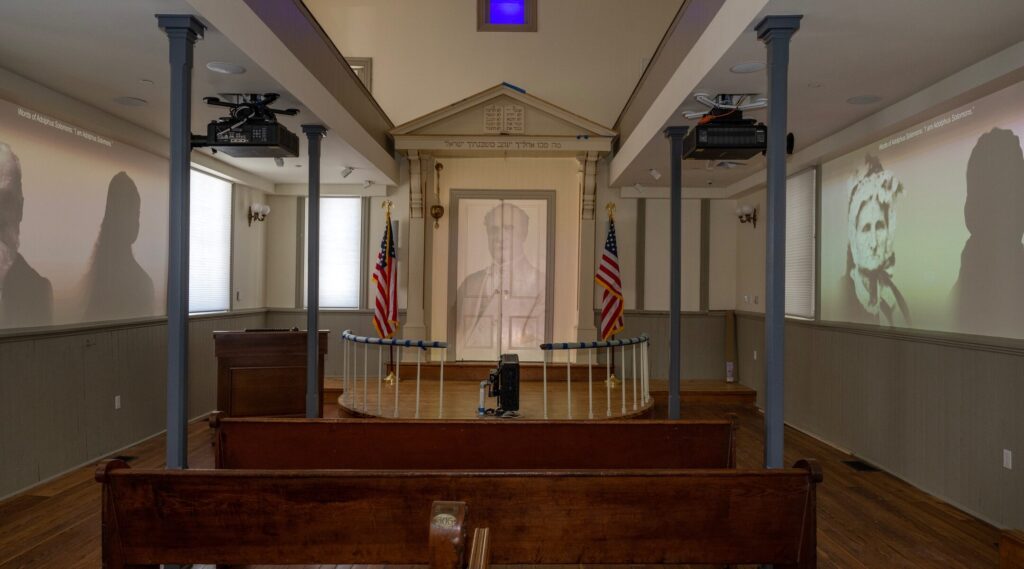
The museum’s core is the 1876 building that Grant helped dedicate. It has since been physically moved in its entirety three times in order to preserve it, most recently in 2019 as part of the initiative to build the museum, which began two years earlier.
The museum’s upper floor reproduces the sanctuary, with the original pews. Its walls, however, are renovated: they display an audiovisual chronicle of the area’s Jews.
The museum’s permanent exhibition aims to traverse that history in other engaging ways as well. The same section that highlights Levy Phillips’ adventures (including her diary’s account of her arrest — “I am not in the least surprised, Sir” she told the agent who came to take her away) also mentions Rabbi Jacob Frankel, who was commissioned by Lincoln during the Civil War as the first Jewish military chaplain.
A photo of Jews and Blacks joined in a bid to desegregate a local amusement park in the early 1960s receives equal billing with one of Sam Eig, an area Jewish developer. In 1942, the Russian-born Eig advertised Rock Creek Forest, a Chevy Chase neighborhood he built, as “ideally located and sensibly restricted,” a euphemism for not allowing Black people to buy property there.
Also, in one of the exhibitions at the Capital Jewish Museum, Camp Louise is among the sleepaway summer camps highlighted in the region. Louise — and its “brother” camp, Airy — was founded in 1922 by Baltimore philanthropists as a summer camping experience for Jewish girls and boys in the area.
Encouraging Debate and Discourse
Interactive exhibits include a Passover seder table that encourages guests to debate immigration, Israel and civil rights. Parts of the museum’s exhibition recount Jewish debates over pivotal issues such as those and others, including abortion.
Ginsburg will be the museum’s first main attraction, and it makes clear she was a role model. The special exhibition on her life and career includes a glamorous photo of the two Jewish women who coined “The Notorious RBG” nickname, Shana Knizhnik and Irin Carmon. Visitors can go into a closet and don duplicates of Ginsburg’s judicial robes.
One of the first events is on July 12 when museum-goers will join in fashioning the special “I Dissent” collars that Ginsburg would famously wear over her robes when she was ready to dissent from the bench.
Jonathan Edelman, the museum’s collections curator, described one prized collection — items he persuaded disability rights advocate Judy Heumann to donate before she died in March.
“Judy’s is a Washington story,” he said. “She came to this city first as an outsider as a protester protesting for disability rights. And then she came back to the city as an insider working within the government to make change both in D.C. government and in the federal government.”
The Capital Jewish Museum is located at 575 3rd St. in northwest D.C. For information, visit capitaljewishmuseum.org/.
Ron Kampeas is the Washington, D.C., bureau chief of the JTA global Jewish news source.
The story is now coming out about three Jewish refugees from Nazi Germany who built Iceland’s classical music scene from scratch.
The history of Jewish Barcelona is fascinating and complex, and a tour of the Jewish Quarter offers a glimpse into the city’s tragic past.
With his chamber music organization, AmiciMusic, Daniel Weiser aims to break down barriers between audiences and performers.
Dr. Gerd W. Ehrlich's manuscript offers a unique look at life in Germany during World War II.