
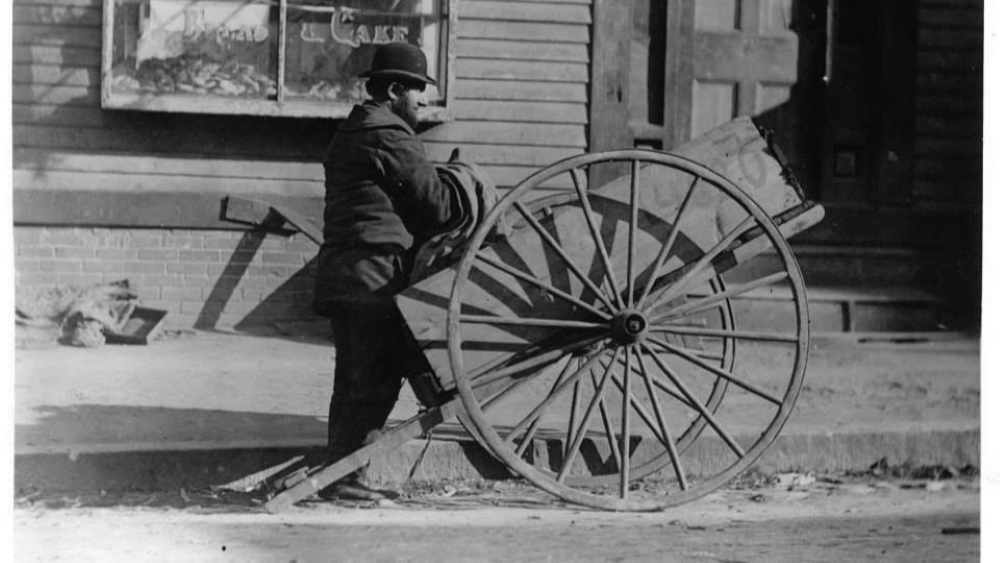
“The women and men rush about, crowding and shoving. They shop from pushcarts, bending over these rickety outdoor emporiums and critically inspecting the merchandise — squeezing, touching, tugging, and probing.” — “Lower East Side: A Jewish Place in America” (Princeton University Press), by Hasia R. Diner
In the late 19th and early 20th century, thousands of merchants throughout America’s major metropolitan centers — many of them recent Jewish immigrants — peddled food and other goods by foot in wooden pushcarts as a means of survival and providing for their families.
A common sight in such places as Manhattan’s Lower East Side, Maxwell Street in Chicago and Baltimore’s Lombard Street, the pushcart came to represent entrepreneurship, upward mobility and transformation for Jews in their quest of “the American Dream.”
But with the rise of supermarkets, department stores, suburbia and shopping centers in postwar America, itinerant peddlers and their pushcarts largely became relics of the past, the fodder of nostalgia and museum exhibitions.
Some lovers of Jewish art and culture, however, are determined to help rescue the pushcart from the dustbin of history and give it a contemporary twist.
On Sunday, July 2, from noon until 5 p.m., a new organization called Pushcart Judaica will present a Pushcart Judaica Pop-Up Craft Market inside Red Emma’s Bookstore Coffeehouse, at 3128 Greenmount Ave. in North Baltimore’s Waverly neighborhood.
The Jewish Museum of Maryland will co-sponsor the event, which requires masks to be worn. (One or two vendors will also be located outside of Red Emma’s.)
Pushcart Judaica is a nonprofit with the mission of providing “easily accessible, ethically sourced Judaica that reflects the vibrancy of our tradition and uplifts the work of queer, trans, disabled, Sephardi, Mizrahi and Jews of Color artists and craftspeople within our communities.”
Founded in 2004 at St. Paul and Madison streets, Red Emma’s is named after the Russian-born Jewish anarchist, political activist and writer Emma Goldman. Calling itself a “radical infoshop … run by a worker-owner collective,” Red Emma’s sells books, fair trade coffee, and vegetarian and vegan foods.
In its mission statement, Pushcart Judaica said, “Our goal is for the Northeast corner of the Jewish diaspora (U.S., Canada, & Europe) to be able to easily access workshops and teachings, ritual items, books, and art that reflect liberatory values, handcrafted beauty, and queer brilliance. No more scouring the internet to find Judaica and craftfolk that reflects us and our community!”

Besides Baltimore, the Pushcart Judaica pop-up tour will travel to an estimated 20 destinations in North America this year. Each stop offers an opportunity for local communities to celebrate the Jewish arts and culture of their region, as well as bring art and ritual items from other areas.
Offerings come from more than 30 artisans, as well as Jewish food, music, kids’ activities, adult learning, body work, song circles and fundraisers.
The tour will also stop in Washington, D.C., on June 25 and Philadelphia on July 16.
Located at 15 Lloyd St., the JMM recently announced it will be closed to the general public to conduct the first phase of a major renovation of its campus in East Baltimore’s Jonestown neighborhood. The museum plans to reopen to the public around June 30, 2024.
During this yearlong period, the facility will be open to JMM employees and others working on educational, archival, programming and collections projects, as well as for exhibition development, capital project support, and audio and visual productions.
The partnership between the JMM and Pushcart Judaica is a natural one, said Ollie Emmes Schwartz, founder of Pushcart Judaica.
“I really respect the way that the museum is bringing in young Jewish artists, trans artists and political work,” said Schwartz, who grew up on the Lower East Side. “They are using their role as a museum not only to preserve the past but to create the future of Jewish culture. And that is what we are doing here at Pushcart — revitalizing our tradition, putting the margins at the center, innovating within our tradition through the arts. “
So far, Schwartz, who lives in western Massachusetts, said the reaction to Pushcart Judaica has been overwhelming.
“This program has only been around for six months, but thus far it has been a huge success,” Schwartz said. “For example, at our first event, with only one month’s notice we had over 300 participants, over 30 vendors and received a lot of positive feedback. At each of my pop-up events, participants I don’t know come up to me to tell me how meaningful this event was for them. I was given cards, a Havdalah candle, tears and hugs. My events are profoundly joyful and community-building.”
For information about Pushcart Judaica’s stop in Baltimore, visit pushcartjudaica.com or redemmas.org. For information about the JMM, visit jewishmuseummd.org.

Schools in Montgomery County have recently experienced a wave of antisemitic incidents.

CCBC Honors scholars are discovering a level of academic rigor and opportunity typically associated with elite four-year institutions.

Filmmaker Justin Schein looks at wealth and inequality through the very real story of his late father.
This year’s Community Block Party at the JCC of Greater Baltimore will feature classic cars, giant inflatables, games, a rock-climbing wall and roller skating rink, and strolling entertainers.