

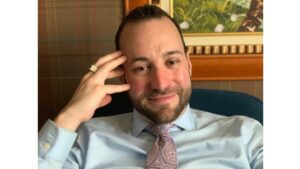
It might surprise some people to learn that the world’s largest collection of hip-hop memorabilia, paraphernalia and artifacts belongs to a 47-year-old Jewish dad living in Bethesda.
“I kind of view the world through the lens of hip-hop,” says Jeremy Beaver. “Growing up in New York City as a kid, carrying around my boombox, I was hanging out with kids who were Black, Puerto Rican and Jewish. Hip-hop was why we were all hanging out together. And if you look at the hip-hop industry, you’ll find a bunch of Blacks, Puerto Ricans and Jews all working together.”
Beaver has spent his entire career working in the hip-hop industry as a DJ, producer, engineer, business owner, and now the founder and primary collector for the National Hip-Hop Museum in Washington, D.C.
The museum, located at 2622 Georgia Ave., was launched in January of 2019 inside Listen Vision Studios, and its House of Hip-Hop gallery opened in October of 2021. The gallery exclusively features the works of visual hip-hop artists.
In 1994, George Washington University brought Beaver to the D.C. area, where he worked as a college radio DJ. After graduating from school, he produced and sold more than 30,000 vinyl DJ Break Records and became a producer for National Public Radio, and then director of production at XM Satellite Radio, where he helped launch the country’s first satellite hip-hop channel.
He then launched Listen Vision Studios and has been instrumental in D.C.’s hip-hop scene. Beaver says his passion for hip-hop has always been more of a calling than a job.
“I think hip-hop is so cool and it gives you purpose,” he says. “But when you have purpose, and it links your passion with other people’s passion, that’s what’s cool about hip-hop. The best part of hip-hop is its passion and creativity.”
Beaver’s personal hip-hop collection started small in 2016 and without an end-goal in mind.
“My friend opened a shop in Union Station and there was a little Biggie Smalls doll for $12,” he says. “I bought him and put him on my desk. He sat there lonely by himself. I thought, ‘Biggie needs a friend,’ so I went on the internet and was shocked to see the Biggie doll going for $1,000 on eBay! I started snooping around on eBay just to see what else exists. What else could I find?”
This was around the same time that cryptocurrency was taking hold. Beaver invested in the alternate form of payment, and it turned out to be quite profitable.
“I was doing pretty well financially at the time,” he says. “And I was thinking to myself that I needed a hobby and that I wasn’t living my life authentically. I didn’t see crypto as being a long-term, realistic investment vehicle so the second it started doing really well for me, I divested a lot of it and went about trying to purchase everything hip-hop related that existed on the internet. It was enough resources to create something substantial in quantity and quality.”
The collection started to grow and grow, to the point that his wife could no longer open her car doors in their garage because of all of the items. Beaver realized he couldn’t keep all of the collection contained in his garage and basement any longer and wanted to share his collection with others.
The collection includes memorabilia and artifacts from Beaver’s purchases, as well as donations from others in the industry. Highlights include custom-made costumes and clothes from The Fat Boys; a brick from Eminem’s childhood home in Detroit; and Jay-Z’s first-ever Gold RIAA Award.
Operating out of a temporary space, the museum has 11 staff members, a Hip-Hop Shop retail space, an online store and events space (where Beaver’s son will become a bar mitzvah); two dispensaries; an art gallery, pop-up experiences and workshops.
“Each one of our staff members is the highest-level expert in their field,” Beaver says. “We’re working to preserve hip-hop, educate hip-hop, archive hip-hop, help other people start collecting hip-hop, help people learn how to DJ and get more into hip-hop, make graffiti and paint hip-hop, dance hip-hop … you name it.”
He is currently searching for funders and partners towards the goal of establishing a permanent museum space in the D.C. area.
“I just thought, ‘Make an amazing collection and at some point, the right organization or institution will provide space for it,’” he says. “You don’t build an American institution by getting a big building, and then hoping to fill it.”
For Beaver, hip-hop goes beyond the music to the larger cultural and societal significance. The museum’s mission is to preserve hip-hop history and culture, featuring strong themes and takeaways around social justice.
“Hip-hop tells the story of empowerment, specifically for People of Color,” he says. “If you look at the Bronx in the ‘70s, where hip-hop was born out of, it was literally on fire. It was so challenging to create a fun, happy, peaceful existence. The fact that hip-hop was the flower born out of the crack in the concrete is to me, what’s so amazing. Blacks and Jews share a common plight. Jews endured, and we are the flower that was born out of the crack in the concrete, too. In hip-hop, this seed went from thugs and gangs to turntables and music. And that transformation is very American.”
The National Hip-Hop Museum is located at 2622 Georgia Ave, NW, in Washington, D.C.. For information, visit nationalhiphopmuseum.org. The Hip-Hop Shop is located at 1919 18th St. NW, Washington, D.C. For information, visit nationalhiphopshop.com
Anna Lippe is a freelance writer based in Washington, D.C.

Pikesville resident and entrepreneur Luna Rosendorff discusses what she's seeing these days in the world of contemporary interior design.

Jewish Community Services' upcoming "Future-Ready Workplace" event will feature a keynote address from workplace expert and bestselling author Liz Fosslien.
The BCO, founded in 1984, will perform the works of Frank Zappa, Beethoven, Mason Bates and Karena Ingram.
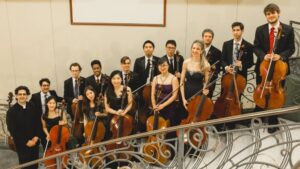
Led by local Israel-American cellist Amit Peled, the Mount Vernon Virtuosi aims to inspire people beyond musical enjoyment.