
By Naomi Tomky
The Gorica Bridge in Berat, over the Osum River, is one of Albania’s oldest and most popular landmarks. (DeAgostini/Getty Images, provided by JTA) A view of the exterior of the Solomoni Museum, Albania’s only museum about its Jewish history. (Photo by Naomi Tomky)
Stone pathways wind up to the white Ottoman houses built into a hillside of the central Albanian city of Berat. They lead to an imposing 13th-century castle at the peak, a must-see for most tourists to this town of approximately 60,000.
But I had other plans.
Albanians take pride in their ancient code of besa, which translates to “keep the promise” and leads them to prioritize guests and religion in their homes. For Albanian Jews or those who fled there from elsewhere in the Balkan Peninsula during World War II, it promised safe harbor with Albanian families and even throughout entire towns. Albania is the only European country whose Jewish population grew during the war.
Berat’s Solomoni Museum tells the story of Albania’s Jewish community. Some people collect souvenir spoons, t-shirts or mugs when traveling. I collect fragments of Jewish identity. Planning this trip to Albania with friends, I insisted on a stop in Berat to see the small museum.
“I’ll call her,” said a woman behind the desk at the Ethnographic Museum across the street. She was referring to the Solomoni Museum’s caretaker, the widow of an Orthodox Christian professor who started the museum — Albania’s only one dedicated to Jewish history — as a passion project funded by his pension.
But the call ended with bad news: The caretaker was sick, and the museum would remain closed.
After Simon Vrusho’s death in 2019, the museum closed until a French-Albanian businessman heard the story and donated funds for it to reopen in a larger, permanent location.
Almost 2,000 years ago, Jews first arrived in Albania as Roman captives. The first major wave was Spanish Jews fleeing the Inquisition. The Ottoman Empire, which ruled the area at the time, offered nominal religious freedom.
Recently, the country’s prime minister announced plans to open a museum in the capital of Tirana dedicated to the stories of Albanian citizens who sheltered Jews during the Holocaust, when the country was occupied by fascist Italy and later Nazi Germany. Yad Vashem, Israel’s Holocaust remembrance authority, has recognized at least 75 Albanians as “Righteous Among the Nations” for saving Jews.
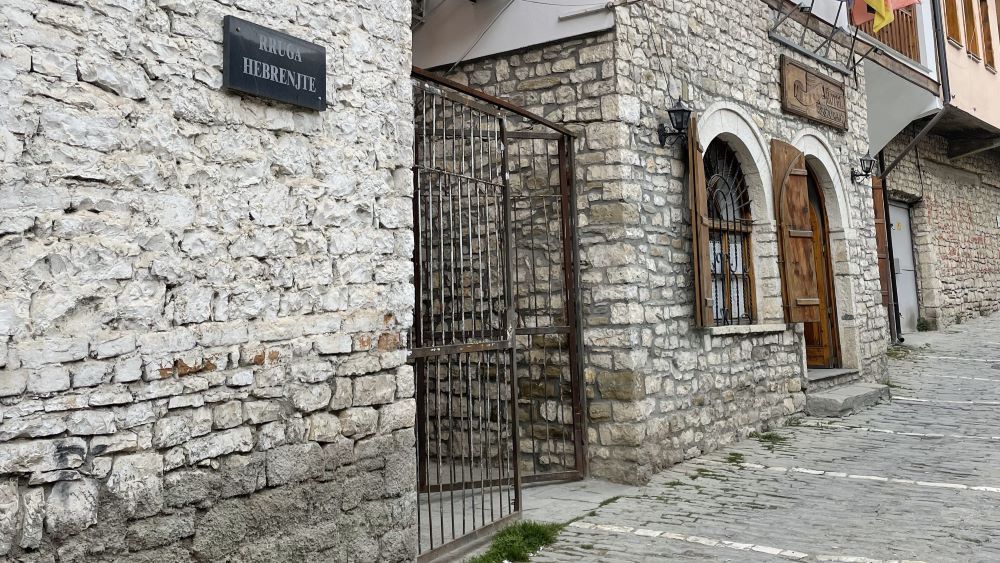
Six blocks away from the Solomoni Museum, I found a simple black plaque with white lettering. It read, “Rruga Hebrentje.” I stared at it. “Jew Street.”
The brutal post-World War II communist regime of dictator Enver Hoxha shuttered all religious institutions in 1967, declaring Albania the world’s first atheist state. His forces destroyed more than 2,000 mosques, churches and other sacred buildings, arresting priests, clerics and imams, many of whom disappeared forever into labor camps and hidden graves.
So many people and huge swaths of Albanian culture and history were violently erased. I joined my friends to explore Berat’s exceptions to the wanton destruction, starting at the Sultan’s Mosque, which dates to the 15th century and boasts an intricately carved wooden ceiling. We expected to admire just the outside, since our guidebook said the doors opened only around Friday prayer.
But as we stared at the somewhat ordinary façade, a friendly gentleman chatted us up. He spoke Albanian, Greek and a bit of Italian, the last of which proved useful at matching up to our Spanish and French. He told us a little about the mosque and the casual styles of observance by most Albanian Muslims, but we only realized he worked there when he invited us inside, retrieving a key when we responded with excitement.
We marveled at the green, red and gold ceiling, illuminated by a round chandelier. He asked if we wanted to climb up the minaret, warning us about the ascent. Narrower than the width of my hips, the tightly coiled spiral of 94 stairs featured a layer of dust and cobwebs that stuck to our bare feet.
But at the top, swallowing my fear of heights, confined spaces and bugs, I reaped my reward: a 360-degree view of “the City of One Thousand and One Windows” (Berat’s nickname) flanking both banks of the Osumi River, and the double eagle of Albania’s red flag flying proudly above it all from the castle.
Back on the ground, we thanked the man profusely and dropped donations in the box outside the mosque door as we prepared to say goodbye. Instead, he led us across the square to another building — the Halveti Tekke, or Teqe. Light flowed through the high stained-glass windows onto the walls of the 700-year-old gathering place belonging to the mystic order of Sufi Muslims called Bektashi. Chains hung from the ornate gold-leaf-decorated ceiling over a space where, according to our new friend, the bektashi, or dervishes, used to perform their whirling rituals.
“You want to go up?” he asked my friend’s eight-year-old daughter. She nodded excitedly, and he tossed her a ring of keys, pointing the way to the balcony. As she climbed the stairs, I noticed a pair of six-pointed stars framing the main doorway, a reminder of my original mission — even if they were likely not Stars of David.
But if I felt sad about missing out on the Jewish museum, I was heartened by what I did receive: a firsthand lesson on Albania’s life-saving culture of hospitality.
Naomi Tomky is an award-winning food and travel writer based in Seattle. The article was provided by the JTA global Jewish news source.
An island-city of 53,000 residents in southeastern Texas, Galveston has a long history of welcoming Jews and others.
The Trondheim Synagogue in Norway, one of the northernmost synagogues in the world, marks its 100-year anniversary in October of 2025.
Israelis and other tourists are finding a warm welcome in Albania, which ranks among the world’s fastest-growing tourist destinations.
Maryland is a lot more than cornhole and Old Bay. From Aberdeen to Zihlman, there's plenty to check out in the "Old Line State."