
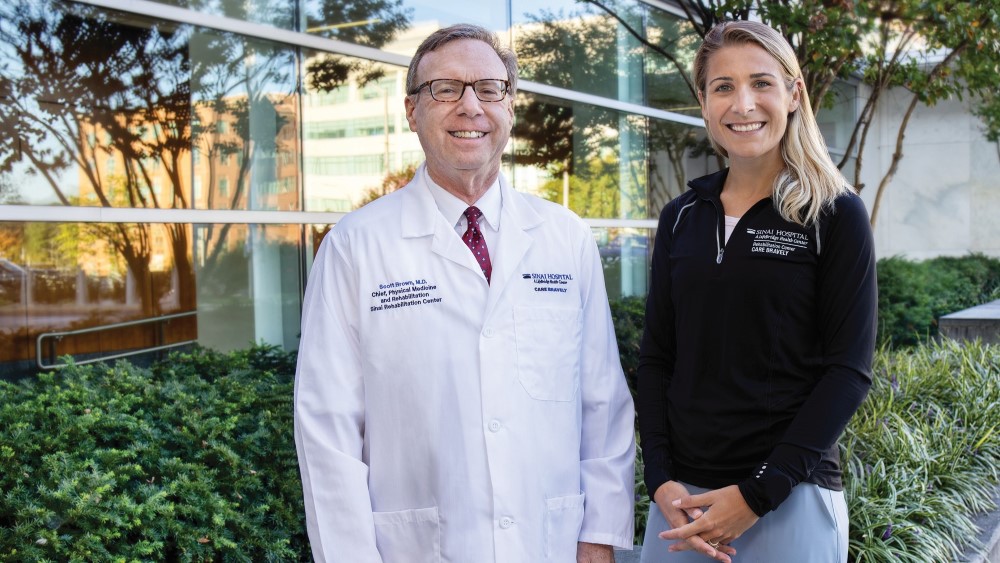
Throughout the course of one’s life, most people at some point will require physical therapy and/or rehabilitation medicine. Jmore recently spoke about trends and innovations in those fields with Dr. Scott E. Brown, medical director of the Sinai Rehabilitation Center and chief of the Department of Physical Medicine and Rehabilitation at LifeBridge Health, and Grace “Annie” Neurohr, a doctor of physical therapy and board certified orthopedic clinical specialist who is the Bio-Motion Specialist at The Running Program at the Sinai Rehabilitation Center.
October is ‘National Physical Therapy Month.’ Does that impact your work in any way?
Dr. Brown: Absolutely. We love to celebrate all our therapists, and we also celebrate a week to honor everyone involved in the rehabilitation process. Our field is an interesting one, and not one very well understood [by the public]. We’re not defined by a single organ system or disease process, so we treat folks with problems that range from brain injuries and amputations to strokes and back pain. We treat a wide range of conditions and diagnoses, and physical therapy is a critical component to all those treatments.
Did the pandemic impact your field?
Dr. Brown: It’s a little hard to know how much is rebound and how much is pent-up. To some degree we are seeing, as best as we can tell, an increase in issues related to activity. People are getting out and doing things more, so we would naturally expect that. Whether that’s more than we would see if there had not been a pandemic, that’s hard to tell.
Dr. Neurohr: One thing COVID brought in was an influx of road runners simply because gyms were closed, so people were outside and running instead. We saw a growth in the running population from what we usually treat. With new runners comes a lot of overuse injuries because people are introducing running into their lives without really being prepared for it. With that comes overuse issues such as shin splints and bone stress injuries.
In terms of sports, we’re seeing more ACL tears with soccer now, especially with our female athletes. A lot of that has to do with training schedules being completely halted and brought back too fast, with athletes not being adequately prepared for such vigorous participation.
Does climate change impact your field?
Dr. Neurohr: Most of what I see are people needing more information about expectations with training and with how they deal with the heat. I work mostly with distance runners, but I think it goes across the board with outdoor sports. Things have to be more intentional in terms of hydration, how much sodium you intake, electrolytes and setting expectations for the demands of the sport and your performance. I have a lot of patients training for different races and they feel they should be performing better. But they’re forgetting that the temperature is so much hotter on these runs. It’s about creating clear goals and expectations while knowing that the conditions are not necessarily the same as they were last year or the year before.
What are some of the trends you’re seeing in physical therapy and rehabilitation medicine?
Dr. Neurohr: For us, the trend we’re seeing in the profession is it’s becoming more autonomous. Maryland is a Direct Access state, which allows people to come to physical therapy without a referral. Access to physical therapy is now more direct. You don’t necessarily have to see a physician first. I think one of the benefits of working at a hospital is you can refer to physicians and all the resources they bring. I have the best of both worlds. I have more autonomy than a physical therapist did years ago, but I also have a lot of resources available as well. I can see a patient right off the street and when I evaluate them, I can easily refer out as needed for consultation. This allows us to get people in and assessed, bringing better access to health care to those who may not otherwise seek it.
Because the profession has become more autonomous and less ancillary, the level of education continues to progress. The level of education is now a doctorate level and we’re seeing more residency and fellowship programs developing, including those here at Sinai. We just established a neurological residency and we’re working towards establishing an orthopedic one as well.
Does artificial intelligence play any role in your field?
Dr. Neurohr: AI has made a lot of procedures in physical therapy more efficient. There are a lot of apps and metrics we now have access to because of the technology, AI-powered or otherwise. I do a lot of talking with app and tech developers about tools to bring into our clinic, and it’s been exciting.
I still feel you can’t replace physical therapy with AI because it’s such a nuanced profession. There are certain things you might not need to be super-specific to know what’s going on, and certain things you need to be with the patient, working with them, hearing them, getting your hands on them. I think AI can supplement, but it’s been interesting to see what’s come out of it.
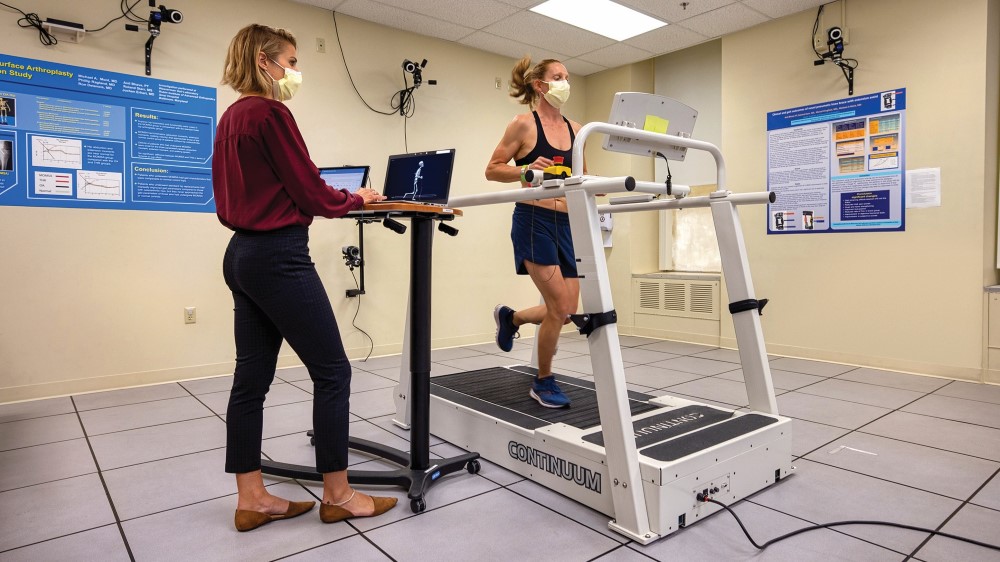
In terms of innovation in assessments and rehabilitation, we’re using technology to perform comprehensive running and movement analysis. We use 3D cameras to break down very specific angles on how your joints move when you’re running or walking. We also use little sensors to look at different metrics like ground reaction forces and acceleration rates you couldn’t see if you watched someone run. Having this information allows us to tie injury rates to a person’s movement patterns. It gives so much information about how someone is moving that the naked eye would not be able to see, and that’s made my job unique and innovative.
Dr. Brown: When AI is invoked, some of the catastrophic endgame is, ‘Oh, it’s going to replace this or that.’ It’s an advanced technology that can enhance the personal interaction.
During the pandemic when everyone was embracing telehealth, there was this thinking of, ‘Oh, that’s going to replace coming into the doctor’s office.’ But there are so many aspects of our field that you cannot assess virtually and AI cannot really assess. You really got to get your hands on [the patient].
What is some of the latest technology and equipment you’re now using to help patients?
Dr. Neurohr: One thing we use are Alter G treadmills that fill up with air to allow you to run or walk with less weight and impact through your lower body. This helps patients get back to walking or transition from walking to running particularly post-surgery or if they have joint pain with higher impact exercise. It helps them do that without as much impact on their joints or undue stress on areas needing recovery or continued healing.
We also use something called Biodex, a machine that measures certain muscle groups and compares them to [muscles not operated on]. We use this a lot on ACL injuries as they return to sport and knee replacements. You can test joints and analyze strength in different ways. We can use that early on in rehab to get a good baseline and then retest it during the rehab process.
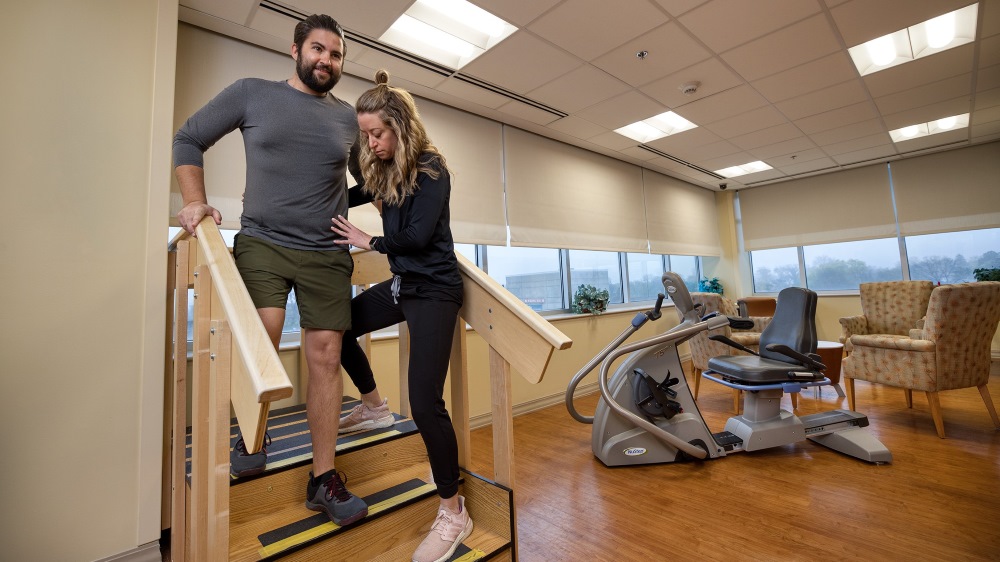
One new thing installed in our neuro department is our Vector System, which allows you to safely challenge balance with patients who would be a fall risk. It’s a harness system that provides body weight support and allows them to challenge themselves with stairs, lunges and higher-level movements and even fall in a safe way. It lowers them to the ground and helps the patient get prepared for the fall. That’s been a great way of putting patients in a real-life situation without jeopardizing their safety.
Another piece of rehab technology we now use is blood-flow restriction therapy. It’s most beneficial to people who’ve recently had surgery and experienced a large degree of muscle atrophy. It’s basically a tourniquet system, which sounds scary, but it will constantly measure someone’s blood flow so their muscle cells work at partial oxygenation levels. This allows patients to perform low-resistance exercises, things that don’t stress or put patients into too much pain but gain the strength benefits much faster. We’ve been using blood-flow restriction with a lot of our post-operative patients and seeing it gets them stronger faster.
There’s a lot of talk about pickleball injuries these days. Are you seeing a lot of that?
Dr. Neurohr: I have not seen a lot of pickleball players yet, but I just read an article about treating them. I think they’re mostly seeing back injuries and hamstring injuries, and a lot of that has to do with the posture in which you’re playing the sport. You’re also seeing people who may not have normally been engaging in physical activity or sport, and they’re coming into pickleball and it’s more athletic than something they’ve done before, and they didn’t do the proper warmup to get their muscles ready. The way the sport works is you’re in this constant crouch position with intermittent lunges and quick responsive activity. Most of what we’re seeing is not traumatic injuries but more so muscle strains because of that movement.
For some of our older patients, pickleball is a good way to stay active. But with an older population, there’s typically a higher risk of injury. I’d encourage people to just come in and get a screen or work with a trainer to get some of the basics of movement warmup so they can play the sport. I think it’s great to stay as active and agile as possible, but being prepped and ready is really important, too.
Can you talk about the field of pain management?
Dr. Brown: We do a lot of pain management in our department. The term ‘pain management’ is a catchall that can refer to a wide array of treatment options and interventions for patients. For some people when they hear the term, they think it means getting injections or pain medicine or just going to a therapist. All those things are components of pain management and have their roles, but pain itself is a very unique, individual experience. It’s multi-dimensional, especially when we’re talking about chronic pain. So an important part of pain management is taking the time to elucidate all the dimensions of the chronic pain experiences for that individual.
Many of these interventions can be appropriate. It could be a simple intervention or a full array of multi-disciplinary approaches. It literally involves every discipline in our department, from therapist to the psychologist to social workers to the doctors and nurses. It’s a very broad topic.
One thing we want to try to prevent, especially in the musculoskeletal world, is pain becoming chronic. If someone experiences an injury and they’re not getting better in a reasonable amount of time, it should really be checked out. The ability to get to a physical therapist or physician early on for treatment is important before it otherwise becomes a longstanding chronic pain problem. It requires a deep dive into all the potential aggravating circumstances and issues.
What about regenerative medicine?
Dr. Brown: Over the last decade, that’s become a hot item in medicine. Regenerative medicine basically means utilizing biologic materials to help accelerate or facilitate the actual healing process. In other words, to help your own tissues regenerate more quickly and fully and successfully. Regenerative medicine itself is not new, but the use of biologics in regenerative medicine has hit the scene in the last decade or so.
Most of what is used in these injection procedures comes in two flavors – stem cells and what is called platelet-rich plasma injections. Stem cells are immature cells, and by using them we can encourage them to become more specialized cells in the healing process. The platelet-rich plasma injections can help the healing process, since they contain growth factors that enhance healing tissues.
The approach to doing these procedures is not standardized, so how many shots we do, how much stuff you put in, how you prepare the stuff to put in, there are lots of questions about the process. When using the person’s own stem cells and biologic material, it’s fairly low-risk. You’re not injecting a foreign body or material. But there are always risks. It’s still considered experimental so it’s an out-of-pocket treatment. You have to be careful about what you’re getting and ask a lot of questions.
Are there misnomers out there about physical therapy and rehabilitation medicine?
Dr. Neurohr: A lot of my patients tell me they expect a lot of PT to be pain and torture instead of physical therapy – ‘no pain no gain.’ Everyone’s rehabilitation experience is personal to them and at times, pain may be inevitable. But that’s certainly not the goal. We’re trying to gain function and actually improve your pain overall. We want to get you back to doing things you were doing before your injury or surgery, while mitigating the pain as well.
I also think people think your job as a patient is to just show up at PT, but we give you a lot of homework. Patients really need to take control of their own recovery in the rehab process. Coming to PT one or two times a week, for 30 or 60 minutes, won’t have the same effect if you’re not doing the things on your own at home. Your physical therapist is there to guide you in the process, but not do it for you. It’s a team-based process.
John Singer wants to help Marylanders of all economic backgrounds to afford ankle foot orthoses.
Colorectal cancer rates are climbing among young people and Ashkenazi Jews.

The donation will be directed to help foster research conducted by faculty at the University of Maryland School of Medicine and to advance innovative treatments.
The founder and owner of Catonsville Dental Care, "Dr. B" maintains a spirit of optimism that inspires friends, colleagues and patients.