
The mission tagline for Jews United for Justice is, “Think Jewishly, Act Locally.” And that’s exactly what the Washington, D.C.-based nonprofit has been doing for the past quarter of a century.
Since its inception in April of 1998, JUFJ has tackled progressive issues such as renters’ rights, police accountability, water justice and fair elections — all through a decidedly Jewish lens.
This Sunday night, Nov. 19, JUFJ will celebrate its 25th anniversary with a celebration at the Montgomery College Cultural Arts Center in Silver Spring. As part of the celebration, JUFJ will present its annual Heschel Vision Awards to Baltimore area social justice activist Tracie Guy-Decker; CASA, the immigrants rights organization; and Washington, D.C., Councilmember Janeese Lewis George.
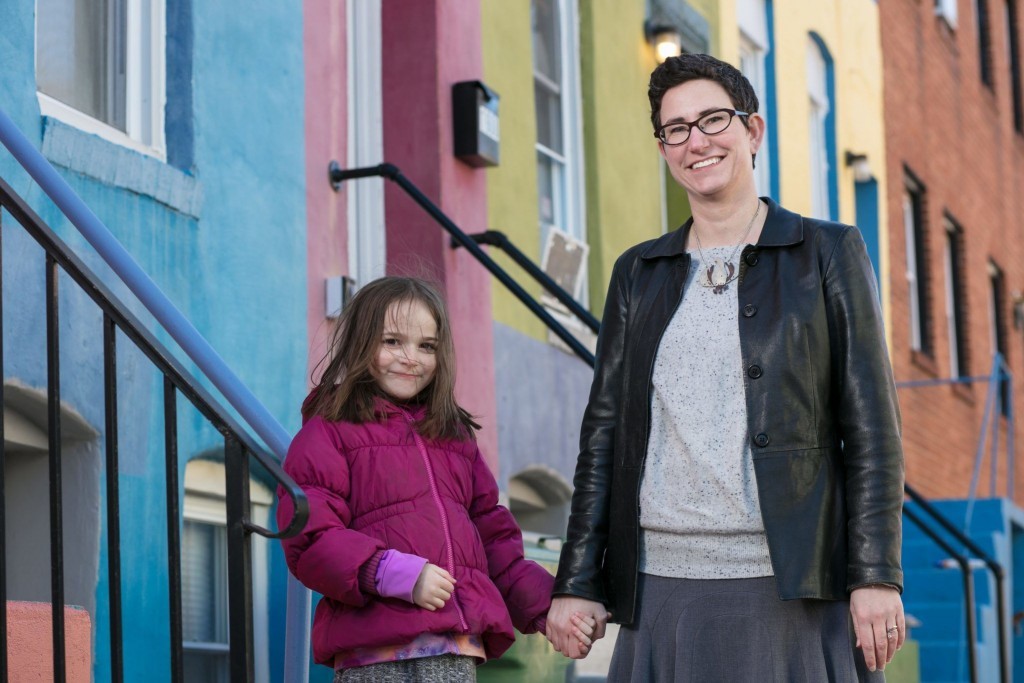
Guy-Decker is the immediate past leadership council chair of JUFJ’s Baltimore office, which was established in 2014 and is helmed by Maryland policy director and Baltimore director Molly Amster.
A fifth-generation member of Baltimore Hebrew Congregation, Guy-Decker is the former deputy director of the Jewish Museum of Maryland and is chief operating officer of the local social justice organization Joyous Justice.
She will be honored by the JUFJ for “her leadership and dedication to pursuing justice in Baltimore, always grounded in a deep sense of Jewish values.”
A Northwest Baltimore County native, Guy-Decker, 46, described receiving the award as “deeply humbling. The work that I do for JUFJ, if I’m doing it well, is pretty invisible. My work for the leadership council [has been] about systems thinking and group dynamics and making sure that we’re maximizing the time and talent that people are giving. I’m delighted to be recognized, and also a little bit surprised.
“Jews United for Justice has given me so many gifts since I first became involved,” she said. “The work, the time, the effort that I spend in thinking about trying to move us toward a more just world is a Jewish obligation in my mind. Having an outlet to do that work in a Jewish way alongside other Jews and our allies and our partners, it just feels right.”
JUFJ’s history dates back to a class taught decades ago by Rabbi David Shneyer, founder of Am Kolel, the Jewish Renewal Community of Greater Washington. The course focused on the teachings of the late philosopher, activist and theologian Rabbi Abraham Joshua Heschel, best known for his civil rights work alongside Dr. Martin Luther King Jr.
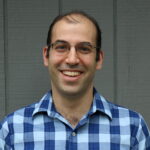
“At the end of that class, a group came together and said, ‘Almost all of [Heschel’s] teachings are about the intersection of who we are on the inside and how we act in the world,” said Jacob Feinspan, JUFJ’s executive director. “Let’s try doing that acting in the world part together.”
When more than 60 people showed up to the JUFJ’s first planning meeting, the organizers realized there was an appetite for Jewishly informed social justice work in the D.C. area and beyond.
“The belief from the beginning was that there is something powerfully Jewish about being engaged in structural change work in our community, and that there’s a powerful contribution that we can make as Jews, by coming together to do that work,” said Feinspan.
Feinspan, who is based in the D.C. area, joined JUFJ’s board in 2006 and has served as the organization’s executive director for the past 16 years.
He said when JUFJ began its work in Baltimore, some members were initially skeptical that such a progressive group would gain a lot of support from Baltimore’s Jewish community.
“What we found is that there’s a huge interest among Jews across all ages [in Baltimore] to work together to better the whole community for everyone,”
Feinspan said. “The Synagogue Social Justice Council that we built in in Baltimore was the first of the ones we built in the region, and there’s been widespread interest in being involved. … We’ve been appreciated and welcomed in Baltimore in a way that’s been really exciting and energizing.”
Feinspan said JUFJ has worked on several issues since it began operating in Baltimore, including affordable housing, renters’ rights and the transformation of public safety and policing. The latter has been at the forefront JUFJ’s work in Baltimore since 2014. A year later, that work intensified after the killing of Freddie Gray.
“For many Jews in Baltimore, being part of [the anti-racism] space, and being part of marches with JUFJ, was a key way for them to grieve and to be part of communal response,” said Feinspan.
JUFJ Baltimore recently announced its initiatives for the next six months. The group and its partners will focus on court and prison reforms, economic justice, immigrant rights, and renters’ rights.
At a time when many Jews are focused on national and international issues, Feinspan said, “The story of how changes happen in our country over the last two decades is that it all comes from local work. The work to increase the minimum wage federally happened first in a city and then in a second and third city, then in a state and then in another state. It’s all connected.”
Mansoor Shams is known for carrying around a sign proclaiming, “I’m a Muslim and a U.S. Marine. Ask anything.” Now the Baltimore County Department of Recreation and Parks community engagement and outreach officer is running for Baltimore County Executive.
Baltimore native Susan Landsman recently celebrated her rite of passage surrounded by family, friends, fellow residents and staff.
Founded by Marci Yankelov, Julie Kichline, Elizabeth Miller and Lila Perilloux, the Bmore Community Fridge Network serves a crucial role in feeding the hungry.
The German-born rabbi, scholar and activist, who served Temple Emanuel from 1963 to 2000 , was a prominent figure in the local Jewish community for more than six decades.