
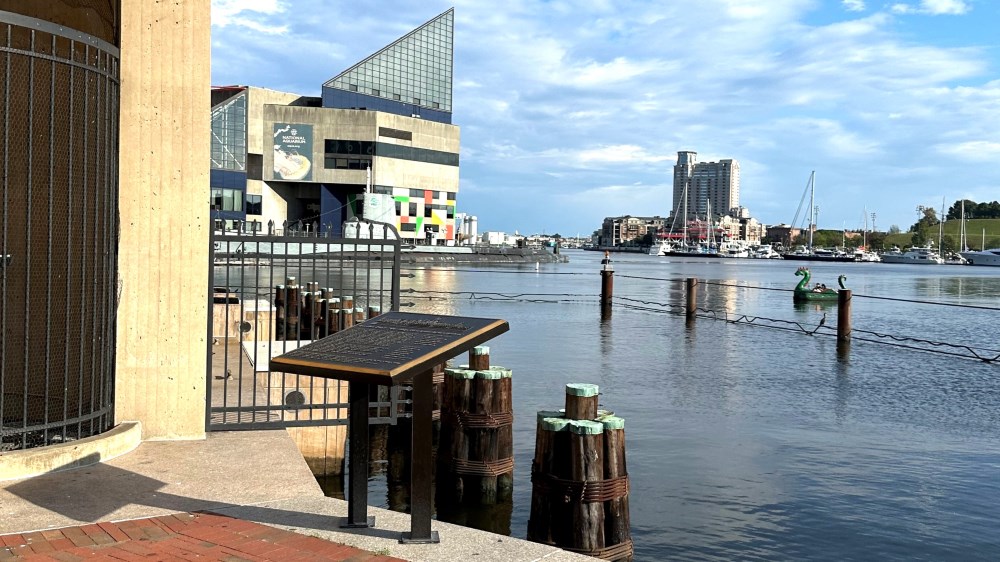
Earlier this year, my wife Miriam and I decided to take a walk around the Inner Harbor. The sun was shining as we enjoyed our casual downtown stroll.
As we approached the World Trade Center from the west, we grudgingly followed the detour away from the water because the building’s iron gates were closed and locked. When we moved to Baltimore in 2010, those gates were open during the day. This was great because it allowed pedestrians to make full use of the perpetual easement along the water stretching all the way from Canton to Locust Point.
Also important was that passersby could read from a large bronze plaque about an important piece of Jewish, Baltimore and world history. The plaque was erected in 1997 by the Jewish Museum of Maryland and Baltimore Zionist District to mark the 50th anniversary of a tragic yet also inspiring and ultimately transformational event.
Built in 1928 as the Old Bay Line flagship, the steamer President Warfield ran nightly between Baltimore and Norfolk, Virginia. Later, the ship joined the U.S. Navy fleet as a harbor control vessel off Omaha Beach. Its last commission, though, was what, according to the plaque, marked “her epic voyage into history.” The President Warfield became one of four vessels secretly outfitted by the Haganah in Baltimore harbor to transport Holocaust survivors past the blockade into British Mandatory Palestine.
On July 18, 1947, the ship (newly renamed Exodus 1947) was carrying 4,515 refugees, including 655 children, when it was attacked by British warships and boarded in international Mediterranean waters. A bloody conflict ensued during which dozens of refugees were injured and three people were killed.
The British, for their part, sought to make an example of those seeking refuge on the Exodus. The passengers were forced onto deportation ships and sent back to their port of disembarkation in France. The three ships languished for three weeks in the hot summer air. Even so, passengers mounted a hunger strike and refused to disembark. In an act of petty and retributive cruelty, the British then transported these Holocaust survivors to Germany, of all places, where they were imprisoned in British internment camps.
According to the U.S. Holocaust Memorial Museum: “Displaced persons in camps all over Europe protested vociferously and staged hunger strikes when they heard the news. Large protests erupted on both sides of the Atlantic. The ensuing public embarrassment for Britain played a significant role in the diplomatic swing of sympathy toward the Jews and the eventual recognition of a Jewish state in 1948.”
The story inspired the epic 1960 film “Exodus” starring Paul Newman, based on the novel by Baltimorean Leon Uris.
The day Miriam and I took our walk and encountered the locked gates blocking access to the Exodus memorial plaque, we resolved to do something about it. I reached out to City Councilman Eric Costello, who facilitated communication between myself and representatives from the Maryland Port Administration. I was told the gates had been closed during daytime hours since 2018 because an employee from one of the World Trade Center tenant firms was assaulted on the promenade. The MPA was disinclined to reopen the easement to public access but was willing to relocate the plaque at their expense.
I asked Howard Libit of the Baltimore Jewish Council to join me, and we worked with the MPA to identify a new location for the historical marker. On July 19, 2023, 76 years and one day after the Exodus 1947 was attacked, Howard and I received an email informing us the plaque had been successfully relocated next to the World Trade Center and beyond the iron gates. Baltimoreans, tourists and anyone curious about history can once again read about this storied ship while gazing past the memorial over our serene harbor toward Federal Hill.
The story has a happy ending, and I’m grateful to the Port Administration and the World Trade Center for finding a solution. Still, questions remain. Why does the MPA feel it perpetually necessary to close and lock these gates on the Inner Harbor’s perpetual easement? As Baltimore looks forward to the redevelopment of Harborplace, will there be an opportunity to revisit this decision? As we consider the future of Baltimore’s “crown jewel,” an asset for our entire city and beyond, we might ask: who do those iron gates protect? And who are they being protected from?
Rabbi Daniel Cotzin Burg is spiritual leader of Beth Am Synagogue in Reservoir Hill. This column and others also can be found on his blog, The Urban Rabbi.

As he gets ready to leave for California, Rabbi Daniel Cotzin Burg looks back on his time in Baltimore and his 10 years writing for Jmore.

Michael Olesker pays tribute to WJZ’s retiring Marty Bass, a longtime fixture on local TV screens.

The Orioles' weak defense plays a major role in the nightly carnage, writes Michael Olesker.