
In the early morning darkness of Dec. 28, 1958 — 65 years ago this month — I’m a 13-year-old paperboy crouched on the cold cement floor of an apartment building basement, where arguably the greatest moment in Baltimore sports history is only hours away.
I’m stuffing together sections of a newspaper called The Sunday American for distribution across the vast, hilly Seton Park Apartments and surrounding Northwest Baltimore neighborhoods, with my eyes scanning the big headlines of the day.
There they are, folks, read ‘em and forget ‘em:
“D’Alesandro Gearing Up for Mayoral Campaign.”
“Cuba Opens Big Drive on Rebels.”
“Railroad Policeman Shot, Woman Arrested Here; Argued over ‘Other Men.’”
On that distant morning, does anyone care? The truly important business of life is up there in the top corner of that front page: “It’s the Payoff, and Colts are Rarin’ to Go.”
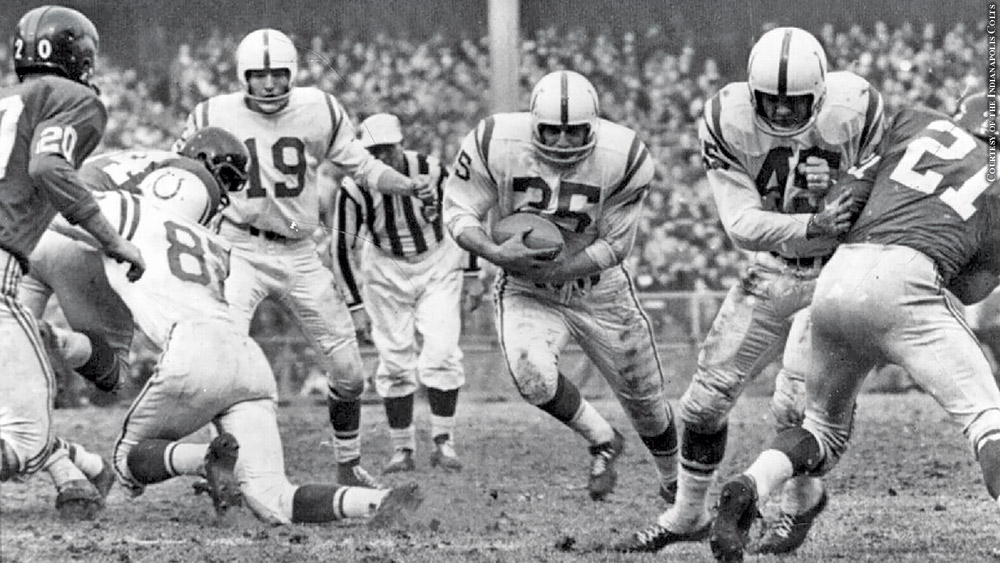
The Baltimore Colts are about to play the New York Giants for the professional football championship of the world. The contest will come to be known as “the greatest game ever played.”
For better or worse, America’s sporting culture, and its TV habits, will never be the same. From now on, those who spent Sunday afternoons watching Alistair Cooke on “Omnibus” will now watch John Unitas throw footballs across the horizon.
From now on, Mickey Mantle hitting homers will mean less than Alan “The Horse” Ameche, with his head down as he plunges into the Yankee Stadium end zone and, simultaneously, into the American future.
And Baltimoreans, famous for feeling second-rate to politically powerful Washington and smug New York, will find themselves at the heart of America’s love affair with the new national sport.
The modern Ravens are now Baltimore’s football passion. But they’re the spiritual godsons of those Colts, who were once the city’s great secular religion.
How big was Dec. 28, 1958? Big enough that 12,000 Baltimoreans rode trains and buses up to The Bronx. The Colts band, in uniform, came tootling down the packed railroad aisles playing, “Let’s go you Bawlamer Colts/and put that ball across the line,” and every two minutes there was somebody hollering, “Gimme a C!” to set off a round of cheers.
And on that day, with darkness descending, there came a miracle. With New York leading, 17-14, the Colts huddled at their own 14-yard line. The clock showed one minute and 56 seconds remaining. Then, worse, Unitas threw two straight incompletes passes.
Never mind, folks, he’s about to invent something called a two-minute drill in front of the whole disbelieving country. On third down, the cool Unitas hits Lenny Moore and gets a first down. Then, with the clock running, he hits Raymond Berry three times in a row.
Seven seconds remain when Steve Myhra kicks a tying field goal. In Sudden Death overtime, it’s Unitas to Berry a few more times, and then a gutsy pass to Jim Mutscheller to set up Ameche’s one-yard plunge into the end zone.
Colts 23, Giants 17.
And then came one more miracle.
At a place we once called Friendship Airport, the Colts’ plane was scheduled to land at 7:50 that evening. By 6 o’clock, more than a thousand fans were there, waiting for their team.
The original thousand became 10,000, and then 20,000, which became 30,000. They were splayed all over the airport, as if waiting to cradle the incoming plane. When the airport garages overflowed and the long road into the airport backed up, people parked their cars along the highway and walked the rest of the way.
In the next day’s News-Post, reporter Alexander Gifford wrote, “It was a mob, a happy bunch of semi-lunatics carrying signs, carrying babies, and some of them just carrying on.”
The thousands who were there that night were joined by thousands more watching it on live television. They saw the new world champions arrive. They saw fans climbing onto the roofs of two Colts buses. They saw a love affair in its grandest hour.
We were a town that always felt second-rate to our big-city neighbors near and far. But 65 years ago this month, we felt like America’s darlings.
Michael Olesker is the author of the 2008 book, “The Colts: A City and its Love Affair in the 1950s” (Johns Hopkins University Press).

A new biography captures the intensity and magic of the musical theater giant, writes Michael Olesker.

Melinda Michel pays tribute to the longtime Jewish community leader and volunteer who passed away on June 8 at age 68.
Meanwhile, the Jewish announcer Andres Cantor will be calling his 12th straight tournament.

Jmore Editor-in-Chief Alan Feiler remembers Temple Emanuel's longtime spiritual leader, who passed away earlier this week at age 91.