
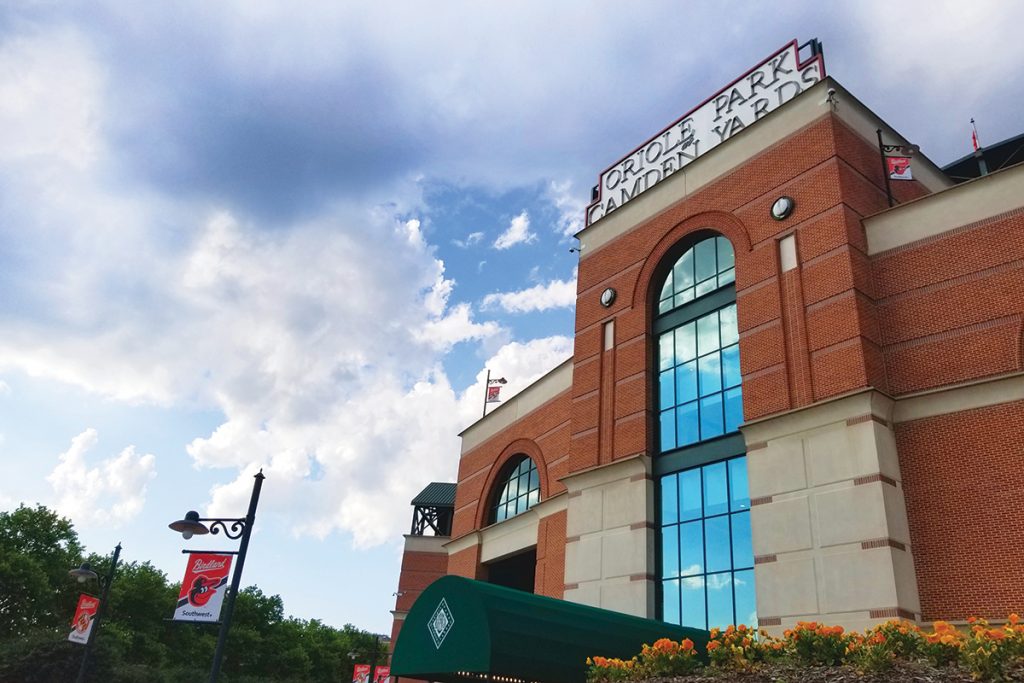
David Rubenstein, meet the ghosts of Tommy D’Alesandro, Clarence Miles and Jerry Hoffberger.
Rubenstein, as everyone knows, is the man purchasing the Baltimore Orioles baseball team from the family of Peter Angelos.
The price for dem O’s is a reported $1.725 billion, which is about 10 times more than Angelos paid for the team three decades ago.
D’Alesandro, Miles and Hoffberger were three key Baltimoreans who helped bring the old St. Louis Browns here and launched the modern Orioles baseball team. That was 1954, when David Rubenstein was four years old and beginning to grow up around Fallstaff and Reisterstown roads in Northwest Baltimore.
The price for those 1954 O’s was $2.475 million, which is not the same as $1.725 billion, even considering inflation. Today, you can’t even afford a backup shortstop with $2.475 million.
So big deal, those ‘54 Birds weren’t much to look at, much less to pay for. In St. Louis, the last Browns team lost 100 games. They drew 297,238 fans the entire 1953 season.
In 1954, as the Orioles, they topped that attendance total on May 20, five weeks into the season, and went on to draw more than a million fans that first year.
Much more is expected of the current Orioles, even beyond the $1.7 billion sale price.
These Orioles didn’t lose 100 games last year, they won 101. They’re young and talented, and they ought to draw well over 2 million fans this summer.
And the new ownership group is probably going to spend money more generously than the current owners.
This is nice to hear but calls for a sense of balance.
We’ve seen the blossoming of today’s team by means of an old system, which was called “the Oriole Way.” That system called for building from within, for building a solid minor league system, for stressing the same fundamentals throughout the system.
It didn’t call for spending massive amounts on free agents. The winning O’s of yesteryear called themselves “The Best Team Money Can’t Buy.” Mid-size markets like Baltimore can’t compete with the financial big shots like New York and Los Angeles, with their endless supply of money.
But by smart drafting and solid minor league fundamentals and attention to modern analytical metrics, the Orioles have shown you can win without the big spending, haven’t they?
So what do they do now that they’ve got such billionaires as Rubenstein and Michael Bloomberg sitting there in the owners’ box? Toss out the system that’s gotten them reborn as contenders? Toss big money around, just because they can?
On the other hand …
These Orioles seem built for the long season, but maybe not for the short playoffs. That’s why they’ve now brought in a couple of high-end pitchers. The money’s big, but maybe these pitchers come up big when the chips are really on the table.
It’s nice that the new owners bring options with them: continue to build from within, but spend the big bucks here and there, and hope this brings back a World Series for the first time in four decades.

A former Baltimore Sun columnist and WJZ-TV commentator, Michael Olesker is the author of six books, including “Journeys to the Heart of Baltimore” (Johns Hopkins University Press) and “Michael Olesker’s Baltimore: If You Live Here, You’re Home” (Johns Hopkins University Press).
As he gets ready to leave for California, Rabbi Daniel Cotzin Burg looks back on his time in Baltimore and his 10 years writing for Jmore.

A former college campus activist, Veksler will speak at Chizuk Amuno on June 8 at the Ruth and Jay Lenrow Visiting Scholar-in-Residence for Combating Antisemitism.
Michael Olesker pays tribute to WJZ’s retiring Marty Bass, a longtime fixture on local TV screens.