
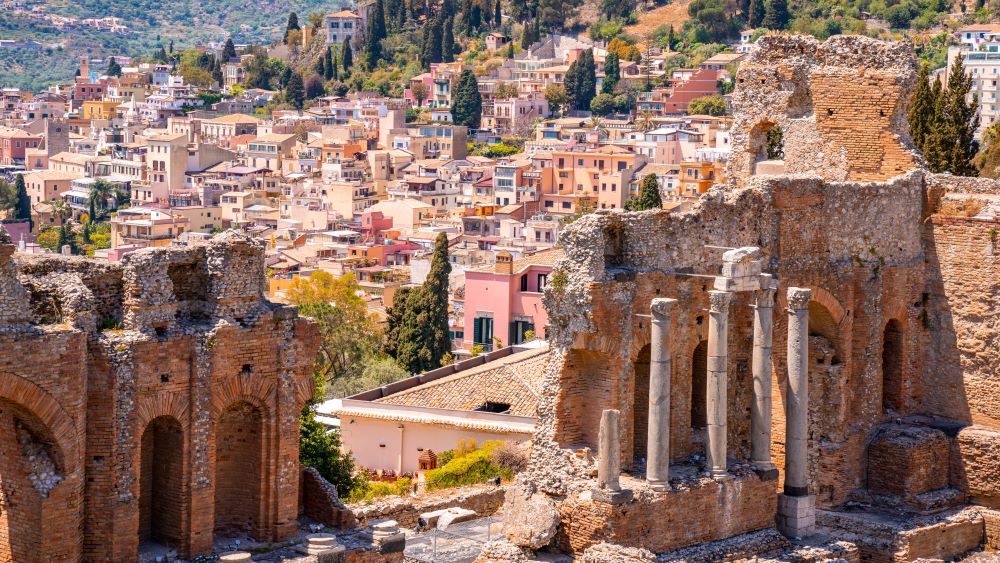
About six months ago, my 84-year-old father announced he wanted to take me and my younger sister to Europe.
Dad said he felt guilty for never taking us there when we were children. I was puzzled by the guilt since limiting family travel to the United States and Canada wasn’t exactly abusive. Then again, Jewish parents (me included) can always find something guilt-worthy when it comes to their children.
All guilt aside, I was absolutely delighted. What a sweet and generous gesture! After some back and forth about where to go, the three of us decided on a 10-day trip to Sicily!
Palermo
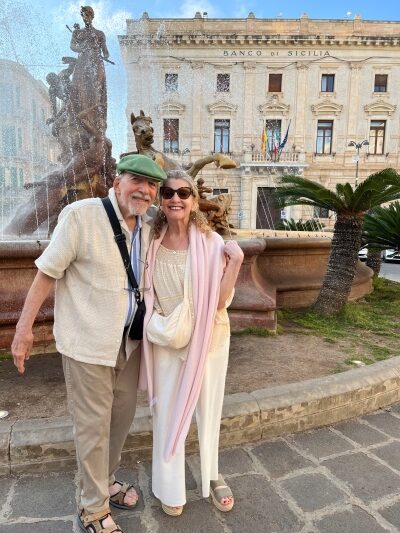
We began our trip in Palermo, Sicily’s capital, a vibrant, gritty and colorful metropolis. There was Italian music in the piazzas, souvenir shops with traditional Caltagirone ceramics, linen tablecloths and lava stone items from nearby Mount Etna. On every corner were carts selling pomegranates, lemons and blood-orange juice freshly squeezed, with or without Aperol or Campari.
Laundry hung from windows of ancient residences, and motorcycles zipped through la stradas.
On our first full day, my sister and I toured Palazzo Conte Federico, one of the city’s oldest homes, where a family of aristocrats — descendants of Frederic II on one side and Italian nobles on the other — still reside and lead their own tours of the palace.
Built around a 12th-century Arab-Norman tower once surrounded by sea waters, the palace featured floors of majolica tiles, silk wallpaper, 17tth-century painted wooden ceilings, baroque ceiling frescoes and displays of ancient weapons, photos and paintings of current and past residents.
During the tour, we were told it was the site of a meeting in which Garibaldi and the Freemasons planned the unification of Italy in 1861.
After the tour, we reunited with our father who was waiting at the Cathedral of Palermo. Founded by Phoenician traders, the cathedral was consecutively home to congregations of Romans, Byzantines, Arabs and Normans.
Later that day, we tasted our first Sicilian pizza and cannoli of the trip.
Delizioso!
We were surprised to come upon what was once the city’s Jewish quarter, Harat al Yahud. While there wasn’t much to see, I learned later that Jewish history in Palermo dates back to Roman times. Approximately 5,000 Jews lived there until they were expelled in 1492.
Jews in Palermo worked mainly as weavers, silk workers and merchants. Since 2017, a group of Jews with roots in Sicily have been working to reclaim Palermo’s Jewish history.
Around the corner from our hotel was the San Cataldo Catholic Church. Built in 1154, the church features a unique row of red domes and is an example of the Arab-Norman architecture popular during the Norman rule in Sicily.
Cefalu
The following day we set out on an adventure – a day trip to the beach town of Cefalu. Known for its 12th-century Norman cathedral full of Byzantine mosaics, it is also a place to swim, shop and dine.
As luck would have it, our driver dropped us off far from our destination. Dad, who used a walker on the trip, braved uneven pavement, cracked cobblestone slopes and dangerous traffic until we reached the quaint village where we stopped for a granita, a delicious drink similar to a Baltimore snowball. Then, we wandered down to the beach, where we waded into the sea.
Afterward, the three of us window-shopped and enjoyed lunch at a lovely beachside café.
Agrigento
Founded by the Greeks in 580 B.C., Agrigento is home to the Valley of the Temples, a UNESCO world heritage site. Agrigento is recognized as the most significant remnant of ancient classical culture on the island of Sicily.
Accompanied by a terrific guide, we spent several hours viewing the site’s seven Doric temples, each named for a different god.
Siracusa
Our next stop was Siracusa, a beautiful Grecian city founded around 734 B.C. After arriving at our hotel, Dad took a nap while my sister and I hurried down to the beach for a dip. It was rocky and hard on the feet, but worth the pain. The water was pristine, cool and refreshing, and we marveled at the beauty of the setting.
Afterward, we sat on the beach and collected sea glass –white, green, blue.
The subsequent day, we visited the archaeologicalpark Neapolis, which includes the Roman Amphitheater, the Teatro Greco and the Orecchio di Dionisio, a limestone cave shaped like a human ear.
We also saw the remarkable 5th-century Temple of Athena, which was converted to a Catholic cathedral in the 7th century. Amazingly, instead of destroying the Temple of Athena, the Catholics built their cathedral around it.
Like Palermo, Siracusa has an abandoned Jewish quarter called The Giudecca. Prior to the Spanish Inquisition at the end of the 15th century, the Giudecca had a dozen synagogues and approximately 5,000 Jews lived there.
According to J-Italy, “The Giudecca reveals distinct marks of the ancient Jewish presence: a Jewish star on the facade of a Gothic building, Jewish medieval tombstones now displayed in a museum, or an inscription in Hebrew in the apse of the church of St. John the Baptist, which had once been a synagogue.
In 1987, a remarkable treasure was discovered: an abandoned mikveh dating to the Byzantine era, which is thought to be the most ancient in Europe. Tours of the mikveh are available daily.
Villa Romane del Casale, Piazza Armerina
A friend told my father we could not leave Sicily without seeing Piazza Armerina’s famous mosaics. So we took a cab to the Villa Romane del Casale,an astonishing example of a late antique Roman villa.
As the story goes, in the late 3rd century, a nobleman lived there with his family where gorgeous mosaics, created painstakingly by North African artists, were covered by a landslide in the 12th century A.D.
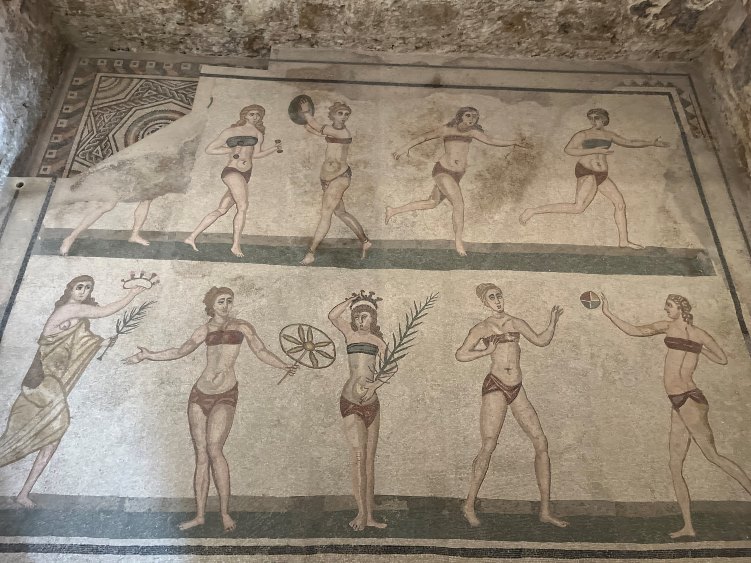
About 75 years ago, an excavation exposed the biggest, most well-preserved Roman mosaics on Earth. There were images of animals from Africa and Asia being transported to Sicily for the Roman games, women exercising and wearing what resemble modern-day bikinis, children playing, lovers embracing, hunters shooting and Orpheus serenading the beasts. It was truly magnificent.
Taormina
Readers who have seen season two of the TV show “White Lotus” on HBO-MAX will remember Taormina, a town on the Eastern coast of Sicily where the show was filmed.
Much of the show’s action took place at the Four Seasons Hotel Taormina, and I was hoping to enjoy a cocktail at the hotel’s bar.
But no dice. Due to the popularity of “White Lotus,” one now needs a reservation to enter. No biggie, though. There was so much else to see.
Our hotel was adjacent to the public gardens, designed by a Scottish woman named Lady Florence Trevelyan. A friend of Queen Victoria as well as the mistress of Victoria’s son, Edward VII, Lady Florence was sent to Taormina when Edward married.
In addition to the garden’s trees, shrubs and flowers, one can appreciate the views of the coast and Mount Etna, where it is possible to see smoke rising from the volcano.
Taormina has shopping galore — clothing boutiques, leather and jewelry stores, as well as high-end designer brands. Like everywhere in Sicily, the food was superb — lasagna with bacchanal sauce and pistachios, orange fennel salad, fresh bread with olive oil, wonderful wine and aperitifs.
After two days in Taormina, it was time to start packing for home. I was so grateful to my father for envisioning this trip of a lifetime.
The father/daughters experience left us with lifelong memories and cherished time together. A month after our return, Dad celebrated his 85th birthday at an Italian restaurant in downtown Manhattan. I’m sure this won’t be his last overseas adventure!
Duke Zimmerman and Lori Gale will talk at Towson University about their new book "People Get Ready" and the role played by Globe Posters in the civil rights movement.
The new exhibition revisits and updates a previous show about ritual hair covering in the observant community.

The Pikesville resident's latest offering "There's a Dragon in the Tree House and He Won't Come out!" was co-written with her grandsons.
A new biography captures the intensity and magic of the musical theater giant, writes Michael Olesker.