
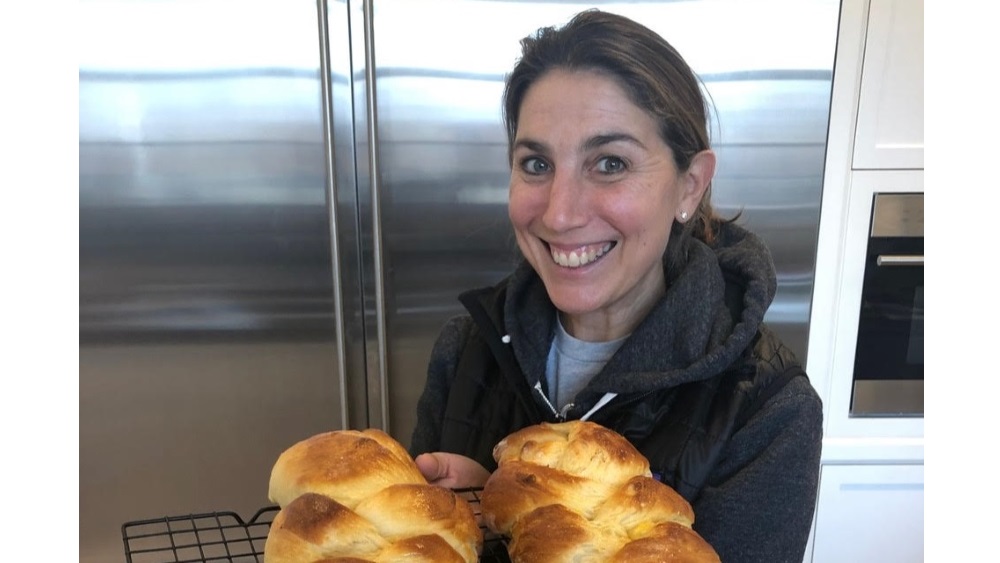
Is being Jewish in the post-Oct. 7th era different than it was in previous generations? Zibby Owens believes it is.
A bestselling author, publisher and podcaster, Owens served as the catalyst and editor of the recently published “On Being Jewish Now: Reflections from Authors and Advocates” (Zibby Books). The anthology features essays by 75 contemporary Jewish writers, artists and thinkers exploring their views on faith, heritage and community in the 21st-century.
Among the contributors are TV personality Jill Zarin, scholar and author Rabbi Steve Leder, novelist Amy Ephron, venture capitalist Bradley Tusk, literary critic Daphne Merkin, and actors Mark Feuerstein and Jenny Mollen.
With today marking the one-year anniversary of the Oct. 7th massacre, Jmore recently caught up with Owens, who is is the founder and CEO of Zibby Media. A graduate of Yale University and Harvard Business School, she lives in New York (and sometimes Los Angeles) with her husband, Kyle Owens, and four children ages 9 to 17.
Jmore: With the conflict in the Middle East and antisemitism spreading around the world, many American Jews feel quite bleak approaching this High Holiday season. What gives you hope for the future?
Owens: As I say to my kids, ‘We’ve done it before, and we can do it again.’ We will not be extinguished. We will not be defeated. We are here to stay.
Is being Jewish now after the Hamas attacks of last year really different than in the past?
Yes, it’s different than in the past 40-50 years. There’s a renewed awareness of how deep antisemitism runs, a fear, a solidarity and a tribe-like mentality that had faded to the background.
How did the concept for this anthology originate?
After another terrible news day in late June, I was feeling hopeless. No matter how much I spoke out or posted on Instagram or Substack, it wasn’t moving the needle. Could I do anything that would actually help?
Then I thought, what about an anthology? I have access to so many amazing authors. They could share their thoughts and feelings in a way that would help others — and I could donate the profits to a non-profit I’d helped get off the ground called Artists Against Antisemitism. I’d edited two other anthologies and had my own publishing house. Could we make it in time for October? We could. And we did.
Are there any other books like it?
There are collections of stories but they’re quite different. [Haaretz reporter] Lee Yaron’s nonfiction book ‘10/7’ is absolutely incredible. It’s a reported, journalistic-style book documenting all the individuals, families and communities affected on Oct. 7th, one by one — Pulitzer Prize newspaper reporting.
There’s also ‘Humans of Judaism,’ which Nikki Schreiber founded as a community in 2014. It morphed into a social media outlet, and the book encapsulates many stories of notable Jews. This is the only personal essay collection about what it means to be Jewish — and how it feels — after Oct. 7.
How did you select the essayists? What were the criteria?
Contributors would only have three weeks to get their essays in, so I started emailing everyone I knew who was Jewish. I contacted friends who had become activists, friends who were leading the charge in their own communities, other founding authors of Artists Against Antisemitism and some of their authors friends and authors from my podcast ‘Moms Don’t Have Time to Read Books.’
I invited 200 authors to contribute, [and] 75 said yes.
Who was your biggest ‘get’ for the book? Who else would you have liked to contribute?
I was hoping to get Debra Messing, Julianna Margulies, [Israeli writer] Noa Yedlin and [actor] Brett Gelman. Noa Yedlin did blurb the book.
My biggest get for the book? Well, they’re all friends, but Jenny Mollen, Jill Zarin and a new friend actor Mark Feuerstein having the biggest followings. But they’re all huge gets!
What is the common thread among all the essays?
Community. Culture. Connection.
What do you hope readers get out of this book?
I hope readers feel connected. I hope they feel less alone. Moved. I hope non-Jewish readers see the shared humanity and decide to speak up on our behalf when our self-defense falls on deaf ears.
I hope people will laugh and cry and think about their own lives. And feel loved.
What is your own Jewish background?
I was raised Reform and did all the big things: Hebrew school, bat mitzvah, High holidays. I didn’t start celebrating Shabbat every Friday until my 30s. But it’s been an essential part of me.
How do we get young Jews to be proud of their heritage and care about Israel?
This is critically important. Young Jews need to be our ambassadors in the world. By learning their family history and the history of people like the men and women writing in our book, they can feel connected in a new way.
For information about “On Being Jewish Now,” visit zibbymedia.com/products/on-being-jewish-now
The BCO, founded in 1984, will perform the works of Frank Zappa, Beethoven, Mason Bates and Karena Ingram.
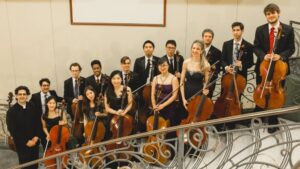
Led by local Israel-American cellist Amit Peled, the Mount Vernon Virtuosi aims to inspire people beyond musical enjoyment.

Container vegetable gardening is a terrific option for people with limited space and/or time. Rebecca Brown and Norman Cohen share some tips.
Filmmaker Justin Schein looks at wealth and inequality through the very real story of his late father.