
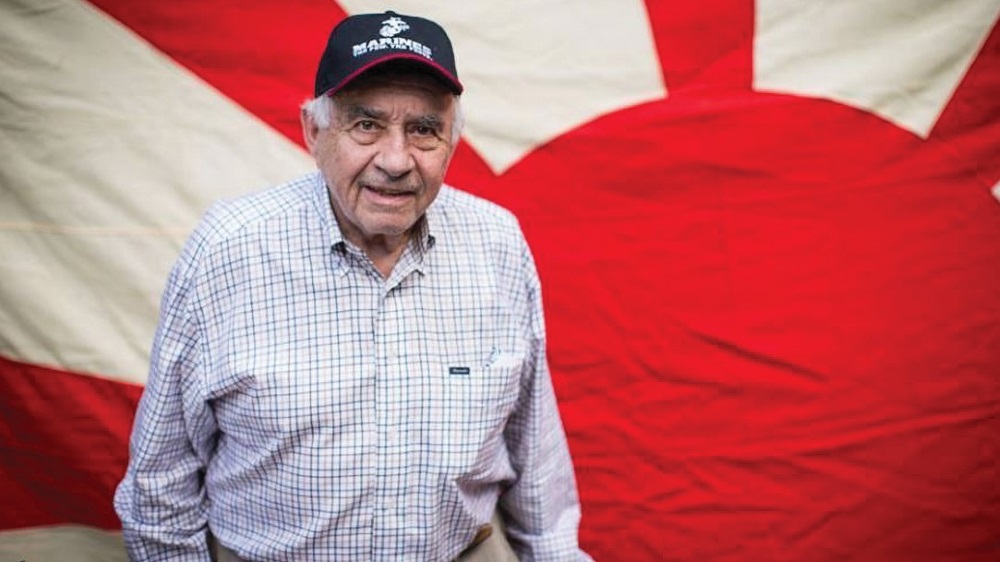
After participating in the military campaigns to liberate Guam and Okinawa during World War II, PFC Melvin S. Kabik and his fellow Marines in the 4th Marine Regiment “were loaded aboard ships headed for Japan. We were out in Tokyo Bay when the Japanese surrendered, and we were the first ones ashore at Yokosuka Naval Base.”
That’s how Kabik, a Pikesville real estate investor who passed away in 2020 at age 95, described the circumstances that led him to the Japanese battleship Nagato. And that’s how he came into possession of the rear admiral’s flag that had flown on that ship.
“When my dad was exploring the ship, he found the flag room, full of large and small flags, and he grabbed the biggest one,” said his son, Jeffrey Kabik.
Now, 79 years later, that flag is going to The National WWII Museum. Next Monday, Nov. 18, Melvin Kabik’s daughter, Terry Reamer, and granddaughter, Lisa Yacono, will travel to New Orleans to officially donate the flag to the museum.
Reamer said the flag was one of her father’s most cherished possessions. After building his house in 1977, Kabik had a case specially made for the flag, as well as a dedicated shelf on which to display the item, said Reamer.
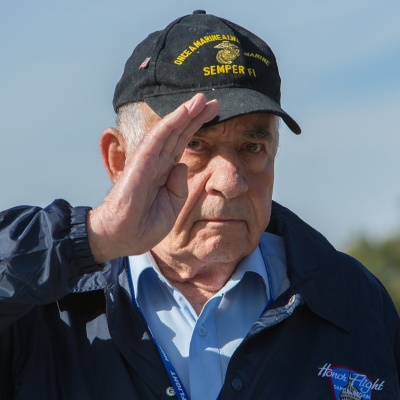
When nearing the end of his life, he told his family to “watch over the flag” and perhaps donate it to a museum.
“This flag isn’t just something he’s had in a trunk all these years,” said Reamer. “It’s not just a rear admiral’s flag. It’s not just a souvenir. It’s an embodiment of who my father was. Donating it to the museum in his memory is a huge deal for my family.”
After Kabik’s death, Reamer, her brother and other family members explored several possibilities and decided to donate the flag to the New Orleans museum.
The flag holds a special place in world history since the Nagato was the flagship of the Imperial Japanese Navy fleet and transmitted the order on Dec. 7, 1941, for the attack on Pearl Harbor.
“The Nagato flag is a significant piece of history, as the Nagato was the last remaining capital-grade warship that remained in the Japanese Navy and was under the command of Rear Admiral Miki Otsuka when Americans captured the ship in August, 1945,” said Ross Patterson, curator of the National WWII Museum.
A Marine through and through, Kabik displayed a Marine ornament on the hood of his car, as well as a “GUNGHO3” Maryland license plate. He flew a U.S. Marine Corps flag in front of his home.
Many of his birthday gatherings featured red, white and blue decorations with family members and friends in military dress. One year, Yacono said she made a birthday cake topped with a replica of the WWII Memorial in Washington, D.C.
In addition, two active-duty Marines in 2015 attended Kabik’s 90th birthday party, one of whom returned a couple of years later to present him with a new Marine Corps flag. The Marine motto “Semper Fi” is engraved on Kabik’s gravestone.
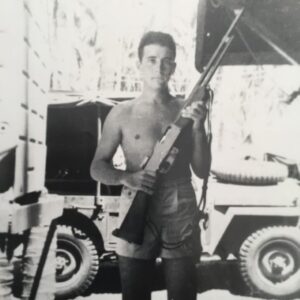
Yacono said that being Jewish greatly informed her grandfather’s Marine identity.
“He told us that most of his fellow enlistees at Parris Island [South Carolina] where he went for training had never seen a Jew,” she said. “Some were surprised he didn’t have horns. Some of the people he served with were uncomfortable with Jews, and he learned to just be brave and unashamed of who he was, proud of being a Jewish Marine and representing his family and his religion honorably.”
Reamer said being a Marine stuck with Kabik throughout his life.
“My dad believed in sealing a deal with a handshake and sticking by your word. He always said it was the Marines that instilled that sense of honor in him,” she said. “Not everyone operated that way, and he did get burned a few times, but he never changed his belief. That principle guided him through his career, from his post-war job managing the family’s Eddie’s grocery store in Catonsville to his decades in commercial real estate.”
Kabik’s wartime experiences have been chronicled in two books: Howard J. Leavitt’s “Tales of Valor: Jewish-American Heroes in WWII” (Xlibris) and Mark Zangara’s “My War in the Pacific,” scheduled to be published in early 2025.
“Dad said that when they came home from the war, they got no recognition,” Reamer said. “They just got jobs, went back to their families and tried to resume their lives. So the idea of acknowledging his service more publicly — even posthumously — makes it that much more important.”
Jonathan Shorr is a local freelance writer.

One of the most competitive local races for public office this political season is for Baltimore County Executive. Jmore recently spoke with four of the candidates about their views on how they hope to enhance life in the county.

The Pikesville resident's latest offering "There's a Dragon in the Tree House and He Won't Come out!" was co-written with her grandsons.
A native of Poland who lived in Baltimore since 2010, Pancerman passed away a day after her birthday.

Leslie Simmons, executive vice president and chief operating officer of LifeBridge Health, will serve as interim president of Sinai and Grace Medical while a national search is conducted for Shlossman’s successor.