

Back in the late ‘70s, Time magazine published an article on the confluence of Jewish humor and tragedy, citing a study by the late psychologist Samuel Janus. The study found while Jews made up only 3% of the U.S. population, more than three-quarters of comics in the country were Jewish.
No one has likely conducted a follow-up study on the subject since, but it’s a safe bet that today’s results would be similar. Among the leading Jewish comedians of our era is Modi, who recently brought his stand-up show “Pause for Laughter” to The Lyric Baltimore.
Born Mordechi Rosenfeld in Tel Aviv and raised on Long Island, Modi has been acting and doing stand-up for the past three decades, headlining at comedy clubs in New York, Los Angeles and around the country.
Modi has been featured on HBO, Comedy Central, Netflix, “The Howard Stern Show” and E! Entertainment Television, and he was voted among the top 10 comedians in New York by The Hollywood Reporter. His resume includes roles on “The Sopranos,” “Madam Secretary” and “CSI: NY.”
Jmore recently spoke to Modi, 54, about his career, his Jewish and gay identities, and what he characterizes as “Moshiach energy.”
Did you always want to be a comedian?
No, I began in investment banking, and then I was imitating the secretaries. My friend said, ‘You should do this on stage.’ That’s when it began, 30 years ago on the Upper West Side at a club called Stand Up New York.
I [recently] did three shows at the Beacon Theatre, which is five blocks down. It was fun to know that I started five blocks down in front of 20 people and now I’m at the Beacon with three sold-out shows.
And you’re a cantor?
Yes. I got a scholarship to Yeshiva University’s Belz School of Jewish Music. I learned with some of the best cantors. I still sing but it is a hobby, not a profession.
You talk a lot about ‘Moshiach energy.’ What exactly is that?
The goal of all the Jews is for Moshiach to come. And one of the ways to do that is to have a community come together in someplace like Baltimore. Everyone comes together and laughs in unison, and not just the Jewish community. The allies and friends come together.
That laughter — that’s Moshiach energy.
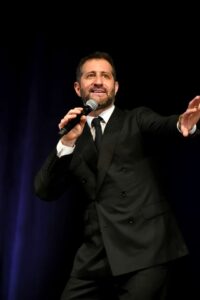
Why do you call the show ‘Pause for Laughter’?
When Oct. 7th happened, we were in Israel. We had just done a tour … and were flying to Paris for shows there. We had to figure out if we’re doing the shows in Paris or not. I realized that I need to be working more than ever now to create that energy and laughter.
The tour is called ‘Pause for Laughter’ because people need that pause between all the news cycles they’re running through and things happening in Israel [and] here in America with the politics.
Some in the media said an article in Variety marked your coming out as gay. Is that true?
I don’t really feel like that. That article came out to the industry but amongst the comedians, my friends, I was always out. My parents always knew I was gay.
I didn’t talk about it on stage because it wasn’t [relevant]. Now I’m married and have a husband. So I talk about having a husband. Comedy is so personalized now.
Has there been any negative reaction from Orthodox audiences?
Believe it or not, no. I still do events for very, very religious organizations. They try to hire me if they can afford it. If not, they just come to a show in the area. I definitely think there has been a shift. There’s still room for improvement, but there’s been a shift of acceptance because [if one’s child is gay] you want them to be a part of your life. And that’s great.
Who are some of your favorite comedians?
Alan King, an old-school comedian, I loved his cadence and timing and pride. Jackie Mason, obviously, for being able to connect to the world, showing the world through Jewish eyes. Don Rickles, George Carlin and many different types of comedians.
At the Lyric, you’ll be performing for a diverse audience.
Yes, it’s not specifically for Jewish audiences. We’ve been getting goyim, gays and others to the shows, and they are all getting it. My favorite thing is when non-Jews bring their Jewish friends, but the Jewish community understands the material more than anybody else.
And you have a podcast?
It’s called ‘And Here’s Modi’ and it’s like the off-stage Modi. It’s with my husband, and we connect to the Jewish community and to all the comedy community — our audience, our friends. Because literally, the fans are just friends that we haven’t met yet.
For information, visit lyricbaltimore.com.

Rabbi David Wolpe looks at the recent interest in Hollywood productions about King David and why the story is resonating now.

Directed by Johanna Gruenhut, the production is based on of the 1998 novel and 2003 film of the same name.
In "The Future is Peace," Aziz Abu Sarah and Maoz Inon say there is still hope for coexistence between Arabs and Jews.
In his new memoir, piano man Marc Shaiman tells a showbiz story shaped by Jewish humor.