
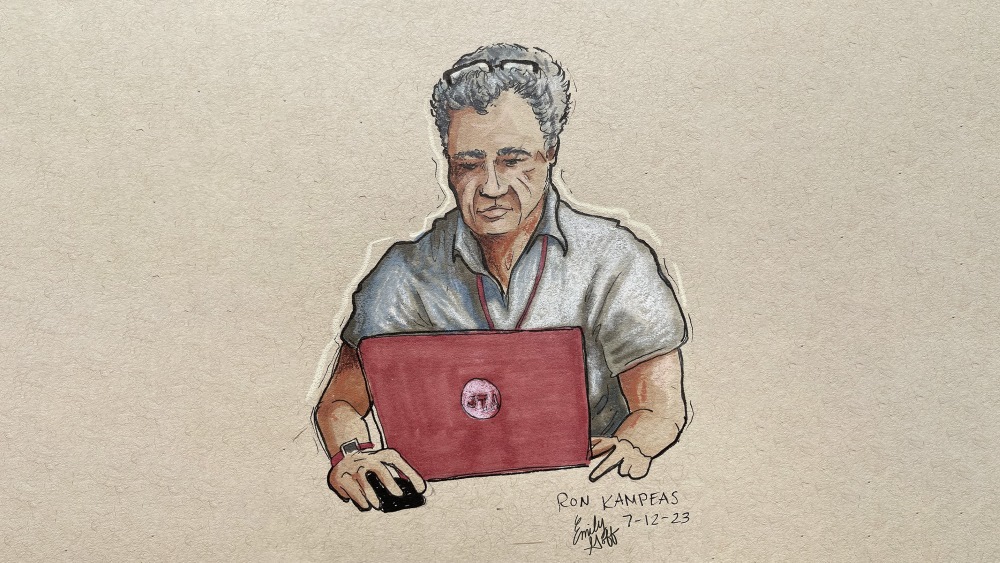
I watched Yitzhak Rabin die on a dot matrix printer on a Saturday night in London.
It was November of 1995, and I was working for The Associated Press. Breaking news about the Israeli prime minister arrived in bursts of urgent updates spit out by clunky printers.
By the time Rabin’s death was confirmed, I had already booked a flight to Israel.
I filed numerous stories during that week, but what lingers most is the story another reporter refused to write. In the midst of the newsroom frenzy, gossip circulated about a reporter, not at the AP, who refused to cover Rabin’s assassination. He filed a report that made no mention of it. Someone called to confront him, and he simply stated it was his choice not to report on the event. Then, he hung up.
His refusal haunted me. At the time, I couldn’t fathom it. Rabin’s murder shattered me — a hero of Israel’s founding, a man who had once shown me kindness, murdered by one of his own. My reflex was to report on the aftermath, as though chronicling Israel’s heartbreak was akin to writing a weather report.
But what if the reporter’s retreat was as valid as my instinct to bear witness?
This tension — to witness or to turn away — has defined my career. It blazed anew for me on Oct. 7, 2023, during the Hamas attack on Israel. I was in Shenandoah National Park in Virginia when I woke to my phone buzzing with anguished texts from family in Israel and an alert from the prime minister’s office: “Israel is at war.”
I was JTA’s only available Hebrew-speaking, non-Shabbat-observant reporter. Packing my laptop, I trudged through the drizzle to the main lodge, where the Wi-Fi was strong.
I have often thought of that reporter who chose not to cover Rabin’s assassination and wondered, when does the privilege of bearing first witness become a burden too great to bear? But how can I as a Jewish journalist turn away from history’s call?
Jewish reporters occupy a unique space. Our history demands that we chronicle unimaginable horrors, yet the act of bearing witness exacts a heavy toll. This tension is as ancient as our people.
Today, Jewish reporters must continue to bear witness to the unbearable. In January, I received an Israeli army alert naming a fallen soldier: Amichai Oster, the son of my former colleague Marcy, with whom I had worked for years at JTA.
Amichai had stayed with us over the summer. On the news source Ynet, Marcy described why reciting Hallel, the liturgy of praise, had become impossible for her. “Right now the words get stuck in my throat,” she wrote. Her resilience inspires me.
The impulse to step back from Jewish tragedy is not new. Daniel Schorr, one of JTA’s most famous alumni, left in 1941, weary of reporting on the Holocaust’s unfolding horrors. Schorr’s frustration resonates. Jewish media walk a fine line between preparing readers for harsh realities and preserving their morale.
Despite the challenges, I have found meaning in reporting Jewish stories. There is sweetness in tracking the acceptance of Jewish thought in American politics or chronicling cultural icons like Bob Dylan and Leonard Cohen. Yet the deeper resonance comes from grappling with the hard stories: the AIPAC espionage case, the Pittsburgh synagogue shooting, the Charlottesville march, and the perpetual reckoning with antisemitism.
In these moments, I have seen the profound impact of Jewish identity on decision-making. Bethany Mandel’s resilience after her conversion rabbi filmed her and more than 150 others in the mikveh; Laura Moser’s decision to move her family to Berlin after encountering pervasive antisemitism in her congressional campaign and Jake Tapper’s public invocation of biblical commandments during Donald Trump’s impeachment hearings — these stories highlight the strength and complexity of Jewish life.
As I step away from daily reporting, I carry these stories with me. The burden of bearing witness is immense, but the privilege is equally profound. To chronicle Jewish history is to be part of an ancient continuum. Despite the pain, despite the doubt, I have always chosen to bear witness.
Now, as I step off the beat that has defined my career and into retirement, I am reassured that my colleagues will continue to make that choice, however difficult it may be at times. For how could we not? 
Ron Kampeas served as the Washington bureau chief for the JTA global Jewish news sources for more than two decades until his retirement at the end of 2024.
The story is now coming out about three Jewish refugees from Nazi Germany who built Iceland’s classical music scene from scratch.

The Orioles this season have proven that money can't buy happiness, writes Michael Olesker.

The history of Jewish Barcelona is fascinating and complex, and a tour of the Jewish Quarter offers a glimpse into the city’s tragic past.

A recent experience reminded Editor-in-chief Alan Feiler of why we cannot allow the antisemites to make us cower and hide.