
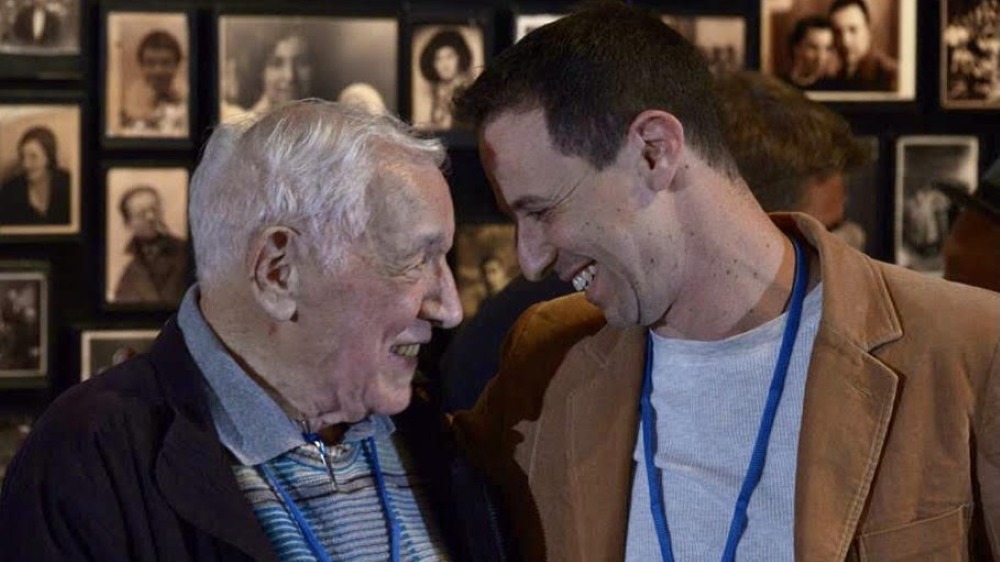
Can music help you overcome any hardship or obstacle in life? That question lies at the heart of “How Saba Kept Singing.”
This Thursday, May 8, at 6:45 p.m., the award-winning documentary will be screened at Third Space at Shaarei Tfiloh, at 2001 Liberty Heights Avenue.
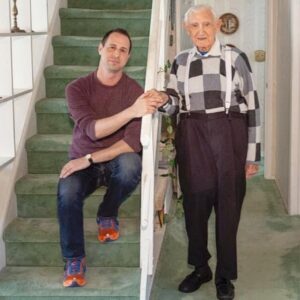
The film shares the story of the late Cantor David S. Wisnia, a Holocaust survivor and military veteran who spent his later years traveling and performing with his grandson and musical accompanist, Avi Wisnia. In his appearances, the Polish-born Cantor Wisnia, who passed away in 2021 at age 94, spoke about how he survived through the transcendent power of music.
This film is directed by Sara Taksler and executive-produced by Hillary Rodham Clinton and Chelsea Clinton. Both Taksler and Avi Wisnia will speak after the screening.
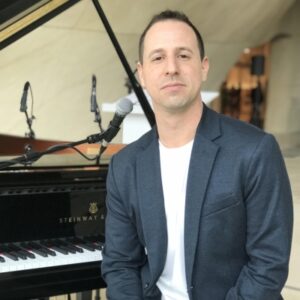
Jmore recently spoke with Wisnia, an award-winning singer, songwriter, storyteller and educator based in Philadelphia.
How did this documentary come about?
This documentary became a reality because of the vision of director Sara Taksler. Sara attended the New Jersey synagogue where my father was rabbi for many years. We grew up together. Our families knew each other well. She knew my grandfather, Cantor David Wisnia, as I did — as “Saba.”
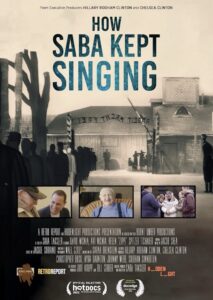
I reconnected with Sara many years later in New York where she had become a TV producer and filmmaker, while I was studying music at NYU. When my grandfather and I began doing concerts together, using music to help tell his story of survival, Sara came to one of those events in Manhattan and approached us, asking if Saba’s story could be her next project.
Though my grandfather had long held in the details of his past, he had more recently become comfortable sharing his story with a wider audience, and now he was ready for the world to hear it. It was soon after we started filming some interviews that we got invited to attend the 2020 ceremony commemorating International Holocaust Remembrance Day, taking a film crew with us to Poland, where most of the present-day footage of the documentary takes place.
Sara coordinated some incredible producing partners in Hillary and Chelsea Clinton to make it a feature length production. And since its premiere on PBS, it has only garnered more attention.
What is the overarching message of “How Saba Kept Singing”?
For a long time, I believed my grandfather survived through the Holocaust by using his beautiful singing voice to entertain his Nazi guards while a prisoner in Auschwitz. And while this was certainly true, it was only a part of the whole story. Through the film, you discover the many other people — and one person in particular — instrumental in saving his life, again and again, in so many different ways. Hearing his story constantly reminds me that none of us can survive this world alone, especially in our most troubling times. We need each other, we rely on each other, and we are in fact responsible for one another.
What was the key to your grandfather’s resilience and perseverance?
My saba was always a lover of life. I don’t know if he was always that way, or if living through the Holocaust brought him that appreciation. But he always found the most joy in making music. I think one of the ways he was able to survive and keep going was by singing. Music kept him connected to his roots, and it helped him envision a future beyond the barbed wire.
How did he not fall prey to anger and despair?
I know my grandfather always carried with him a certain amount of darkness and sadness, things he mostly kept for himself. He did his best not to share it with the family, he tried to protect us from that pain. But I also remember my grandfather telling me there was something motivating him to make it through, day by day, minute by minute. He had this drive to outlive the Nazis, to know that in the end their prejudice and hate would not win. Throughout the film you also see how along the way, there were always certain individuals who helped him remember the good in people, and that there was something worth living for.
In light of his passing, is it sometimes difficult for you to watch the film?
Yes, absolutely, it is always difficult and emotional to watch this film. He was my buddy, and I miss him every day. But I feel really honored that I get to introduce my saba to a new audience every time his face comes on the screen.
Every audience makes such a deep connection to my grandfather — through his emotional singing style and also through his humorous one-liners. They really get to know him and love him as I did. In a beautiful way, this keeps him alive. David Wisnia’s story continues to impact people in a profound way that resonates well beyond our family, and for that I’m very grateful.
Can you share a personal anecdote that captures the essence of your grandfather?
My grandfather was always joking and laughing. He had a wide, infectious smile, and loved to entertain. Strangers at the airport became new travel companions; strangers on a train became new best friends. And of course, he was always singing.
When we would go out for lunch to his favorite kosher deli, he would sing his order to the waitress. In one of five languages, you never knew which one. He was certainly a character.
What was “SabaFest”?
“SabaFest” was our annual Wisnia family gathering, with all of Saba’s children and grandchildren, and sometimes with our extended Wisnia cousins, too. It happened towards the end of summer overlapping with my grandfather’s birthday, so we really made sure he was the center of attention. We even had T-shirts made. In fact, there was one year we had just discovered that he had lied about his age so many years ago while a prisoner in Auschwitz, so we had to celebrate his 83rd birthday three years in a row to catch him up to his actual age.
Why was music always such a crucial part of his life and identity?
David was a child singing star in Poland and a unique talent in his family. From a young age, his father recognized and nurtured this talent, and he was constantly performing on concert stages and on Polish radio. He was trained by very famous cantors at the grand synagogues of Warsaw.
I think performing was always a part of his personality, so the fact that music is the through-line of his life is no surprise. Music gave him purpose as a young boy, music sustained him through the concentration camp, and music reconnected him with community after the war.
I actually think music was an incredible tool for him to begin to open up about the very difficult experiences he had during the Holocaust. Music helps us express things we may not be able to articulate in words, and that was certainly true with my grandfather’s singing. His voice was always full of emotion and heart-ache and passion.
Over the years, as he taught me songs from his childhood, it opened a door for us to also discuss some of the stories of his past he had hidden away. Music was like a window into what he was feeling, even if he was not ready to talk about it.
How did his love of music inform your own career as a singer-songwriter?
I saw how at ease he was in front of a crowd, and how his voice alone could command and create these transcendent communal experiences. It made me realize the power of music to convey emotion and story, and how music can also be used to bring people together. He certainly transferred his joy of performing onto me, and now when I’m performing my own concerts, I try to channel that energy into everything I do on stage.
What was it like to perform with your grandfather?
When I first started making music and touring as a musician, I got very used to going on the road. But I never could have anticipated I would be doing it with my 90-year-old grandfather. We shared a special bond through music and spent a lot of time together, performing in cities all over the U.S. and talking over so many cups of coffee on the road.
It also gave me a chance to ask him a lot of questions, and I think we learned a lot from each other. I certainly got to know him as a person, and not just as my grandfather. My grandfather lived a long time, so I’m very fortunate that I got to spend so much time with him. I will cherish those memories forever.
What was it like to accompany him to Poland?
Returning to Poland with my grandfather was one of the most impactful and life-changing trips I have ever taken. I also love that as a viewer of this film, you can follow our journey as we trace his footsteps from his childhood home outside Warsaw to the very grounds of Auschwitz itself. And you also see us process all those emotions in real time.
I was very protective of him and what he was going through on that trip, and yet I was also having my own very emotional experience. For instance, when you are at the site of the concentration camp — you are so used to seeing it in black-and-white. But in real life, the grass is green, the sky is blue, on a clear day there can be a gorgeous sunset over the barracks of Birkenau while the birds are singing — it is very unsettling and upsetting. It makes it very real, and drives home how this is just a place like any other, that something as horrible as this can happen anywhere.
How do you think your saba would feel about the current political climate?
I try to be very considerate and intentional not to speak for him unless it is something I have heard him say. I can only speak for myself, and what I have learned from him — how knowing his story has dramatically shaped my life and how I see the world around me, how I apply it to the present day and to what we are all currently living through here and around the world.
My grandfather saw war from all sides: he was an immigrant, a refugee, a prisoner and a liberator. I know he was so grateful to come to this country, because this country opened its arms to him and gave him a chance at a new life. Not everyone was so lucky. Not only did he love the promise of the United States, but he also had fresh memories of how quickly a seemingly well-educated and modern country could slide backwards, how quickly things could crumble.
I learn from my grandfather’s experience how important it is to speak up and push back because things can always get worse, especially when those in power are convincing you that the only way forward is to turn on your neighbors. I think of my family’s history and how immigration is not something to fear, but something to be embraced as intrinsic to the fabric of our society. A well-functioning compassionate society means tending to your community every day, embracing diversity, and modeling the behavior you want to see in others.
What do you hope your Baltimore audience learns about your grandfather?
My grandfather was a pretty remarkable guy. He was extremely special, but also extremely ordinary. He had hopes and dreams, friends and family, passions and flaws. The Nazis tried to take away his humanity — they even took away his name and replaced it with a number, tattooed on his arm.
But this film gives him back his story, and you get to know David Wisnia as a human being. That he experienced all these things, so many tragedies and triumphs, gives you a greater understanding of the Holocaust itself, the scope and scale of it. It is so important to know a story of survival like his, for when you hear from a witness, you become a witness.
Any future plans?
I’m looking forward to spending some time writing songs and putting out new original music in the coming year. I’ve also been deeply inspired by my recent time on the road and travels with the documentary. I plan to continue working on preserving more of my grandfather’s music through video and recording projects, to help ensure his musical legacy continues.
Through all of it, I will continue to share my grandfather’s story, and I will continue performing and making music. As Saba says in the film, “Music is life. You’re supposed to sing … no matter what.” That’s what I plan to do. I’m going to keep on singing.
For information, visit thirdspacest.org/event_categories/arts-culture/.
Schools in Montgomery County have recently experienced a wave of antisemitic incidents.
CCBC Honors scholars are discovering a level of academic rigor and opportunity typically associated with elite four-year institutions.
Filmmaker Justin Schein looks at wealth and inequality through the very real story of his late father.

This year’s Community Block Party at the JCC of Greater Baltimore will feature classic cars, giant inflatables, games, a rock-climbing wall and roller skating rink, and strolling entertainers.