
Jordan or LeBron? Beatles or Stones? Brando or De Niro? Lincoln or FDR? “The Babe” or “The Georgia Peach”?
Americans seem to immerse themselves in endless loops of discourse about who is the greatest of all time – the “G.O.A.T.,” if you will — whether the topic is sports, medicine, entertainment or even municipalities. (Go no further than the weathered public benches that still can be spotted around Charm City emblazoned with the slogan, “Baltimore – The Greatest City in America.”)
Why are we so fixated with the concept of greatness? What does is it say about American exceptionalism, the belief that the United States is different, and arguably greater, than other nations?
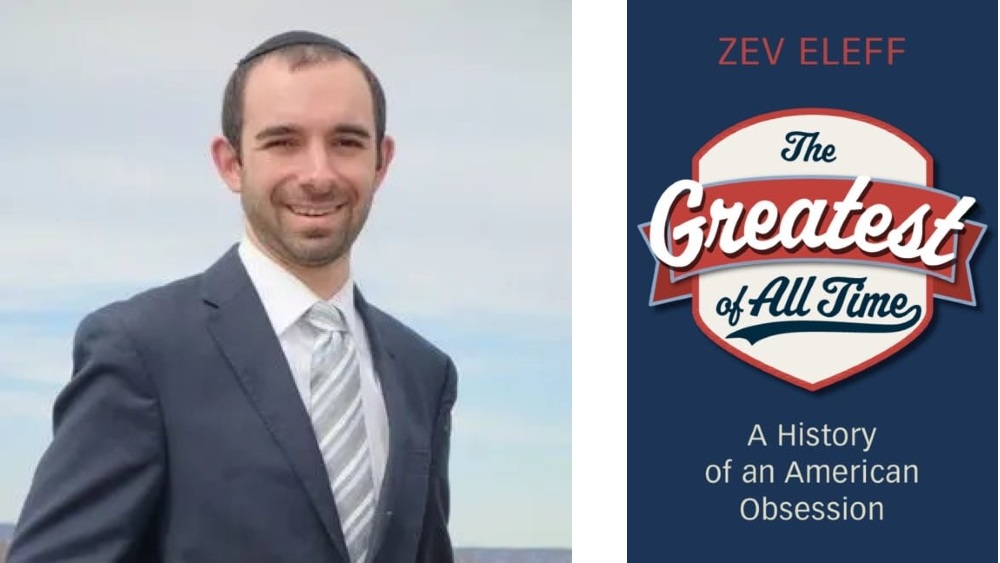
That’s what Dr. Zev Eleff set out to find out when writing his latest book, “The Greatest of All Time: A History of an American Obsession” (Cambridge University Press).
Eleff, who is president of Gratz College in Melrose Park, Pennsylvania, grew up in Baltimore and is a graduate of the now-defunct Yeshivat Rambam Maimonides Academy, of which his parents were among the co-founders.
After studying in Israel, Eleff, 39, received his rabbinical ordination from Yeshiva University, master’s degree at Columbia University and doctorate in American Jewish history at Brandeis University.
Jmore recently caught up with Eleff, the author or editor of 13 other books, to discuss “The Greatest of All Time.”
Would you say your book is the greatest of all time about this particular topic?
There are so many books about ranking who is the greatest in a particular category – singers, economists, Jews, Italians, etc. You name it. But I’m not aware of any other book like this one. This book strives to change the conversation about greatness.
America has always been about the Horatio Alger [rags-to-riches] concept of greatness, which is something viewed as silly, even foolish, to most Europeans. People are uncomfortable about it. This book tries to go to the balcony and above the debates and asks what is happening when we say so-and-so is the greatest. It’s a fascinating slice of American culture.
What was the genesis of this book?
My previous book [2023’s “Dyed in Crimson: Football, Faith, and Remaking Harvard’s America”] was about Harvard University and antisemitism in the 1920s. In my research, I found Jim Thorpe describing Eddie Mahan as the greatest football player of all time. I realized that who we dub as “great” changes over time, and that got me thinking. This book features a lot of well-known people, but I found that none of the other books out there about them really chronicled their trajectory of greatness. I felt I was onto something.
This is not a Jewish book, although I talk in it about Einstein and Henry Ford’s antisemitism. As a scholar, you’re always trying to find new knowledge. So I went through every database and typed in greatness. I let the stories bubble up and landed with these stories. But this book is not exhaustive. There are many other chapters that could have been written.
Are Americans particularly obsessed with greatness?
I mention in my introduction that the History Channel had a “greatest of all time” series hosted by [football legend] Payton Manning that was popular here, but similar shows flopped in England and France. I also write about when Pele met Richard Nixon in 1973 and didn’t know how to respond when he called him “the greatest in the world.” There’s just something about America and greatness that is different.
When did this American infatuation with greatness start?
Well, in my book I trace it back to the [1901] creation of the Hall of Fame for Great Americans [in the Bronx, New York]. But after World War II and in the middle of the Cold War, that’s when there was a lot of ammunition to call America the greatest country in the world. Before that, America was looked at as more about experiment and change. But after the war, greatness became more about your past accomplishments than auguring change.
In the middle of the 20th century, greatness became part of the warfare in the Cold War. Greatness became a corrective.
Does the perception of what or who is great change over the course of time?
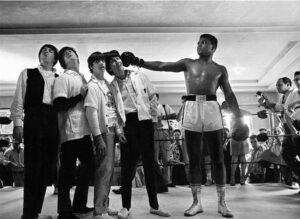
Yes, the metrics of greatness change over time, sometimes because of nostalgia and our own sensibilities. My book explores how politics played a role in how we now view Muhammad Ali and Babe Ruth as great. People years ago thought of Ty Cobb as the greatest baseball player of all time, but his racist attitudes prevent that from happening today. Let’s also remember that “the Greatest Generation” wasn’t called that until Tom Brokaw used that term in the 1990s.
In addition, visual images play a part, whether it be older photographs or on YouTube. When you think of Ali standing over his opponent [Sonny Liston in 1964], people remember that image, whether they were there or not. I can still remember exactly where I was in Baltimore [on Sept. 19, 1998] when Cal Ripken Jr. [broke Lou Gehrig’s consecutive games record]. These magical moments keep us frozen in time. They’re almost embedded in our DNA.
Why must we constantly strive for greatness or call something great?
Part of it is about tradition, and we cling to it. We all want to be part of greatness. It makes us comfortable.
Is greatness actually a myth?
It’s not a myth so much as a shared experience. We’re inspired by greatness, so it’s a meaningful myth. It’s a shared legacy and experience. It’s part of our language that Americans embrace, and part of our values.
How does Judaism view the concept of greatness?
Well, the rabbis were always concentrating on greatness and rankings. Who is greater than whom. Even in the yeshivas today, they’re focused on greatness – gadolim means great ones.
In the Torah, we read that Moses wanted to pass on the mantle [of leadership] to his children but God said no, he wanted Joshua because of his greatness. So it’s part of our heritage and language as well.
Who do you think was the greatest Jew of all time?
On theological grounds, I would say Moses. But Einstein was commonly referred to in the 1930s as the greatest Jew since Jesus.
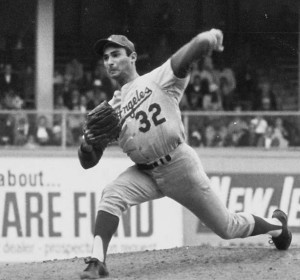
And then there’s Sandy Koufax. In 1965, Koufax refused to pitch on Yom Kippur [during the World Series]. Nobody paid much attention to this in the contemporary press, because there were other reasons regarding the decision for him not to pitch that day. But it became more well known in the Jewish community in the 1970s and onward, and now Koufax is remembered as one of the greatest Jews of all time, and not necessarily the greatest pitcher. So it’s seen through the lens of Yom Kippur and not his Cy Young Awards. A lot of times, greatness centers on personal matters.
So greatness is largely not measured by accomplishments but personal values and traits?
There’s an idea of working hard and making it and standing for ideals. Greatness is a coded language for our values. Look at “The Oriole Way.” That’s something that transcends baseball. “The Oriole Way” is about doing things the right way.
Who is your intended readership with this book?
I tried to write it in a popular, accessible way, so I’m hopeful that it will get widely read and will resonate with a lot of people.
What is your feeling about the contemporary usage of the term “G.O.A.T.”?
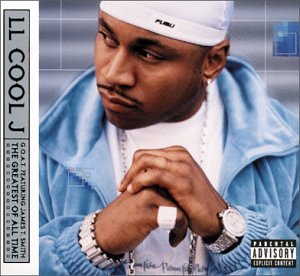
It’s a term that was trademarked by Ali in the early ‘90s and popularized by LL Cool J [with his 2000 album, “G.O.A.T.”]. It’s a form of shorthand and a playful acronym that adds another layer to the conversation. It’s a shortcut.
Lily Tomlin famously once said, “Sometimes I worry about being a success in a mediocre world.” Why are we so disdainful about being ordinary and unremarkable?
We’re very scared of mediocrity, and we’ll bend over backwards to avoid it. We all simply want to be great. We’re all very isolated from each other these days. Greatness has a way of connecting us.
Did Donald Trump and the MAGA movement take the concept of greatness to a new level?
It’s not just Trump. Every president since Jimmy Carter has called America the greatest country in the world. Reagan and Clinton also used similar language.
But from a public relations perspective, [Make America Great Again] was a stroke of genius. People want to be great, and it says what we have now is not great. It was a rallying cry to be part of greatness. Whatever you think of [Trump], he seized on this and intuited voters. He understood that people want to be associated with greatness and talk about greatness. He developed a connection with his voters and mobilized his base that way.
Speaking of Jimmy Carter, isn’t he unique in that he didn’t become associated with greatness until after his presidency?
He was a one-term president, but [his image was] resuscitated not for his work as president but afterward. He became a meaningful personality for certain causes and social agendas. He became more useful as a humanitarian. That’s how he attained greatness.
What kind of reaction have you received to your book so far?
People like the book. So far, it’s inspired a lot of conversation. It’s not a dictionary of who I think is great. I’m hopeful that I’m giving readers the tools to think and talk about greatness in a new light.

Led by local Israel-American cellist Amit Peled, the Mount Vernon Virtuosi aims to inspire people beyond musical enjoyment.

A former college campus activist, Veksler will speak at Chizuk Amuno on June 8 at the Ruth and Jay Lenrow Visiting Scholar-in-Residence for Combating Antisemitism.

Container vegetable gardening is a terrific option for people with limited space and/or time. Rebecca Brown and Norman Cohen share some tips.

Schools in Montgomery County have recently experienced a wave of antisemitic incidents.