

During a recent press conference about deploying the National Guard on the streets of the nation’s capital, President Donald Trump characterized Baltimore and other cities as “so far gone.”
But Zeke Cohen would strongly beg to disagree. In fact, he would argue that Baltimore is in the midst of yet another renaissance.
A native of Northampton, Massachusetts, and grandson of Holocaust survivors, Cohen has served as president of the Baltimore City Council since last December. A Democrat, he previously represented the 1st District in the City Council from 2016 to 2024.
A graduate of Goucher College, Cohen, 40, earned a master’s degree in public policy from Johns Hopkins University. Besides teaching middle school social studies, he has worked as an entrepreneur and founded The Intersection, a nonprofit afterschool program for city youth.
Jmore recently caught up with Cohen, who lives in Southeast Baltimore’s Brewers Hill neighborhood with his wife, Dr. Reena Ardeshna, and their two children, Maya and Elias.
Last month, U.S. News & World Report listed Baltimore as fourth among the nation’s most dangerous cities. Why do you think that is?
Sometimes, these lists can be arbitrary. The reality is the first six months of this year, we saw fewer homicides than we’ve ever seen in the history of Baltimore since we started recording homicides. We are also seeing persistent drops in non-fatal shootings and a decline in almost every category of violent crime.
By the numbers, Baltimore is a much safer city than it was five or certainly 10 years ago. We still have a long way to go. My goal is to make Baltimore the safest city in the United States of America. Right now, we have strong leadership in our police department with Commissioner Rich Worley. We have a great state’s attorney in Ivan Bates. We have a mayor, Brandon Scott, who has been tremendous with his anti-violence strategy and going after homicides through the group violence reduction strategy.
And we have a great City Council that I’m serving with. So there are a lot of positive signs in public safety.
Do you see other positive signs about Baltimore’s future?
We have a vibrant arts and culture scene with some amazing talent, both growing up in Baltimore and coming here to perform. Think about Center Stage, CFG Bank Arena, the Baltimore Symphony Orchestra and the Hippodrome. Our cultural institutions are really knocking it out of the park.
I think the Baltimore food scene is having a real renaissance with a high level of creativity and energy in the restaurants. And it’s affordable.
Why does Baltimore still suffer from image problems?
One of the things we need to work on is perception. We need to do a better job of telling our story.
What progress is being made to decrease the use of fentanyl and other illegal drugs in Baltimore?
Baltimore has had an enormous issue with opioids. We have experienced the most deaths from overdose per capita of any city in America.
However, we are seeing a real strategy to reduce overdose deaths and fentanyl distribution in our city that is starting to bear fruit. We are fortunate that our mayor and city solicitor [Ebony Thompson] decided to sue a number of pharmaceutical companies, and we received over $400 million from those lawsuits. For the first time in a very long time, we have the financial resources and the political will to really go after this opioid crisis from a public health and public safety lens.
This is a disease that touches many families, mine included. We know that addiction is really hard to cure. We want to be sure we are bringing best in class solutions and be at the forefront of innovation. Baltimore is blessed with some of the best hospitals in the world and some of the best public health institutions.
Many people who experience addiction have a lot of trauma, and they are using drugs to cope with that trauma. So we’ve been training every city agency in trauma-informed care based on the Elijah Cummings Healing City Act. It made Baltimore the first city in the country to address trauma through legislation.
What about the epidemic of vacant and dilapidated properties across the city?
The mayor, the governor [Wes Moore] and the City Council have embarked on an aggressive plan to revitalize vacant properties across the city. The goal is to have 5,000 properties fully renovated or demolished within the next five years.
We are receiving $250 million per year from the State of Maryland to go after this problem. The City Council has been working on legislation to create a citywide tax increment financing project enabling us to renovate vacant homes. We’ve seen some real success in neighborhoods like Johnston Square [in East Baltimore]. It went from having a very high vacancy rate to a significant reduction in vacant homes. As a result, the neighborhood is thriving.
There’s another part of government that needs to be able to work better, things like permitting that take too long for a developer, homeowner, nonprofit or business to pull a permit. This kind of nuts-and-bolts, ground-level government efficiency is really important to me as City Council president.
What can the City Council do about potential cuts to Social Security?
Baltimore is the primary economic driver of the State of Maryland, so we in the City Council have taken a stand to reaffirm Baltimore’s commitment to protect the Social Security system [and] to not close offices related to Social Security. To stand with the people who have earned Social Security benefits over their life.
There’s not a ton that we can do about federal buildings being closed. But we passed a resolution to signal federal stakeholders that we support vital programs like Social Security, to allow people who’ve worked their entire lives to retire with dignity.
How is the Trump administration’s immigration crackdown impacting Baltimore?
Some of the ICE raids, particularly in East Baltimore, have ICE agents wearing masks and creating chaos. We are committed to following all federal laws. But Baltimore is a welcoming city. As the grandson of refugees and as someone who represented a district with a large immigrant population, I know that immigrants add enormous vitality to the city.
Folks come here from Greece, Italy, Ukraine, and Central and South America. It is a wonderful thing when I walk up and down Eastern Avenue and go to an Italian deli or a taco shop. I am incredibly grateful that my daughter goes to school in Baltimore and hears different languages being spoken by her classmates.
Baltimore understands that the immigration system needs to be fixed in Washington, D.C. But Baltimore also knows that, on aggregate, immigrants commit fewer crimes than non-immigrants. And there’s an entrepreneurial spirit among immigrants. So we’re going to continue to support all of the communities in our city.
Now, folks who have committed crimes, particularly violent crimes, I have no empathy for them. You cannot come to our city and cause trouble. But for anyone who just wants to live and grow up and start a family, Baltimore is a great place.
What about antisemitism in city schools?
The Anti-Defamation League [recently] filed a lawsuit with the Department of Education against Baltimore City schools. Some of the allegations that they document are extremely disturbing, including a teacher saying to their students, ‘I’m going to go full Nazi on you.’
I am the first Jewish person to get elected City Council president or mayor in the last 40 years. I am raising two Jewish kids and sending them to Baltimore City public schools. So for me, there can be no tolerance for antisemitism. There also can be no tolerance for racism, Islamophobia or any other forms of bias within our schools. Reading this report by the Anti-Defamation League was really concerning and disturbing.
But what I’ve seen in Baltimore is that we take care of each other. We are a multi-ethnic, multi-racial city. I remember a few years back when there were swastikas drawn in my district and at a Jewish graveyard in Dundalk. Communities rallied to say this is unacceptable. A huge group of people of all faiths — Jewish, Muslim, Christian, Black, White, Hispanic and Asian — all came together at that cemetery.
As a city and country, we have some serious challenges with antisemitism and other forms of hate and bias. But I believe that in Baltimore, we are going to make our schools and all of our institutions safe for Jewish people and for all people
What recent improvements in Baltimore are you encouraged by?
I’m proud of the precipitous decline in murders and other violent crime. We have been a city marked by violence, and we are seeing some true statistical improvements in public safety.
I’m really proud of my colleagues on the Baltimore City Council. For the most part we are working collaboratively and cohesively. We are making real progress on issues that matter to Baltimoreans. For example, we’ve been pushing very hard to improve the utility rates that BGE has been charging.
I’m really proud of the vibrancy of our city right now. People are starting to understand that Baltimore is one of the best cities in the world that is still affordable. Baltimore is rich in history, is proximate to everywhere on the East Coast, has a beautiful waterfront, incredible arts and culture, and amazing food.
Most importantly, Baltimore has great people. Our neighborhoods are unique, vibrant, diverse and culturally rich. I’m proud of how Baltimoreans from all over the city are working together to build toward the renaissance that we all know we deserve.
Peter Arnold is a local freelance writer.
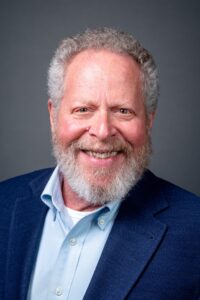
Schwab currently serves as president of Cumberland's historic B'er Chayim Congregation.
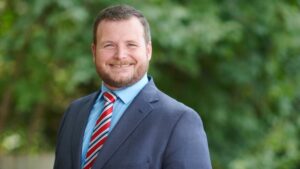
A former U. S. Marine, Pat Young has served as a Baltimore County Council member representing District 1 since 2022.
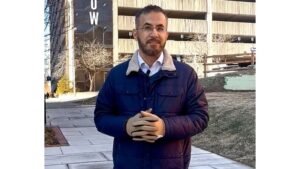
Mansoor Shams is known for carrying around a sign proclaiming, “I’m a Muslim and a U.S. Marine. Ask anything.” Now the Baltimore County Department of Recreation and Parks community engagement and outreach officer is running for Baltimore County Executive.
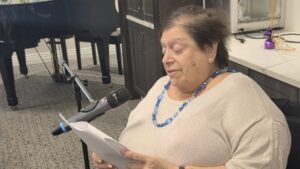
Baltimore native Susan Landsman recently celebrated her rite of passage surrounded by family, friends, fellow residents and staff.