

Sarah Hurwitz wants Jews to reinvent themselves by taking back their narrative and birthright.
In her new book “As A Jew: Reclaiming Our Story from Those Who Blame, Shame and Try to Erase Us” (HarperOne), Hurwitz, a former speechwriter for President Barack Obama and First Lady Michelle Obama, argues that American Jews need to refamiliarize themselves with Jewish history, tradition and beliefs while living as Jews without apologies.
Jmore recently sat down with Hurwitz, a native of Wayland, Massachusetts, who lives in Washington, D.C., before her talk on last Monday night, Sept. 15, at The Soul Center in Pikesville.
What do you hope readers take away from ‘As a Jew’?
I hope to show American Jews the ways in which our Jewish identity has been infiltrated and, in many ways, warped by millennia of anti-Judaism and antisemitism, and by a couple of centuries of our really well-intentioned attempts to escape persecution by assimilating, by leaving behind parts of our tradition to be safe and accepted.
I want them to begin to understand those layers within them and be able to strip away those layers of shame, of internalized self-hatred, and really embrace Jewish tradition on Jewish terms.
I spent thousands of hours learning about Judaism and I know people just don’t have that time. I seek with my books to distill things into really accessible but substantive texts that people can engage with.
Any early feedback?
People across the political spectrum have said they like this book. I haven’t heard from anyone on the real extremes, but certainly people who are pretty solidly on different sides of the political spectrum have liked the book and felt this is important. To see people with diverse perspectives and backgrounds feeling like this book spoke to them, that was really important to me.
In the past, you’ve written about keeping a distance from Judaism and then falling in love with it. What flipped the switch?
I grew up, like a lot of American Jews, where Judaism was three boring holidays and one fun one, and two texts — the prayer book I held in my hand and the Torah at the front of the synagogue.
And a few universalist values, like be kind to those in need; don’t lie, cheat and steal. That wasn’t particularly compelling to me, so I kind of walked away.
But at the age of 36, I happened to hear about an intro to Judaism class at the local Jewish community center and decided to take the class to fill some time. And I was just blown away by what I found — 4,000 years of wisdom about what it means to be human that I felt was tremendously profound.
You write that Judaism isn’t just a religion.
This idea that Judaism is just a religion is simply not true. We can reject every element of Jewish religion and declare ourselves atheists, and we’re still Jews. Regardless of whether you practice or engage with the religious/the halacha [Jewish law] aspects of it, if you were born to Jewish parents or if you converted to Judaism, you’re a Jew.
We’re certainly not just an ethnicity either. Jews are of just about every ethnicity, every race. There are a lot of languages that describe us, but we kind of predate a lot of the words people use to categorize each other in modern times. I think it’s not just a religion or an ethnicity. It is very much a peoplehood, a tribe, a civilization.
How did your years of crafting words for the Obamas help shape your voice in this book?
I learned so much about writing from Michelle Obama. She was someone who knows who she is, what she wants to say and was always asking herself, ‘What is really true here?’ She just had such a meticulous sense of structure, transitions, of what language is fresh and moving and really touches your heart … and what does not. I had to rise to meet that standard, and it taught me a lot about how to reach people and how to write well.
One of the reasons I loved writing for Mrs. Obama so much is in some ways we shared a similar sensibility about what makes good writing and speaking. We both tend to be more on the personal, emotional side, to be drawn more to speaking about values and telling stories than stats and numbers and policies.
What was it like being Jewish in the Obama White House?
One of my favorite memories was the first Chanukah party I ever attended at the White House. You had hundreds of Jews packed into the East Wing. Everyone was so excited to be there and so joyful. At one point, out of nowhere, someone started singing ‘Ma’oz Tzur,’ ‘Rock of Ages,’ in Hebrew. And everyone joined in, hundreds of Jews singing in Hebrew in the East Wing of the White House. I thought not only could my grandparents not have imagined this, my parents could not have imagined this.
The Obama White House was such a supportive place to start my Jewish journey because my colleagues were so supportive and excited for me.
Are you optimistic about the Jewish community today?
There’s an incredible renaissance going on in the Jewish community. There are so many organizations and individuals and writers and thinkers and organizers and CEOs who, for decades, have been doing this incredible project of reclaiming Jewish tradition for Jews of all backgrounds.
There’s just so many ways to engage powerfully with our tradition and live it out and express it. I want to urge Jews to reclaim our tradition because I so strongly believe we still have something to say to the world. Judaism’s countercultural, profound, transformative wisdom is so needed by the world today.
Anna Lippe is a Washington, D.C.-based freelance writer.

Pikesville resident and entrepreneur Luna Rosendorff discusses what she's seeing these days in the world of contemporary interior design.
Jewish Community Services' upcoming "Future-Ready Workplace" event will feature a keynote address from workplace expert and bestselling author Liz Fosslien.
The BCO, founded in 1984, will perform the works of Frank Zappa, Beethoven, Mason Bates and Karena Ingram.
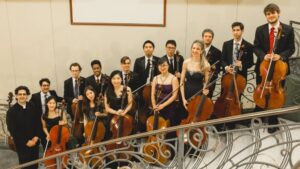
Led by local Israel-American cellist Amit Peled, the Mount Vernon Virtuosi aims to inspire people beyond musical enjoyment.