
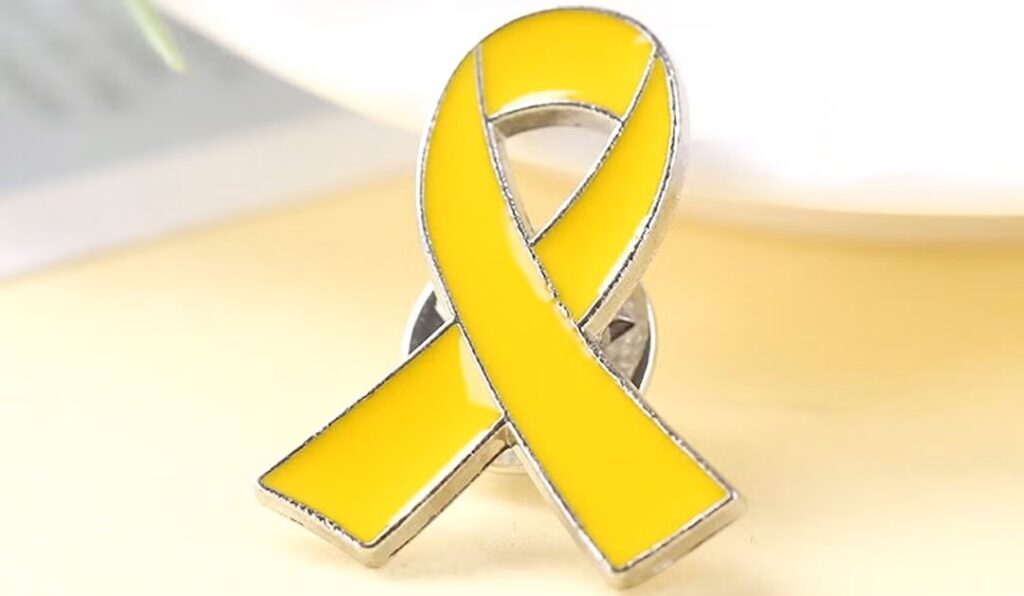
Last Sunday, Rabbi Hanna Yerushalmi, an Annapolis-based licensed couples therapist and published poet, shared a poem on social media titled “Yellow Again.”
The piece imagined a near future in which hope will transform the grief and remembrance associated with the tragedy of Oct. 7, 2023. In part, it read:
Empty chairs will be
saved for friends arriving late,
and tape will be
tape again,
and hostage necklaces
will be put away, forgotten in drawers.
and Saturday night will be date night once again.
This week, with the last 20 living hostages returned to Israel as part of a ceasefire deal between Jewish state and Hamas, many Jews were relieved to be ending these rituals, while questioning whether it is right to do so and how to channel their prayers and practices toward whatever comes next.
Twenty-four deceased hostages are still believed to be in Gaza, and even as soldiers return home and Gazans reclaim what’s left of their former lives, an enduring peace seems remote.
Like most synagogues, Congregation Beth El in South Orange, New Jersey, added new rituals after the Oct. 7 attacks that killed 1,200 in Israel, saw another 251 taken hostage, and launched a grinding war between Israel and Hamas.
The Conservative congregation hung a “Bring Them Home Now” sign out front on behalf of the hostages. Rabbi Jesse Olitzky added the “Acheinu” prayer for redeeming captives to the weekly Shabbat service, and each week read the biography of a hostage.
There and elsewhere, congregants wore yellow hostage ribbons and pins on their lapels, and dog tags with the names of the missing. Some families lit extra candles on Shabbat.
Rachel Goldberg-Polin, whose son Hersh would eventually be listed among the dead in Gaza, popularized the wearing of a piece of masking tape on which she wrote the number of days since the hostages were taken.
At Beth El, the Acheinu and lawn sign will stay in place until the bodies are returned. In the meantime, Tuesday night’s celebration of Simchat Torah will be a chance to experience a sense of relief members haven’t felt in two years.
“Like so many, we haven’t been able as a people to move forward and get to Oct. 8 until the hostages came home,” Rabbi Olitzky said. “And now there is a sense of being able to exhale and breathe and, God willing, to move forward, to rebuild, and for all Israeli citizens and for Palestinians to have opportunities to build peace.”
Rabbi Yael Ridberg, the recently retired spiritual leader of Congregation Dor Hadash in San Diego, said she would remove the yellow ribbon and dog tag she wears only when the bodies of the deceased hostages are returned.
“I look forward to tucking them away, but not disposing of them,” she wrote. “I will stop wearing them when all the deceased hostages are returned. These are keepsakes of a time worth remembering, as hard as it has been for the last two years.”
Ronit Wolff Hanan, former music director at Congregation Beth Sholom in Teaneck, New Jersey, said she is not sure what to do with the ribbon pin and dog tags she’s worn for most of the past two years.
“My whole thing is, well, what do we do know?” said Wolff Hanan, a dual U.S.-Israeli citizen whose son served more than 300 days in the Israeli reserves during the war. “I keep thinking about the long, difficult road all of these hostages and families have ahead of them, and it’s just unimaginable. But also I’m thinking about, when it is really over? We don’t know if this is the dawn of a new era or if we are going to go back to the same old, same old.”
Her partner, Rabbi Eli Havivi, offered his own solution to a similar dilemma: In synagogue on Monday morning, he wore his hostage dog tags, but covered with blue painter’s tape, to suggest, “It’s over, but it is not over.”
Adding Light
On a Facebook page for Jewish women, several members spoke of their reluctance to stop lighting extra Shabbat candles for hostages. Some felt if they did, it would break a kind of spiritual commitment or might suggest they’ve given up on the freed hostages who will continue to have mental and physical challenges.
Some referred to a passage from Talmud (Shabbat 21b) that extends the metaphor of the Chanukah candles to suggest that someone should always add light, not subtract.

By contrast, the New York-based comedian and author Periel Aschenbrand wrote that she was eager to take off the button she’d been wearing in solidarity with Omri Miran, a hostage abducted in front of his wife and two children on Oct. 7.
“I can’t wait to be able to take it off tomorrow, and for Omri to be reunited with his daughters and family,” she wrote on Instagram.
Alyssa Goldwater, an Orthodox digital influencer in the Chicago area, wrote she is also “really looking forward” to taking off the yellow ribbon pin she’s worn over the past two years, but that removing doesn’t mean forgetting.
“When you remove a pin, the tiny holes never fully go away,” she wrote on Instagram. “They will remain and serve as a reminder that we will never forget what has happened to us over the last two years. We will never forget who stood by us and who stood soundly or against us.
“The holes will be tiny because we pray that the hostages will be able to eventually heal and live their regular lives again, where the unimaginable travesties they’ve been through won’t even be noticeable in the human eye, but the holes will remain, because this is a part of us now,” wrote Goldwater.
A Matter of Lifting Up
The Jewish calendar itself seemed to conspire in the spiritual turbulence of many Jews: The hostage release came on the eve of Israelis’ celebration of Simchat Torah and the second anniversary (on the Hebrew calendar) of the Hamas attacks.
The holiday is meant to be a day of unbridled joy. A centerpiece of Simchat Torah is the hakafah, when congregants dance with and around the Torah scrolls. (A community celebration of Simchat Torah and the hostages’ release will be held on Oct. 14 at 8:30 p.m. on the Pikesville campus of the Suburban Club of Baltimore.)
While the release of the hostages is tinged with sadness, many will use the holiday as a celebration of deliverance and gratitude.
The release of the hostages, Rabbi Olitzky said, will “allow Simchat Torah to be that — the holiday when we are supposed to have so much joy. Last year, it was difficult to find that joy on Simchat Torah. I truly believe we will have a greater opportunity in the days ahead to sing and dance.”
Adat Shalom, a Reconstructionist synagogue in Bethesda, will use Simchat Torah to celebrate the hostages’ return by ending another common practice since Oct. 7 — a chair left empty on the synagogue’s bimah featuring the image of a missing hostage.
The congregation will bring the chair and use it to lift up members wedding-style.
“We have a lot of people in the community who are really close with the Hostages and Missing Families Forum in Washington,” said Rabbi Scott Perlo. “We’re going to take that very chair from its depths and lift it up, and make it the centerpiece of our joy.”
Rabbi Perlo said he understands some congregants may be wary of letting go of the new rites and prayers, perhaps afraid that if they don’t keep up the tradition, the horrors prompting their prayers will only return.
“What I would say to them is some version of, ‘Yes, don’t let it go completely, but let it transform into something new,’” he said.
In her poem, Rabbi Yerushalmi concluded with:
And yellow will be
yellow again,
the color of fragrant etrogs,
and speckled autumn leaves,
and crown-tipped spring daffodils,
and rubber ducks, and sprinkles on a cake,
and oh yes, the color of the rising sun.
Andrew Silow-Carroll wrote this article for the JTA global Jewish news source. Jmore staff contributed to this report
Mansoor Shams is known for carrying around a sign proclaiming, “I’m a Muslim and a U.S. Marine. Ask anything.” Now the Baltimore County Department of Recreation and Parks community engagement and outreach officer is running for Baltimore County Executive.

The Tower of David Jerusalem Museum is collecting photographs of the Western Wall ahead of an exhibition next year marking the 60th anniversary of the Six Day War.

Baltimore native Susan Landsman recently celebrated her rite of passage surrounded by family, friends, fellow residents and staff.

Founded by Marci Yankelov, Julie Kichline, Elizabeth Miller and Lila Perilloux, the Bmore Community Fridge Network serves a crucial role in feeding the hungry.