
By Rebecca Kobrin and Maurice Samuels
More than 130 years after standing trial for espionage, Capt. Alfred Dreyfus made headlines recently when French President Emmanuel Macron declared July 12 the date on which the country would remember him and the antisemitism leading to his imprisonment.
This declaration followed the unanimous vote by France’s National Assembly to raise Dreyfus’s rank to brigadier general.
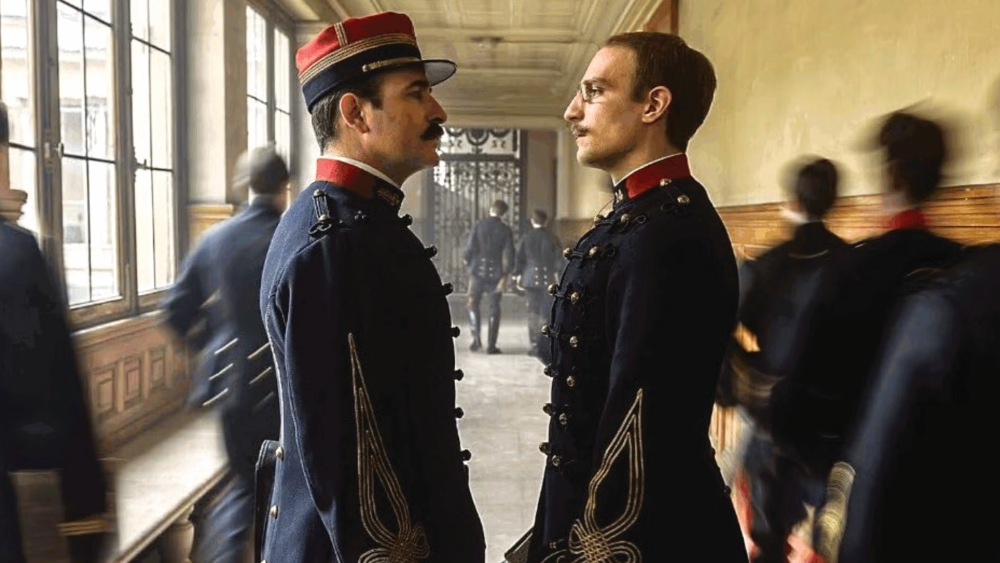
Americans were recently afforded the opportunity to also reflect on the Dreyfus affair when Roman Polanski’s “An Officer and a Spy,” winner of the 2019 Venice Film Festival Grand Jury Prize, finally received its U.S. premiere at New York’s Film Forum.
The movie never came out here for a range of reasons, including the pandemic and new sexual assault allegations against Polanski. The Jewish director was already a fugitive from justice in the United States after fleeing the country in 1978 before being sentenced for having unlawful sexual relations with a minor.
Despite the scandal that surrounds him, Polanski is a master filmmaker, and as scholars whose work has centered on Dreyfus, we can recommend “An Officer and a Spy” despite its shortcomings.
The film revisits the Dreyfus affair, which plunged France into crisis in the 1890s because it raised fundamental questions about the rights of individuals — and the place of minorities — within the modern liberal state.
The affair began in 1894 when the Jewish officer was convicted of selling military secrets to Germany and banished to Devil’s Island, a prison off the coast of South America. When an antisemitic career officer named Georges Picquart discovered proof of Dreyfus’s innocence in 1896, the army tried to silence him.
After the novelist Émile Zola publicized the injustice in a blockbuster newspaper article, France found itself on the verge of civil war, with half the country devoted to seeking justice for Dreyfus and the other half dedicated to defending the army that had framed him. Brought back for a second trial in 1899, Dreyfus was found guilty again before the French president pardoned him in the face of international outrage. Dreyfus was eventually exonerated in 1906 and reintegrated into the army.
Polanski’s film opens with the spectacle of Dreyfus’s public degradation ceremony in the courtyard of the École Militaire in 1895. Polanski’s fidelity to the historical record and attention to detail in the sets and costumes of this lavish production are impressive, bringing the past to life with stunning accuracy.
The fact that so many of the original locations that served as a backdrop to the affair are still intact reminds us how little has changed between Dreyfus’s time and our own, including the passions that animated the populace. With battalions standing at attention all around him, Dreyfus has his insignia stripped from his uniform and his sword broken in two, while a crowd of Parisians behind the gates yell, “Death to the traitor! Death to Judas!”
After this dramatic opening scene, Polanski barely focuses on Dreyfus at all. This is Picquart’s film: He is the main protagonist, present in nearly every scene. The decision to make Picquart (played suavely by Jean Dujardin) the hero reflects much of the historiography, which has long relegated Dreyfus to the sidelines.
Apart from one scene in which Picquart reads a letter that Dreyfus wrote from Devil’s Island, no effort is given to portraying Dreyfus’s inner life. Indeed, the film portrays Dreyfus as a robotic figure who does not seem to comprehend the social and political forces arrayed against him.
The last scene of the film is perhaps the most interesting. Promoted to brigadier general, Picquart is now the minister of war, having risen to the very top of the military hierarchy thanks to his role in the affair. Dreyfus has been exonerated but not promoted to the rank he should have had if the army counted his years spent on Devil’s Island. In 1906, Dreyfus asks Picquart to rectify the situation. Picquart refuses, explaining he doesn’t want to risk angering the anti-Dreyfus forces. Political considerations are now more important to Picquart than justice.
This is an extremely well-crafted film, one that calls much needed attention to a vital historical moment, but it makes little effort to explain the antisemitism that engendered the affair. This is surprising given Polanski’s own experience as a Holocaust survivor. It is also especially regrettable because antisemitism is once again at the center of debates over the nature of liberal democracy.
But as scholars, we urge American Jews to heed the key lessons of the Dreyfus affair: weak and corrupt democracies often use antisemitism to further a variety of political goals; democracies cannot thrive if they allow political considerations to trump the rights of individuals; and justice is always worth fighting for, even when it is not politically expedient. 
Rebecca Kobrin is a professor of American Jewish history at Columbia University.
Maurice Samuels is a professor of French at Yale University, specializing in the literature and culture of nineteenth-century France.
This article was provided by the JTA media source.

Filmmaker Justin Schein looks at wealth and inequality through the very real story of his late father.

For 35 years, the late Deborah Brodie, aka Bubbie Cookie, amassed a collection of over 200 Jewish ritual objects, which she used to teach her Hebrew school students with special needs.

Conceived by Columbia resident Benjamin Kintisch, "Life Review: The Hospice Musical" offers a thought-provoking and occasionally amusing perspective on mortality.

Steve Hofstetter, who will perform at Soundstage next week, recently made headlines for his social media post ridiculing some fans' warnings about Charm City's safety.