

If you’re a parent or grandparent, you probably remember a time when a family trip to a movie, mall, restaurant or museum went terribly wrong.
Carter Arnott Polakoff, president and CEO of Baltimore’s Port Discovery Children’s Museum, is right there with you.
“When my kids were little, I would take a day off and pull them out of school to spend a special day at Port Discovery,” she recalls. “We would come down here on, say, a Tuesday and everybody just fell apart! One was screaming, one was shy, and I didn’t know what to do. It ended up being a disaster of a day.
“I took this job because I had my own child that could not handle coming here.”
That experience continues to shape Polakoff’s vision for the 27-year-old interactive children’s museum.
The opening of Port Discovery’s latest exhibitions, “Galactic Builders” and “SKIES,” are good examples. The exhibitions are part of a multi-year, multi-million dollar transformation of the museum focused on expanding innovation, accessibility and inclusion for families.
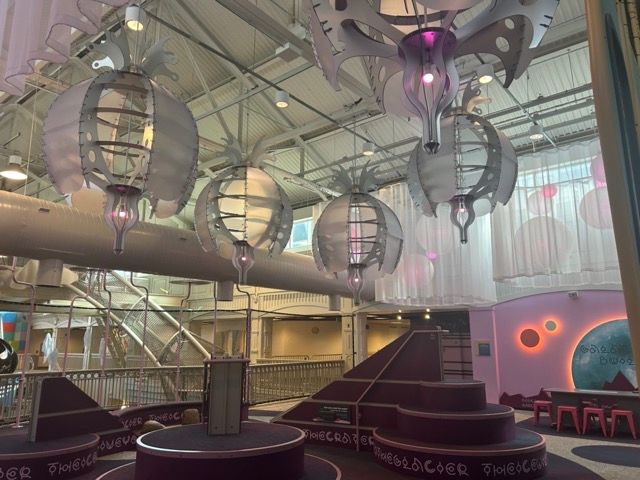
Geared toward older children, “GalacticBuilders” is a 1,788-square-foot, space-themed exhibition encouraging young visitors and their families to “tinker” around with different materials to discover how to launch a rocket, design a workable rover or make a parachute fly.
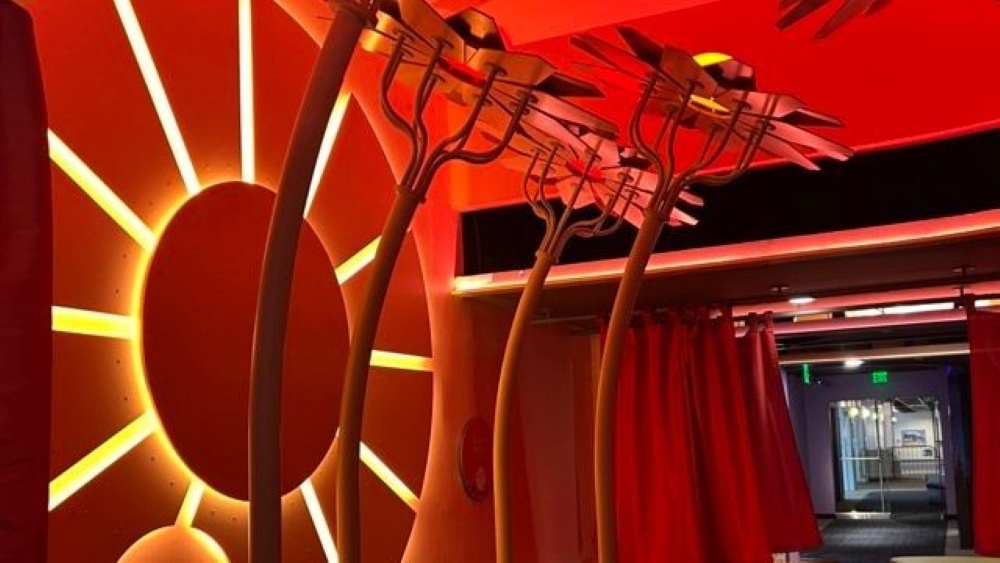
Right next door, “SKIES” offers a contrasting environment.
“’SKIES’ is a low-sensory space intentionally designed to bring the energy down,” says Polakoff.
The fully immersive, 2,250-square-foot exhibition is “inspired by the sky’s daily journey from sunrise to sunset,” with soft lighting, gentle colors and a nature-themed design.
“There is lots of seating, lots of books, pillows and blanket forts,” Polakoff says. “We’re seeing a lot of grandparents up there who might not want to climb a 30-foot climbing wall but still really want to play with their grandkids.”
The space also includes a designated area where children with sensory processing disorders can go if feeling overstimulated by the museum’s environment. The area represents just one of the ways in which Port Discovery works to meet the needs of children who are neurodiverse.
“It’s something that the museum’s always been passionate about, but I think there weren’t as many accessible resources 20 years ago, Polakoff says. “Now, there are so many ways we can help kids in especially in a place like Port Discovery, which is pretty overwhelming at times.
“We have a cart on each floor for families with neurodivergent children who [may need items such as] weighted blankets, headphones, fidget toys,” she says. “Parents can just go up and grab them.”
Beyond the new exhibitions, Port Discovery continues to feature such popular attractions as “Kick it Up” an indoor stadium for a variety of sports and games; the BGE Art Cove, where visitors can explore visual arts; the Royal Farms Convenience Store and Fill’er Up Station, a make-believe grocery store and gas station; Blocktopia, a STEM-based building space for kids ages 5-10; Tot Trails, where infants and toddlers can practice their motor skills; and Adventure Expeditions, Port Discovery’s signature exhibition in which children learn about ancient Egypt.
The museum is also home to a new Lego space and theater. Tiny’s Diner is being redesigned, and a new teaching kitchen will open in the next couple of years. A new activity table to be installed soon will be the foundation for a newly designed train set that will replicate the Port of Baltimore.
Polakoff says an exhibition about joy is also in the works. The exhibition, she says, looks at “how do you cultivate joy in yourself and in the community?”
Port Discovery’s mission extends beyond its walls. Through its At Play Learning Institute, the museum provides off-site experiences for parents, caregivers, scholars, researchers and educators. The institute offers “consistent and evidence-based opportunities to deepen [participants’] understanding and application of playful learning strategies.”
Last year, Port Discovery expanded the APLI to include a program called “Grandparents at Play.” A partnership with the Jewish Community Center of Greater Baltimore, the program engaged a cohort of grandparents in hands-on learning about caregiving and creative play.
Polakoff is also committed to providing educational opportunities for the museum’s staff.
“[We want them to] become real practitioners in playful learning,” she says. “We have 80 employees here and a lot of them are young. With that comes responsibility to give them skills so they can become teachers or daycare providers. So we’re investing a lot of money in that. After four years, seeing them grow is the best part of the job to me.”
Well-trained staff are crucial to the Port Discovery experience, but Polakoff emphasizes they are not a substitute for family engagement.
“The thing I’m really focused on, that I talk about all the time, is this focus on family, whatever that means to you,” she says. “We are hoping we can create experiences where you’re acting as a family together. That doesn’t necessarily mean you have to get down on the ground and play, but it is a place where I want families to feel welcome and they can be themselves together, and we can help create some memories for them.”
For information, visit portdiscovery.org/visit

For more than 130 years, Sol Levinson & Bros. has been woven into the fabric of Baltimore’s Jewish community.
Led by local Israel-American cellist Amit Peled, the Mount Vernon Virtuosi aims to inspire people beyond musical enjoyment.
A former college campus activist, Veksler will speak at Chizuk Amuno on June 8 at the Ruth and Jay Lenrow Visiting Scholar-in-Residence for Combating Antisemitism.

A lifelong Baltimorean, Judge Rosenberg served as a U.S. magistrate judge from 1973 to 1998.