
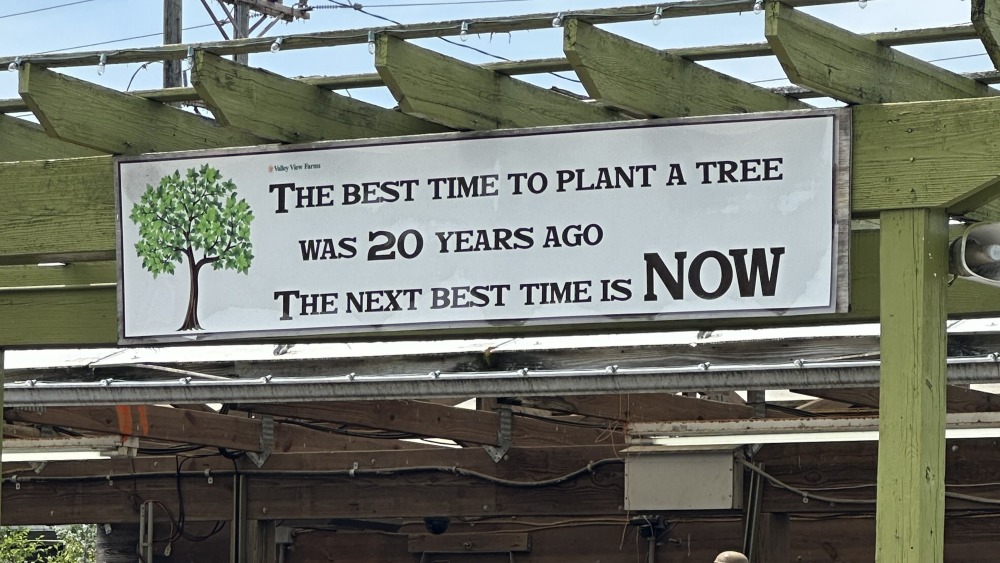
Miriam and I like to buy our plants at Valley View Farms. It’s a bit pricey, but they have a good selection and the staff is knowledgeable.
Each year on Mother’s Day, we drive out to Hunt Valley, buy flowers, herbs and vegetable shoots, and beautify the front stoop, backyard and deck of our Baltimore rowhome.
Last spring, I saw a new banner hanging from the entrance pergola of the nursery reading, “The best time to plant a tree was 20 years ago. The next best time is NOW.”
“Well that sounds Jewish,” I thought, recalling the famous story of Honi the Circle Drawer. When Honi asked an old man why he was planting a carob tree knowing it would not bloom for 70 years, the man replied that just as others had planted trees for him to enjoy, he would now do so for his descendants (Ta’anit 23a).
I went down an internet rabbit hole trying to locate the origin of the phrase quoted at Valley View. It’s included in the fourth edition of the “Oxford Treasury of Sayings and Quotations” (2011) with no attribution except “modern.” The internet seems to think it is “an old Chinese proverb.” One commenter, though, reports that actual Chinese people say it’s from a 2009 English language book. The website Quote Investigator confirms the origin is not Chinese, but found an anonymous attribution going back to 1967 in “The Cleveland Plain Dealer,” except the timeframe is 30, not 20 years. A different mention from 1968 says 80 years, much closer to Honi’s 70.
Whatever the origin of this particular aphorism, it has me thinking about how often we focus on missed opportunities instead of determining right here and now to invest in (plant and human) futures. Sometimes, this is selfishness. Why should I worry about future generations and the climate they will face? Other times, it’s simply inertia. Have you noticed how many businesses or other public venues since the pandemic no longer bother to post recycling bins?
But I also think people can feel embarrassed by those missed opportunities. We focus on the tragedy of not planting that tree 20 years ago and neglect a possible present leading to better future outcomes.
Consider someone you may have seen many times, maybe even spoken with, but don’t really know anything about. At some point, you may feel like it’s too late to ask basic questions: “Where are you from?” “What’s your story?” Even “What’s your name?
Recently, I had an encounter that reminded me why it’s worth it to plant that tree NOW. There’s an older man who often sits, sometimes for quite some time, on the marble retaining wall in front of our garden, steps from the concrete box where I plant flowers from Valley View Farms. He’s portly and avuncular with a cheery gray beard and cane. We would exchange pleasantries, and I would reassure him he’s welcome to sit as long as he likes, but otherwise he was a complete stranger.
The other day, I saw him sitting a few doors down on my neighbor’s retaining wall. I decided to walk over and say hello. I asked him how he was doing. He explained he had moved down the street a bit to take advantage of my neighbor’s tree with its abundant leaves and ample shade. Somebody had planted that tree many years ago, I thought. He asked me what was happening at the synagogue? I said the children had been dropped off for Jewish Discovery Lab.
We chatted about the neighborhood and Baltimore in which he has lived for nearly 85 years since birth. He explained he likes to sit and meditate in the fresh air. I asked what he used to do for a living.
“I’ve done different things,” he said, “but more recently I was in the upholstery business. I don’t want to brag, but I sold $800,000 worth of upholstery over 10 years when I worked there. I like to talk.”
I told him my late father was in sales and that he, too, liked to talk — and listen. He agreed that listening is a critical skill for a successful career in sales. Before heading into my house, I introduced myself. “I’m Daniel.” “Ernest.” “Really nice to meet you Mr. Ernest.” “Nice to meet you, too.”
Sometimes the benefit of planting a seed takes years or decades to realize, but it need not be the case. You can enjoy witnessing a sapling, or a new relationship, grow. Over time, with attention and nourishment, both become stronger, the roots deeper, the branches wider.
Honi understood this but he learned the hard way: there’s a deep connection between trees and human relationships. The Talmud relates that Honi goes to sleep and wakes up Rip Van Winkle-style 70 years later. Yes, the carob tree is fully grown, but all the people he’s ever known and loved are gone. He dies lonely. “Fellowship or death,” the text concludes.
A few days later, I saw the portly old man with the cane walking up the sidewalk. “Hello Mr. Ernest,” I said. “This is my wife, Miriam.” “Hello Miriam. Nice to see you, Daniel,” he said.

A seed becomes a shoot. A plant nursery in Reservoir Hill.
Rabbi Daniel Cotzin Burg is spiritual leader of Beth Am Synagogue in Reservoir Hill. This column and others also can be found on his blog, The Urban Rabbi.

As he gets ready to leave for California, Rabbi Daniel Cotzin Burg looks back on his time in Baltimore and his 10 years writing for Jmore.

Michael Olesker pays tribute to WJZ’s retiring Marty Bass, a longtime fixture on local TV screens.

The Orioles' weak defense plays a major role in the nightly carnage, writes Michael Olesker.