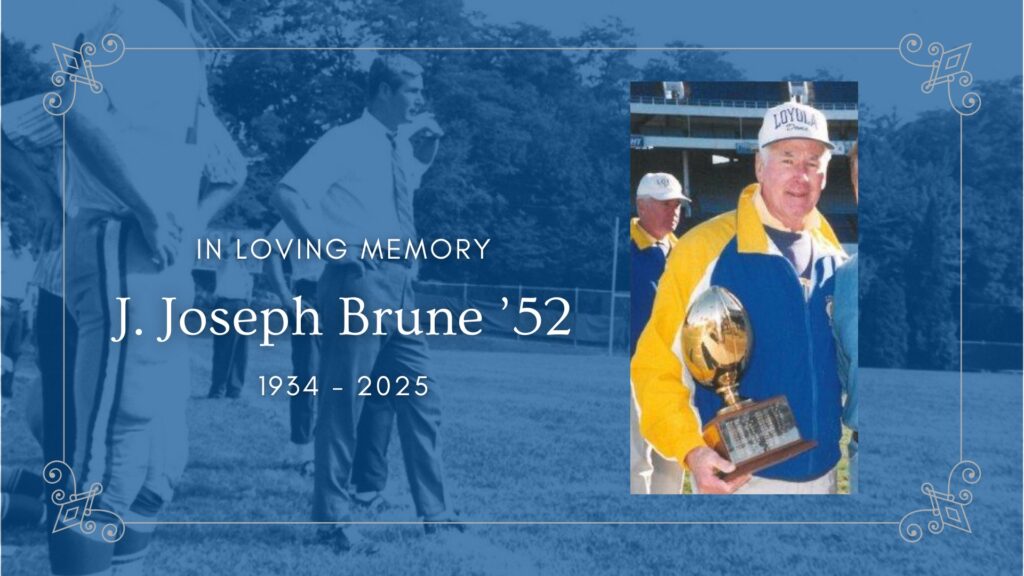
Joe Brune slips away, at 91, and leaves behind several decades of former schoolboys who remember him as their high school English teacher, football and lacrosse coach, and role model for a living, breathing municipal statue.
He had that kind of bearing. I knew him for 65 years and, for most of them, he seemed ageless. He was tall and muscular and lean, and had a thatch of hair that started graying in his 30s and turned white but never a follicle that deserted him.
He was so soft-spoken that it seemed to contradict his strict command of an athletic field. Out there, he was a rock. He coached football for about 35 years at Loyola, where he led the Dons to a bunch of conference championships and 19 Turkey Bowl victories over rival Calvert Hall.
Before that, he spent most of a decade at Baltimore City College, where he coached the varsity lacrosse team and junior varsity football. Typical of Brune, when he got the lacrosse job, he said he wasn’t sure he could handle it.
“I know there’s a lot of talent on this team,” he said, “but I don’t know if I’m good enough to bring it all to life.”
Turned out, he was plenty good. In his second year, his 1962 City College outfit was the last public school lacrosse team to win the Baltimore area championship generally dominated by private schools.
That underdog ’62 City team beat a powerful St. Paul’s team, 7-5, on a sunlit afternoon at the Johns Hopkins University’s Homewood Field when Jerome Schnydman raced half the length of the field for a last-minute clinching goal.
That team included such prep legends as Steve Levy, Mike Oidick, Richard Alter, Joel Shaivitz, John “Butch” Fisher, Charlie Meadowcroft, and a future U.S. congressman named C.A. Dutch Ruppersberger.
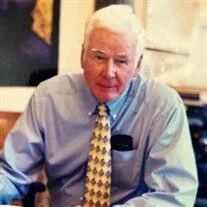
Brune was my homeroom teacher for two years at City. I don’t remember him ever raising his voice, because he didn’t have to. He had a quiet strength about him that said, You don’t want to make this guy angry.
He had solid beliefs as well — and you paid attention, whether you agreed with Brune or not. In those days, school kids everywhere recited The Lord’s Prayer as part of their opening exercises.
On the morning after the U.S. Supreme Court outlawed organized prayer in schools, Brune marched into homeroom, firmly declaring, “I don’t care what that court said. In my homeroom, we’re doing The Lord’s Prayer.”
He was a man of faith, and of values, and no puny Supreme Court was going to tell him how to run a classroom.
It was George Young who brought Brune to City. Young coached varsity football and later became the general manager who led the New York Giants to a Super Bowl victory. Brune coached jayvee football. They were a couple of tough-guy coaches and good friends.
I was covering the football team for City’s weekly newspaper, The Collegian, in 1962 when the team only won two games. Every week, I had to write that the football team looked terrible once again. Apparently, my coverage displeased Coach Young.
Every week, I’d walk into homeroom where Brune would look my way with a sorrowful expression and say, “Uh, Mister Young would like to see you upstairs.”
In front of his entire homeroom class, Young would then bawl me out for writing bad stuff about his football team. It was years later that I bumped into Young when he was an assistant coach with the Baltimore Colts.
“I don’t know if you remember me or not,” I said.
“City College,” Young said. “I used to give you a tough time, didn’t I?”
Not really. What he and Joe Brune were both teaching was a set of standards. They were pretty high standards, and we were free to follow them, or not. But they were guideposts to life, and you paid attention to them.
Joe Brune spent decades holding those standards high for the boys at Loyola and City College. He leaves us now, but his values stay with us.
A former Baltimore Sun columnist and WJZ-TV commentator, Michael Olesker is the author of six books, including “Journeys to the Heart of Baltimore” (Johns Hopkins University Press) and “Michael Olesker’s Baltimore: If You Live Here, You’re Home” (Johns Hopkins University).
What does it mean to be fully present with each other and the sacred, asks Maryland-born cultural anthropologist Alanna E. Cooper.
As millions mourn the passing of Stephen Colbert from the airwaves, Michael Olesker looks back on the "institution" of late-night TV.

As he gets ready to leave for California, Rabbi Daniel Cotzin Burg looks back on his time in Baltimore and his 10 years writing for Jmore.