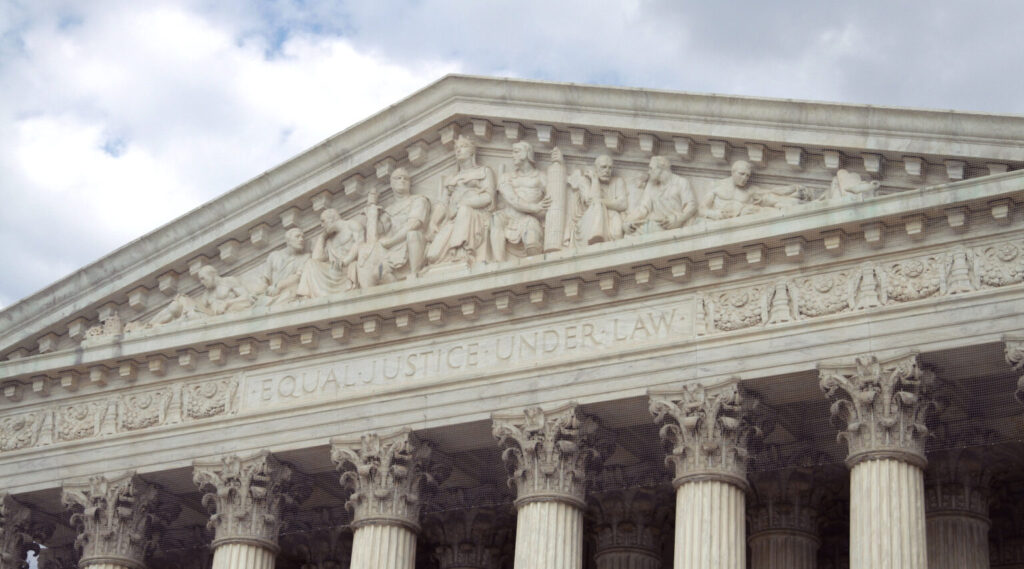
Neal Katyal, the distinguished constitutional lawyer often seen on cable TV news, came to Baltimore last week to talk about the U.S. Supreme Court, but he got here 24 hours too early.
He didn’t get a chance to explain the high court’s latest groveling decision issued from the inside of Donald Trump’s back pocket.
Katyal — who served as the Obama administration’s acting U.S. solicitor general and has argued more than 50 cases before the high court — spoke to an audience of approximately 300 at Loyola University Maryland’s Center for the Humanities on “The Supreme Court in a Time of Crisis.”

Unfortunately, he spoke on the evening of Wednesday, Dec. 3, and it wasn’t until the next day that the court delivered its newest cave-in to President Trump, in the Texas gerrymandering case.
That’s the one designed to fix the 2026 mid-term elections for Republicans in general, and Trump in particular. It’s the one designed to give the GOP five more Texas congressional seats, despite a lower court ruling that the newly designed map willfully divides voters by race.
And so once more, lower courts rule against Trump, and once more the Supreme Court comes to his rescue.
Katyal never got a chance to talk about the latest example, although he offered a couple of fascinating numbers, which we’ll get to in a moment.
But as the Brennan Center for Justice declared last August in a scholarly piece titled, “Supreme Court Must Explain Why It Keeps Ruling in Trump’s Favor,” “On issues ranging from dismantling the Department of Education to banning transgender people from serving in the military, federal trial judges from across the ideological spectrum have repeatedly blocked actions by the Trump administration — only for the Supreme Court to halt those rulings with little or no explanation.”
This time, the high court’s conservative majority not only overruled a district court ruling in Texas. As the New York Times put it, “The majority chastised a lower court for not taking the state [of Texas] at its word that politics, not race, motivated the maps.
“The court, it said, had ‘failed to honor the presumption of legislative good faith.’”
Legislative good faith? — is that anything like “Supreme Court even-handedness?”
So let’s get back to Katyal’s talk at Loyola.
Each year, he said, the Supreme Court is bombarded by “10,000 cases” that reach its offices, each hoping for final legal ruling from what we used to think was the wisest, fairest collection of legal minds to be found anywhere.
And of those “10,000 cases,” how many does the high court actually hear?
“Sixty,” according to Katyal.
Or to put it another way: “60.”
Sixty, out of 10,000.
Which raises a question: With so few cases chosen among so many possibilities, and with the high court faced with its ever-present backlog of truly important, earth-shattering legal questions, why did the justices decide the Texas case needed to be rushed to judgment?
The case had already gone to court, and was decided, like so many others, against the Trump administration.
Case closed.
And then, case unclosed, as this Supreme Court chose the Texas political fix, among 10,000 other cases, to be decided now.
And as usual, in Donald Trump’s favor.
A former Baltimore Sun columnist and WJZ-TV commentator, Michael Olesker is the author of six books, including “Journeys to the Heart of Baltimore” (Johns Hopkins University Press) and “Michael Olesker’s Baltimore: If You Live Here, You’re Home” (Johns Hopkins University).

What does it mean to be fully present with each other and the sacred, asks Maryland-born cultural anthropologist Alanna E. Cooper.

As millions mourn the passing of Stephen Colbert from the airwaves, Michael Olesker looks back on the "institution" of late-night TV.
As he gets ready to leave for California, Rabbi Daniel Cotzin Burg looks back on his time in Baltimore and his 10 years writing for Jmore.