

By Susan Barocas
Folklore has it that when the Jews were forced to leave Spain in the 15th and 16th centuries, many carried biscochos with them to help sustain them for the journey to new homelands. Biscochos are the beloved Sephardic oil-based cookie, usually shaped into a circle and topped with sesame seeds. But of course, since these simple cookies traveled to many places, there are numerous variations in shape, flavoring and toppings, influenced by local customs and family tradition.
Let’s start with the name, which, like so much Sephardic food, is not consistent. The word “biscocho” comes from Old Spanish, which makes sense since that is the root of the Sephardim’s Ladino language. Like most Jews of Turkish Sephardic heritage, I use that original word that some of my ancestors brought with them centuries ago from Spain. That’s from my Turkish grandfather, but in the town my grandmother was from, Monastir, which is now Bitola in North Macedonia, these cookies were known as “bomboneros.”
In the once-vital Sephardic community of Rhodes, Stella Cohen explains in “Stella’s Sephardic Kitchen” that they were called “reshikas,” shaped like skinny pretzels and twice baked. That is unless the ropes of dough were twisted and shaped into a circle or “bracelet,” which made them “biskotchos.” I have even heard of some families that called the cookies “biscotios.” But don’t be fooled by the word “bizcocho,” which is something entirely different – a sweet, spongy dough that is the basis for many different cakes and sweet breads especially popular in Central and South America.
The shape variations continue. Twisted strands of dough can be left as a straight “stick” instead of made round. Some of the descendants of the Sephardim of Monastir, like the singer Sarah Aroeste (and my partner in our food and music project Savor) make small cuts with a knife around the edges before creating the circles, so the cookie fans out a bit when baked. I learned to leave the strands or ropes smooth when formed into a circle. Toppings, at least, are less variable with traditional sesame seeds or cinnamon-sugar. In the recipe below, there are directions for several options for shaping your biscochos.
Whatever they are called and however they are shaped and topped, biscochos are neither sweet like most cookies nor savory, and yet, they are somehow quite habit-forming. The subtle flavor can be from vanilla alone or the addition of anise or almond extract, anise liquor, orange blossom or rose water, or grated rind from a lemon or orange.
Since biscochos store, freeze and travel so well, they are great to keep in a purse, backpack or car just in case. They are a great dunking cookie, perfect with a cup of strong Turkish coffee or mint tea that, for hundreds of years, women would share, along with news and a bit of gossip, in the afternoon when taking a break from all the household work. Even today, many Sephardi women wouldn’t let their homes be without the iconic biscochos for long.
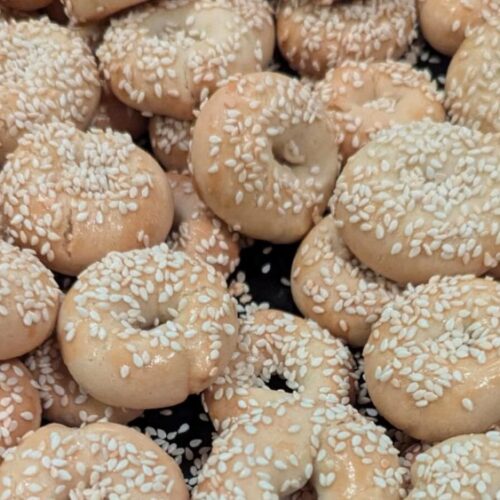
Sephardic Biscochos Cookie
Ingredients
For the cookies:
- 5 large eggs, divided
- 1 cup good neutral oil (avocado, sunflower, grapeseed)
- 1 cup sugar
- 1 teaspoon vanilla extract
- 1 teaspoon baking powder
- 5–6 cups all-purpose flour
Optional flavoring additions:
- Finely grated rind from 1 large orange or lemon
- 1 teaspoon anise or almond extract
- 1/2 teaspoon rose or orange blossom water
For the topping:
- 1/2–1 cup sesame seeds or 1/2 cup sugar mixed with 1 Tablespoon cinnamon
Instructions
- Preheat oven to 350°F. Cover baking sheets with parchment or spray lightly with oil.
- In a large mixing bowl, whisk together 4 eggs, oil, sugar and optional flavoring additions, if using, until the mixture is lighter in color and getting foamy.
- In a separate bowl, mix baking powder and flour until well blended. Add dry mixture to the egg mixture a little at a time, beating constantly first with a whisk and then with a wooden spoon. Switch to using your hands to mix in flour once the dough is a bit firm to the touch. Use as much of the flour as is needed to create a smooth dough that is pliable, but not sticking to your hands or the surface when rolled. If the dough is too sticky, add a bit more flour. If it gets too crumbly, add a bit more oil.
- Working quickly, make several small balls. For larger biscochos, each ball should be about the size of a large marshmallow or a walnut in the shell (about 1/8 cup). Roll each large ball into a strand or rope 4-5 inches long and about ½-inch wide, about the width of a woman’s finger. For smaller biscochos, make the balls from a slightly overfilled tablespoon of dough and roll each into a strand 2-3 inches long and about 3/8 inches wide.
- For twisted ropes, either left straight or shaped into circles, roll thinner strands.For any size, make each strand smooth and even its entire length. For each shape, make the strands consistent in length by cutting off extra dough and using it for another cookie.
- Shape your cookie with one of the following methods (as you work, place each shaped cookie on the prepared baking sheet about 1 inch apart): 1) Make the circle shape by bringing the ends together or overlapping them slightly. Slightly flatten the strand, then fold in half. Make small cuts, about ½-inch apart on the edge of the strand, then form the circle shape. Create the circle, then make a design around the outside edges by gently pressing a fork. 2) For twists, role strands longer and skinnier. Fold a strand of dough in half and twist the ends in opposite directions. Leave straight or shape into a circle, gently pressing the ends together.
- When all the dough is used, beat the remaining egg well in a bowl. Put sesame seeds and cinnamon-sugar in wide shallow bowls or dishes. Working a few at a time, lightly brush a little egg on top of each biscocho, then sprinkle with topping or dip each cookie in topping of choice. During baking, the biscochos will puff up a little but not spread a lot.
- Bake for 30-35 minutes until lightly golden brown.
Notes
- Total Time: 1 hour-1 hour 15 minutes
- Yield: 4 dozen larger or 6 dozen smaller cookies
- Store in an airtight container, unrefrigerated, for 3 weeks or freeze, well-wrapped, for up to 3 months.
- To crisp biscochos that have softened while stored or frozen, reheat in a 300°F oven for 10-12 minutes.
For more articles like this, visit MyJewishLearning.com/The-Nosher/

Dara Bunjon talks with author, chef and food historian Dorette Snover, founder of C'est si Bon! Cooking School.

Jewish institutions in New York are responding to a boycott of Israeli products at a Brooklyn grocery store by buying up Bamba.

On this episode of "The Food Enthusiast," Dara Bunjon talks with Lexx Mills, co-creator of Stursi, expertly crafted non-alcoholic cocktails.

Dara Bunjon talks with legendary chef Jimmy Schmidt, a three-time James Beard Award recipient, restaurateur, author, food scientist and innovator about his journey from the Rattlesnake Club restaurants to Chefs Collaborative and JR Ranch Foods.