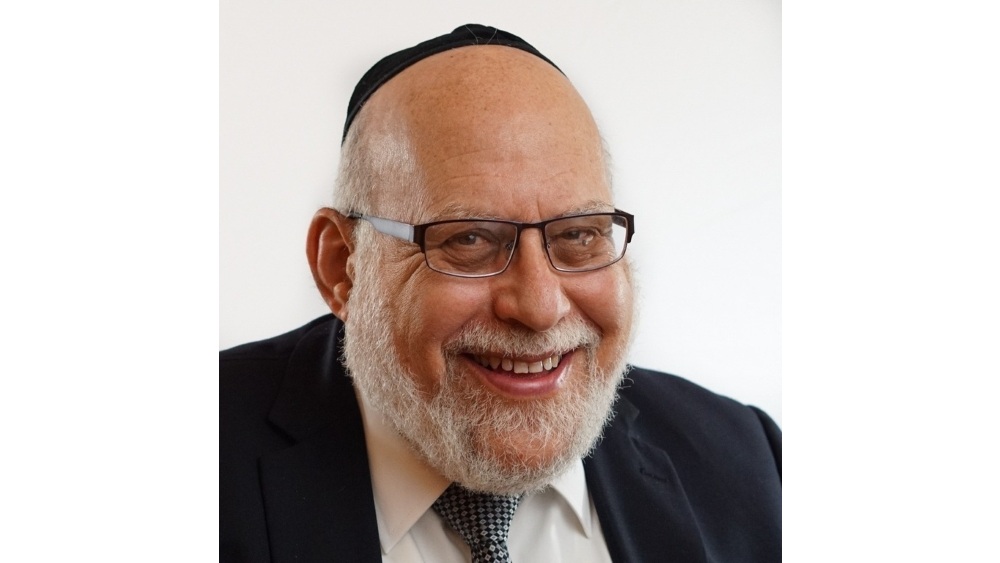
By Dr. Jack Nusan Porter
Back in 1979 after the passing of my father, Irving Porter, I wrote an essay titled, “The Death of a Father.”
It was one of my best essays. I described how at his deathbed, we heard the fluttering of an angel’s wings as his soul flew higher and higher to gan eden, heaven.
My brother, Rabbi Shlomo Porter, died in Baltimore on Shabbat, Nov. 15, 2025. They say that one’s soul goes immediately to gan eden when you die on Shabbat, and I know it did.
Everyone who knew my brother knew he was a very special person. He possessed a gentleness, calmness and patience, plus a beautiful singing voice.
More than 1,000 people attended his funeral — 400 via Zoom and over 600 in the auditorium of Bnos Yisroel of Baltimore. Thirteen rabbis spoke, many in tears. Such was his loss.
At times, Shlomo and I had the usual sibling rivalry — “Mom liked you more!” — kind of nonsense. But also, with him being the oldest and “the rabbi,” I at times resented him telling me what do.
After his funeral, his wife, Shushy, told me, “Jack, Shlomo loved you, and if he suggested things to you, it was always because he was thinking about you, to raise you to a higher level of mitzvot.”
Death brings up all kinds of feelings. There are no right or wrong feelings. Some people cry, some laugh, some feel guilty — all are legitimate forms of mourning.
I feel guilty that I didn’t attend his classes more often to see how he led people to higher levels of observance.
My brother’s secret in dealing with baalei teshuvah (masters of return) was that he himself was a baal teshuvah.
Growing up in Milwaukee, he attended Sherman Elementary School and Steuben Junior High School but then came under the tutelage of Reb Michel Twerski and his wife, Feige. Then, because of the influence of a friend, he went to study at the Hebrew Theological College in Skokie, Illinois, and from there to Baltimore’s Ner Israel Rabbinical College.
Because he could relate to baalei teshuvah without judgment and in their own language, he was successful. He was co-founder of the Etz Chaim Center of Baltimore, one of the most successful kiruv (outreach) programs in the country, and was a past president of the Association of Jewish Outreach Professionals, teaching and mentoring dozens of kiruv professionals.
His technique was never to judge but to meet people at their own level and guide them with study to then move higher up in mitzvot.
He could relate because he knew the culture of the 1950s and ‘60s, like Disneyland and “Leave it to Beaver” with seniors, and “Saturday Night Live” with a younger generation.
People could relate to him. He spoke their language.
We were also a family that embraced the Jewish value of hachnasat orchim (welcoming guests). Our home was open to all — visiting rabbis, meshulachim (traveling fundraisers), even an occasional Jewish hobo. We had people like Rabbi Moshe Teleshevsky, the personal meshulach of the Lubavitcher Rebbe; Rabbi Cohen who could lift both Shlomo and I up with both arms; Rabbi Borack, and the greatest of all, Rabbi Kowalsky of Ner Israel with his beautiful silver beard and silver cane and powerful presence. He would say to the businessmen we went to — Max Karl, Max Kohl, the Afram brothers — “I collected from your grandfather, and I will collect from your grandchildren.”
So Shlomo, my sister Bella Smith, and I learned the value of hachnasat orchim from our parents so later we were able to handle the work and stress of many people coming, because we saw our parents doing it.
But the most important message our parents left us was to care for others and reach out to people. Shlomo and his wife and children did so to hundreds, maybe several thousands, of people during the nearly 50 years they were in Baltimore.
Our parents were great partisan fighters in the forests of Volynhia, Ukraine, and they lost many people. My mother was the sole survivor of her family — and yet she produced children and grandchildren that more than doubled those lost in the Holocaust.
But the greatest gift our parents left us was the gift of joy: “Zei Freilich, Yidn!
“Be happy! Don’t mourn for me,” would be my brother’s message, “but go out and organize!”
I ended my eulogy for Shlomo with two short Yiddish songs that my father taught us: “Zis a mechayah to zein a yid, dar far is mir shendik glick, Ich hob tzu dir kine teines nist, ich dank dir vos ich ben a yid.”
“It’s a pleasure to be a Jew; not a burden. I have nothing to complain about to you, dear Lord, I thank you that I’m a Jew.”
And a Zionist song: “Aheim, Aheim, Yidelach, Aheim, shon bald tzvei thouzen yuhr az mir zenen in galus ad hayom und az mire gitach a tish a greteh, vuzha los mir ach abeten, Aheim, Yidelach, Aheim kein Tzion, Aheim.”
“Go home, go home, Jews, go home (to Israel); it’s been 2,000 years that we’ve been in exile and as we give you a prepared table, why do we have to beg you to partake — go home, go home to Zion, your home.”
That was my brother’s message: Be joyful as a Jew!
A resident of Newton, Massachusetts, Dr. Jack Nusan Porter is a writer, sociologist, human rights activist, and former treasurer and vice-president of the Intenational Association of Genocide Scholars, His website is drjackporter.com.
What does it mean to be fully present with each other and the sacred, asks Maryland-born cultural anthropologist Alanna E. Cooper.
As millions mourn the passing of Stephen Colbert from the airwaves, Michael Olesker looks back on the "institution" of late-night TV.

As he gets ready to leave for California, Rabbi Daniel Cotzin Burg looks back on his time in Baltimore and his 10 years writing for Jmore.