
Eighty percent of Americans including 20% of older women, will experience some form of low back pain during their lifetimes.
Dr. Hogans says she has parlayed her interest in pain management into “living the dream of the triple threat” — a career in research, clinical care and mentorship. She serves as director of pain education and is an adjunct associate professor in the Department of Neurology at the University of Maryland School of Medicine; an associate professor of neurology at the Johns Hopkins School of Medicine; is a part-time clinician with the Veterans Affairs Maryland Health Care System; and is a researcher with the VA’s Geriatric Research, Education and Clinical Center.
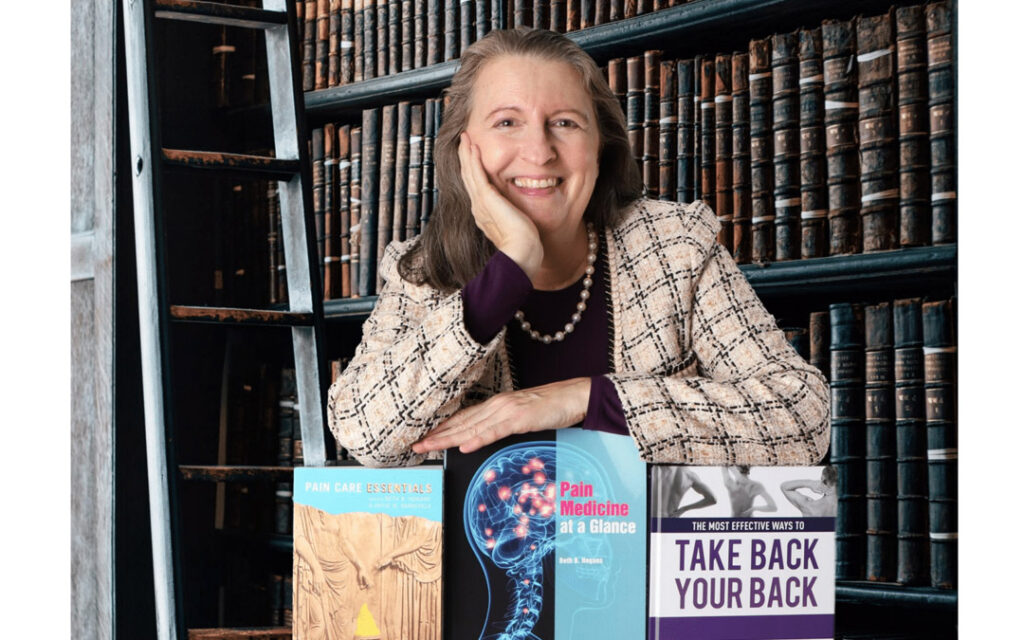
Dr. Hogans, who lives in Pikesville, is also the author of several books on pain management, most recently “Pain Medicine at a Glance” (Wiley-Blackwell), which examines the causes and treatments of chronic pain.
“To understand pain, you really have to understand events that happened all the way from the bottom to the top of the nervous system,” she said. “It’s just incredible to think about how that signal can be shaped and modulated at every step.”
In 2011, Dr. Hogans wrote “Take Back Your Back: Everything You Need to Know to Effectively Reverse and Manage Back Pain” (Fair Winds Press), explaining 10 conditions connected to back pain. In that book, she shared the full spectrum of non-pharmaceutical treatments for back pain such as yoga, tai chi, nutrition, acupuncture, chiropractic, massage and others.
In addition, she developed an app for veterans with low back pain. The app — halfway through the 10-year development process and currently in clinical investigational trials — leads users through the process of designing their own pain self-management plan with evidence-based, non-pharmaceutical therapies available to them but widely unknown to patients and providers.
As users complete the various stages of activity, including exercise, sleep, nutrition, social supports and mind-body preparation, they receive badges indicating their successes.
“There are many treatments that are proven to help, but people right now don’t know that,” Dr. Hogans said. “There are barriers to getting that information out to both patients and providers, so I created the app to facilitate that knowledge transfer. The app is designed to offload some of the burden [from providers] to allow patients to explore at their own pace.”
So far, the trials have shown success among female and Black veterans, populations that are generally underserved, she said.
“We’re really trying to fight the opioid epidemic and help people with chronic pain,” she said. “This is all about saving lives and making people’s lives better.”
Dr. Hogans cited Global Burden of Disease studies finding over the past decade, low back pain is the leading cause of disability around the world.
“It’s almost invisible to the eye unless you know what you’re looking for,” she said. “It’s sometimes hard to tell that somebody’s suffering from chronic pain. [With] acute pain, we all know what that looks like. But with chronic pain, it can be a lot harder to tell.”
A congregant of Beth Tfiloh and Ner Tamid synagogues, Dr. Hogans said she has been fascinated by the brain and nervous system for as long as she can remember. Her memories date back to accompanying her mother, who was pursuing a master’s degree in nursing, to the University of Maryland, Baltimore library. While her mother studied, she said she read neurology journals.
After graduating from the University of Maryland School of Medicine in 1993, Dr. Hogans earned a Ph.D. in physiology from that institution. Her medical residency in neurology took place at the Yale University School of Medicine, and she completed a clinical and research fellowship in neurophysiology and peripheral nerve neurology at Johns Hopkins.
Dr. Hogans worked for a year on a research fellowship in London before spending three years as a visiting and associate clinical professor at the Rappaport Faculty of Medicine at the Technion-Israel Institute of Technology in Haifa.
Dr. Hogans said her latest book was written specifically for primary care doctors.
“I feel sad and frustrated that they don’t know how to take care of [low back pain],” she said. “Part of my mission in life is to fix back pain and help doctors know what to do when [their patients are] encountering pain.
“We’re still at a place in America where we look at pain through the lens of stigma and moral judgment. We need to move past that and see pain as the health care problem that it is,” said Dr. Hogans. “Sadly, the opioid crisis only compounded that because a lot of people just leap to the assumption that if you’re talking about pain, you’re looking for drugs. A lot of times people are just looking for help and relief.”
Linda L. Esterson is a local freelance writer.

John Singer wants to help Marylanders of all economic backgrounds to afford ankle foot orthoses.

Israeli-Americans Rachel Goldberg-Polin and Jon Polin talked about the pain of losing their 23-year-old son, who was kidnapped and later murdered in the Oct. 7th tragedy.

Colorectal cancer rates are climbing among young people and Ashkenazi Jews.
In "The Future is Peace," Aziz Abu Sarah and Maoz Inon say there is still hope for coexistence between Arabs and Jews.