
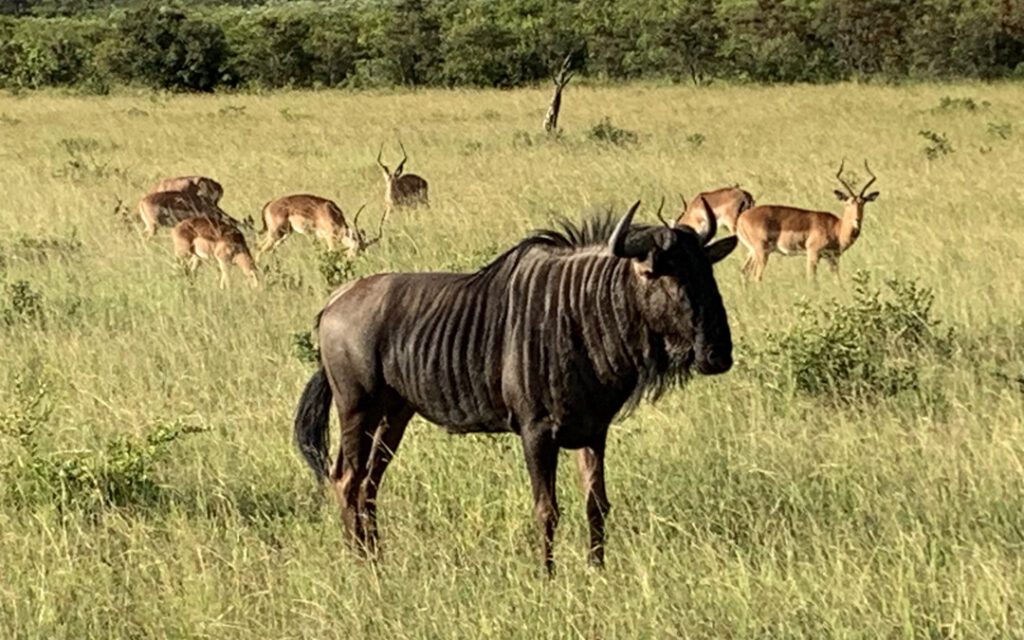
Picture this: You’re in the backseat of an open jeep, hanging off the side of a cliff, craning your neck to catch a glimpse of a leopard effortlessly climbing a tree.
Through your binoculars you see his light green eyes, his sharp teeth. Your mouth is hanging open, your heart beating fast; you’re thrilled and terrified at the same time.
Next, the jeep is driving as fast as it can to take you and your companions to the spot where a family of lions is sleeping off a kill, panting from the exertion of digesting a buffalo.
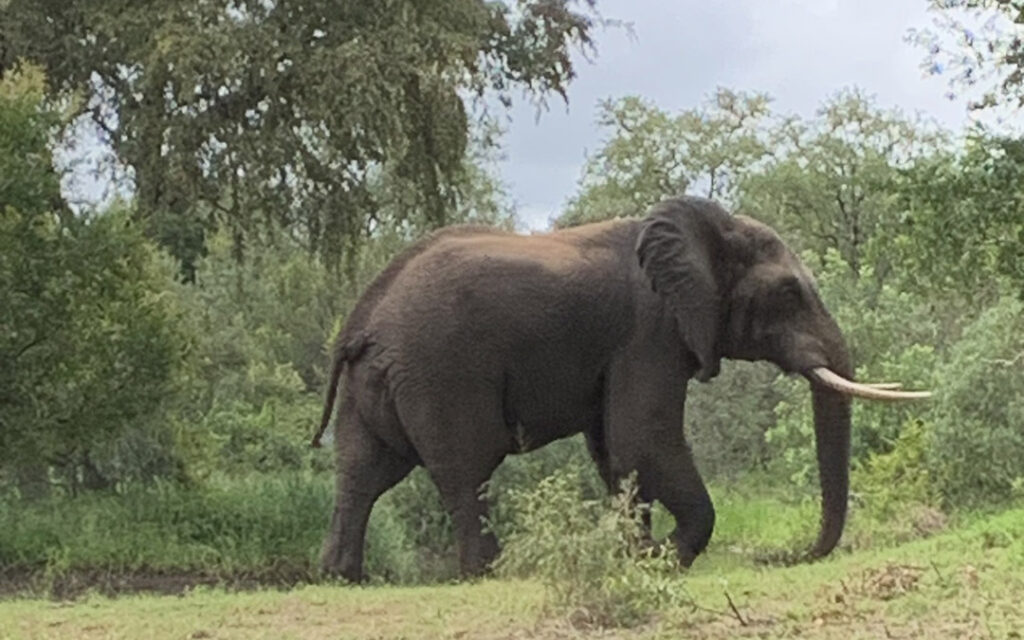
The next morning, the jeep is surrounded by what you now know is called a “memory of elephants.” They’re so close you could touch them, but you know better. Your ranger in the front speaks quietly, explaining that the elephants are headed toward the river for a drink of water, and the adorable baby elephant, perhaps three months old, weighs about 450 pounds.
Back at the lodge that afternoon while sipping a glass of rose’, you see several giraffes coming toward you. They are also thirsty and on their way to the waterhole in front of the lodge. Closer by, dozens of impalas are munching on grass while baboons in the trees jump from branch to branch. Birds of all sizes, colors and species fly by, too fast for photo ops.
These are just a few of the breathtaking sights that I experienced on a recent trip to southern Africa. The trip was made even more amazing because I never imagined visiting Africa. In retrospect, my travel aspirations were extremely Eurocentric.
That’s all changed now that I’ve been to the African bush.
Peaks and Valleys
The six of us — three couples — started our journey in Cape Town, South Africa’s oldest and second largest city, where we stayed in a lovely bed-and-breakfast called The Walden House. In Cape Town, everywhere you look you’re surrounded by views of gorgeous Table Mountain. On our first full day there, we drove — on the left side of the road, mind you — to nearby Simon’s Town, where we kayaked to watch penguins at Boulder Beach. It was rigorous exercise and extraordinarily fun.
The next day, it was time to visit Table Mountain, which gets its name from its flat mountaintop. We took a revolving cable car up to the 3,563-foot mountain peak and walked the circular trail. It’s hard to express the natural beauty of Table Mountain and the sense of well-being I felt there.
That night, it was off to Mzansi, a restaurant situated in a home in Langa, a township outside of Cape Town center. We were sent there by Baltimore friends who raved about it. After experiencing the joy of the place — which included delicious home-cooked food, an art gallery and live music — we could understand why. Mzansi was a blast!
On the way there, our guide drove us around District 6, which was a sobering experience to say the least. Here we saw a degree of poverty I have never seen in my life.
While District 6 was painful to observe, I was glad to learn about this other, less touristy part of Cape Town. The area, a remnant of apartheid, made it hard to believe that every one of the Black hospitality professionals we encountered were so incredibly kind and appreciative of us white travelers. It was deeply humbling.
On our third day in Cape Town, Cezweh, our guide, took us to several wineries about 45 minutes outside of the city. The wineries were gorgeously situated and as upscale as any I have seen in the United States or Europe. While I’m a failure at day drinking, I enjoyed myself thoroughly. After a day of debauchery, we walked to Cape Town’s lovely waterfront for dinner.
Chasing Waterfalls
The following morning, we left Cape Town for South Africa’s Kruger National Park, where we would experience our first safaris.
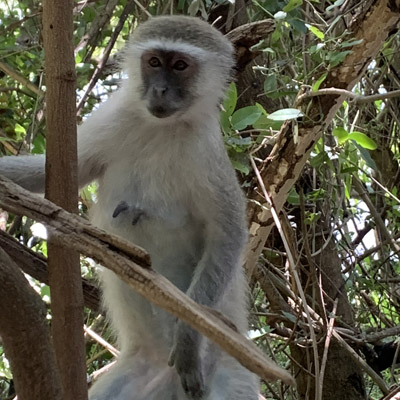
One of the largest national parks in the world, Kruger is the size of a small country. In Kruger, we stayed at the scenic and comfortable Idube Game Reserve located in the private Sabi Sand Game Reserve. The food was good and plentiful, and we were surrounded by velvet monkeys and nyala, a beautiful species of antelopes native to the country. They were mostly oblivious to us, but we delighted in seeing the graceful creatures every time we left our cabins.
After a late and hearty lunch, we headed out to the lush green bush with our trusty ranger, FJ, and our tracker, Bodgani (the lookout guy). We weren’t prepared for how many animals we would see — there were scores of zebras, giraffes, elephants and hippos.
FJ even managed to spot a chameleon in a tree in the darkness, and it was just our first time out! Within a couple of days, we saw what’s known as the “Big Five” — lion, leopard, rhino, elephant and African buffalo. We were way ahead of schedule and felt a sense of accomplishment.
FJ offered to take us on walks after our early morning (5:30!) safaris, and we all agreed. On the walks he pointed out trees, birds and insects, demonstrating an encyclopedic knowledge of flora and fauna in the bush. We spent a few days at Idube and were quite sad when it was time to leave.
To be close to the airport for an early flight to the Zambia border to get to Zimbabwe, we stayed at a fancy hotel called Oliver’s, where I got the best massage of my life for about $40!
In Zimbabwe, we stayed at another upscale hotel called the Botanka Guest Lodge in Livingstone. We were there primarily to see Victoria Falls, one of the planet’s largest waterfalls.
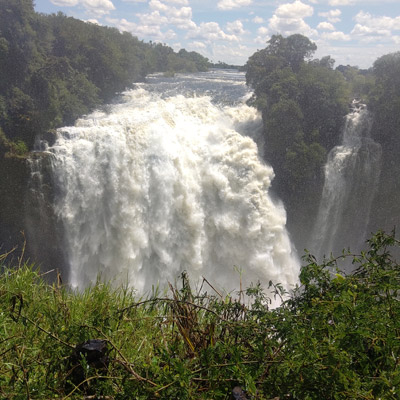
The falls, known as one of the seven wonders of the world, is an awe-inspiring sight on the Zambezi River between Zambia and Zimbabwe. Before we went to the falls, we were warned we would get wet. But we weren’t in any way prepared for how wet we would get!
We were guided to 17 different lookout points to view the falls, and as we progressed, we got wetter and wetter due to the thick dense spray omitted from the falls. Depending on where we stood, the downpour was torrential. Our rain ponchos, rented outside the attraction, were entirely useless in keeping us dry. The weather is warm in Zimbabwe, so getting drenched was terrific!
The following night we went on a sunset cruise on which we met several African families. Everyone, especially the children, was sweet and courteous. Talking with them was a highlight of the trip.
Where the Wild Things Are
Our next stop was Botswana, where we stayed at the Elephant Valley Lodge. It was more rustic than the other places we stayed — the accommodations were in tents with concrete floors — but still fairly comfortable.
Botswana is a beautiful country where our guide, Simon, informed us the president, Mokgweetsi Eric Keabetswe Masisi, was doing great things and that the nation’s democracy is thriving.
We started our visit to Botswana with a water safari on the beautiful Chobe River. Seeing animals such as hippos, elephants and birds from a vantage point other than a jeep was a very special experience. In particular, the hippos were highly entertaining while playing together in the water. One would never have guessed they are among the most dangerous animals in the African bush.
Having already seen the “Big Five,” we were expecting more of the same on our safaris at Botswana’s Chobe National Park. But our assumptions proved wrong. In Botswana, animals — especially elephants — were everywhere in large numbers. There are approximately 450 species of birds in Chobe, and many of them are incredibly pretty.
We learned that Chobe has the largest concentration of animals in Africa. One reason is because there are no fences in Botswana. Animals roam freely and migrate to Chobe from elsewhere. Ample vegetation and lots of water mean there is always enough for the animals to eat and drink.
The next day was a full-day safari with more animal sightings. We were surprised that no matter how many elephants, giraffes, zebras, impalas, baboons or birds we saw, it never got old.
One late afternoon, our guide rushed us to the spot where he had heard there was a family of lions eating the remains of a water buffalo they had killed. Hyenas approached, hoping to eat anything the lions left over. Their “laugh” was strange and chilling.
At one point, the adult male lion walked toward the hyenas to show them who was boss. They backed away, but only until the lion returned to his family. If anyone had told me before the trip that I would be transfixed by the sight of lions eating a buffalo, I’d never have believed them. But I was riveted, understanding for the first time that I was witnessing the circle of life — survival of the fittest. I saw that it had to be like this.
We had run out of words to describe our vacation. Awesome, wonderful, incredible, thrilling, exciting couldn’t capture the feelings we were having. Personally, I felt like I was seeing everything in a new way. I realized how much I had been missing, how I wasn’t really aware of my surroundings. I developed a reverence for non-humans I had never had before. It may sound like a cliché, but my trip to Africa was truly life-changing.
Hamba kahle (farewell) Africa. I hope to return someday soon!
Filmmaker Justin Schein looks at wealth and inequality through the very real story of his late father.
For 35 years, the late Deborah Brodie, aka Bubbie Cookie, amassed a collection of over 200 Jewish ritual objects, which she used to teach her Hebrew school students with special needs.
Conceived by Columbia resident Benjamin Kintisch, "Life Review: The Hospice Musical" offers a thought-provoking and occasionally amusing perspective on mortality.
Spending on "hasbara" should be “like investing in jets, bombs and missile interceptors,” argues Israel’s foreign minister.