
By Jacob Kessler
Growing up in the Jewish community of the Chilean capital of Santiago, Mauricio Avayu wasn’t allowed to pursue art. His father thought he should study something more practical like math or engineering.
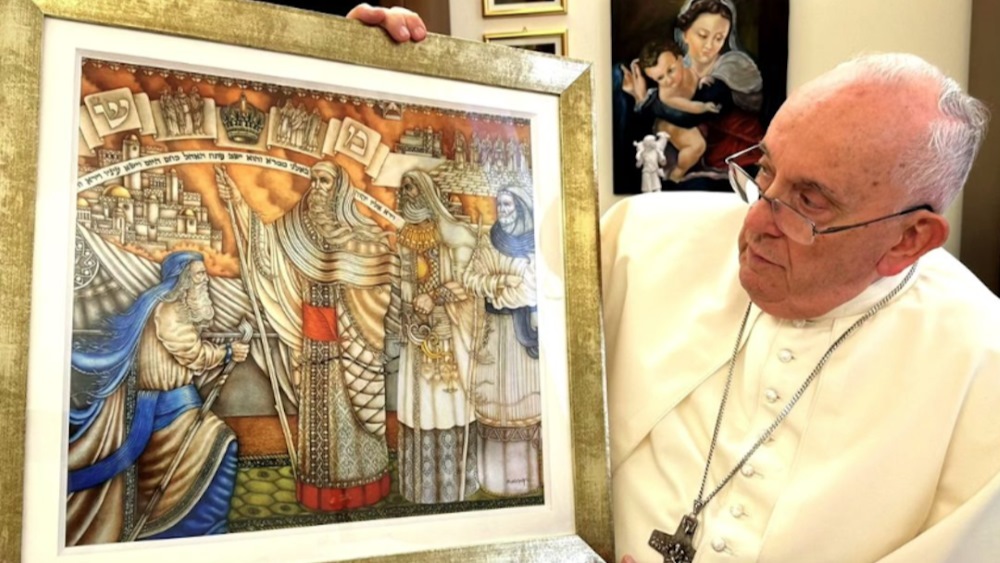
But by now, Avayu, 55, has seen his paintings — many of them Jewish-themed — shown in galleries around the globe, put on the walls in the homes of former presidents around the world and presented to Pope Francis.
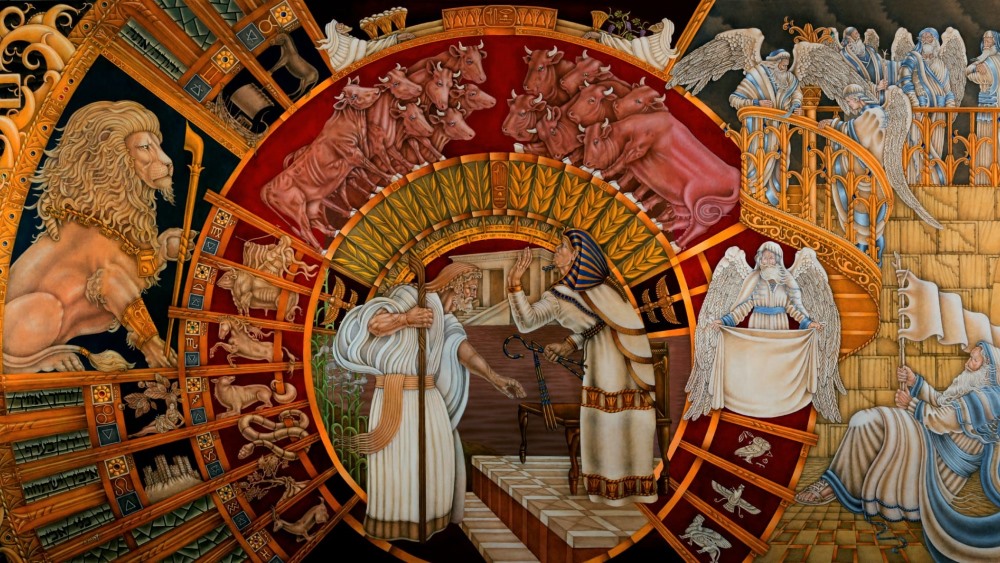
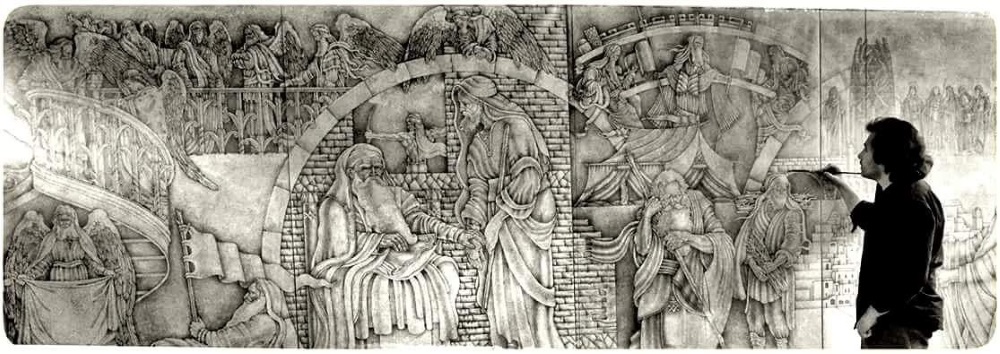
Today, he’s working on his most ambitious project yet: capturing the key moments of the Torah in 40 large murals.
Avayu has already finished the eight murals that comprise his depiction of Genesis. The murals, two meters tall, were shipped two years ago to Taipei, where they will be permanently displayed at the Jeffrey D. Schwartz & Na Tang Jewish Taiwan Cultural Association.
Avayu explained that each book of the Torah takes him about two years to complete. So with four books to go, the project will be complete 8-10 years from now. He already has buyer interest for the entire set.
The majority of Chile’s 18,000 Jews belongs to the Masorti movement, but Avayu didn’t always know that much about Judaism. Several years ago he wanted an artistic challenge, and his lack of Jewish knowledge intrigued him.
“When I paint now, I always paint with a kippah,” he said. “But even though I come from a home where everyone is Jewish, I didn’t come from a religious family.”
Avayu said he was drawn to its many “hidden messages” in the Torah and the variety of commentary available for every passage. When he looked at past master painters’ depictions of biblical scenes, he was struck by the inaccuracy. For example, in the Sistine Chapel, Michelangelo famously painted God as giving life to Adam by touching his finger. However, the verse in Genesis says God created man through His breath.
(Photo courtesy of Mauricio Avayu)
Avayu called the leader of Santiago’s Chabad-Lubavitch community and began intensively studying the Torah. He was particularly drawn to Kabbalah, Jewish mysticism, and studied for about four years at a Kabbalah center.
“When we think we understand something about a certain passage of the Torah, it’s only at that level,” said Avayu. “But then suddenly, at a different time, we are able to understand the same passage but at a completely different level.”
Before he sets out to paint a new work, Avayu not only consults with his rabbi but reads multiple biblical commentaries, from scholars such as Rashi and Maimonides, and chooses the one that resonates most deeply.
For example, when he painted the tree in the Garden of Eden, he consciously did not do what many other famous artists have done: depict the “forbidden fruit” as an apple. Some commentators posit that the fruit is an etrog, others a grape.
Avayu prefers the interpretation that it was a fig. “There’s not only one truth,” he said. “There are a lot of true interpretations.”
When seeing Avayu’s art for the first time, Gabriel Goldstein, chief curator at the Yeshiva University Museum, said he was reminded of the work of Archie Rand, a Jewish artist from Brooklyn who has also painted biblical murals in synagogues across the United States.
Goldstein found aspects of Avayu’s art that he believes are influenced by his country of origin.
“In [Latin American-Jewish art], there is a flavoring that comes from the local culture … as well as from traditional Jewish culture,” he said. “And I think you can see that in his work — there’s a certain kind of vividness and palette and exuberance that may be more frequently found, but not exclusively found, in Latin American art.”
Since around 2012, Avayu has completed more than 120 paintings and has at least 30 more in the works. Not all of his art involves the Torah: He has also painted ketubot, Jewish marriage certificates, and has produced fantastical interpretations of mythological creatures, like the Greek Pegasus. Chilean businessman Tomas Munzer recently gave one of Avayu’s works to Argentina’s ambassador to the Holy See, who presented it to the pope.
(Photo courtesy of Mauricio Avayu)
Avayu is now opening a studio in Florida where he teaches aspiring painters. At the Mauricio Avayu Gallery and Fine Art Academy in Aventura, his classes incorporate lessons from the Torah and Kabbalah. And his students — mostly from the U.S. Russia, Argentina and Chile — don’t mind the mixing of Judaism and fine art, since almost all of them are Jewish.
“Regardless of my daily goal to be a better artist, I am never satisfied with a painting,” Avayu said. “I always try to see how I can make it a little better next time. The same always happens with the study of Kabbalah, where you learn something on a related topic, and over time, you realize you’ve learned a deeper level of that same topic.”
Based in Peru, Jacob Kessler wrote this article for the JTA global Jewish news source.
Educators, ethicists and Jewish leaders are debating the question as content mills slop on.
Filmmaker Justin Schein looks at wealth and inequality through the very real story of his late father.
For 35 years, the late Deborah Brodie, aka Bubbie Cookie, amassed a collection of over 200 Jewish ritual objects, which she used to teach her Hebrew school students with special needs.
Conceived by Columbia resident Benjamin Kintisch, "Life Review: The Hospice Musical" offers a thought-provoking and occasionally amusing perspective on mortality.