
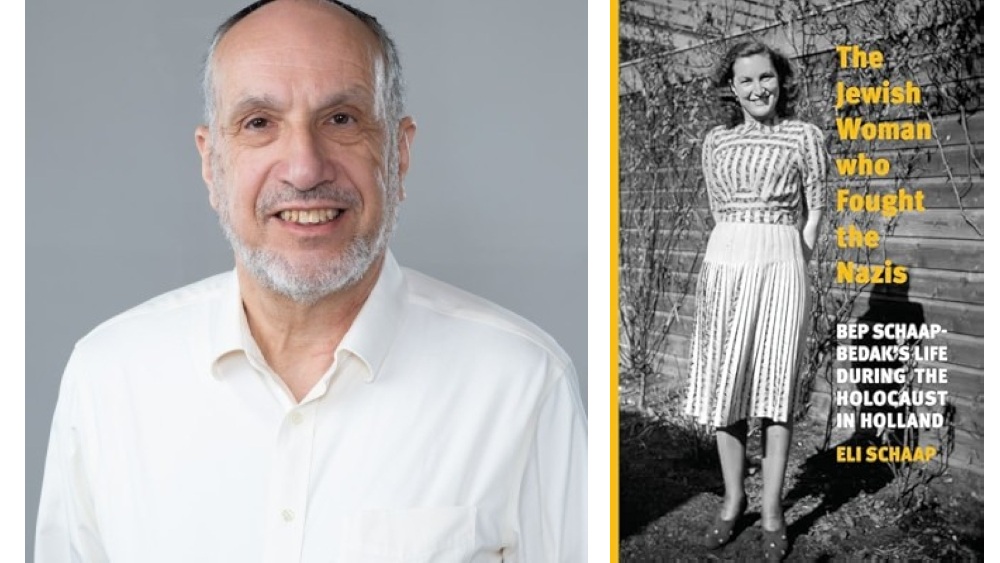
Like many offspring of Holocaust survivors, Eli Schaap found that his mother offered little in the way of details about her life during World War II.
But after his mother’s death in October of 2011 at the age of 96, Schaap and his siblings stumbled across a treasure trove of documents and letters in Bep Schaap-Bedak’s home revealing her life during that period and her heroics as a young woman living in Holland during the Holocaust.
His new book, “The Jewish Woman Who Fought the Nazis: Bep Schaap-Bedak’s Life During the Holocaust in Holland” (Amsterdam Publishers), is the result of five years of research into his mother’s life.
The book chronicles her family’s life before the war, Bep’s pursuit of a law degree, her efforts to help nearly 100 Jews go into hiding during the Nazi occupation of The Netherlands, and her life after the war.
Key to her survival was her parents’ decision during World War I to acquire forged birth certificates as natives of Jerusalem, then part of the Ottoman Empire, thus identifying them as Turkish citizens. (Turkey maintained a policy of neutrality during World War II but maintained a Treaty of Friendship with Nazi Germany.)
During the World War II, about 75% of Holland’s community of approximately 140,000 Jews was murdered by the Nazis.
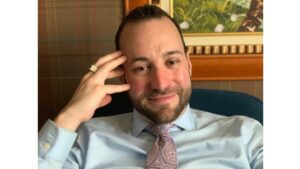
Born in The Hague, Schaap, 71, who lives in Northwest Baltimore, moved to the United States when he was 22. He serves as senior vice president of the New York-based Steinhardt Foundation for Jewish Life.
For “International Holocaust Remembrance Day,” Schaap will speak about his book on Wednesday, Jan. 28, at noon at the Jewish Library of Baltimore, 5700 Park Heights Avenue.
When exactly did you decide to write a book about your mother’s wartime experiences?
When my mother passed away in Israel in 2011, I found the letters and documents, but emotionally I found it too difficult to read them. When COVID started, I discovered that researching my mother’s life during the Shoah gave me strength to deal with the pandemic’s challenges. The Israel-Gaza war motivated me even more deeply to write the book.
Did she ever discuss the possibility of writing an autobiography?
No, she would not talk or write about her experiences. While she saved many Jews, she failed to save her parents. A sense of failure haunted her for the rest of her life.
Growing up, did your parents talk much at all about the war?
My father talked freely and gave interviews, but his experience was quite different with some positive aspects. Together with his elderly father and older brother, he was hidden by good people who acted from conviction and refused take any money.
Do you think your mother intentionally left behind her box full of documents from her years during the Holocaust?
I don’t think so. I believe that she found it too difficult to part with the letters, especially the ones written by her parents and smuggled from the Westerbork transit camp.
How did the Holocaust shape your parents’ perspectives on faith?
Their beliefs gained strength as they found comfort in the structures provided by the Orthodox way of life. They acknowledged that there are no easy answers to the question, ‘Where was God?’ They did find comfort in the establishment of the State of Israel. Their Zionism was key to their Jewish identity from before the war and continued to be a major part of their beliefs after the war.
How did your mother’s false Turkish citizenship benefit her during the war?
Because Turkey was a neutral country and the Nazi regime didn’t want to alienate the Turkish government, Turkish Jews [living in Holland] were not subjected to the increasingly harsh antisemitic measures imposed on other Jews. They were exempt from having to wear a yellow star; they were allowed to keep their telephone, their bikes and their bank account.
My mother successfully used her false Turkish nationality to reverse the confiscation of the operation of their [family’s ] movie theater business. Unlike all the other Jewishly owned or operated theaters which were confiscated in 1941, they continued to operate theirs until October 1943 when the Turkish Jews were arrested.
Only in 1943, when most of the Dutch Jews were already murdered, did Eichmann’s office explore what to do with the Jews from neutral countries.
What was the research process like for this book?
A mixture of exciting and frustrating. Exciting because when I researched my mother’s life before and during the war, I discovered a courageous and daring woman who I never knew.
Frustrating because, after so many years, there are many details of the story that will probably forever remain unknown.
What was it about your mother — and others like her — that produced this kind of strength, courage and resilience?
Conviction, belief in Judaism, support from her close non-Jewish friends who studied with her at Leiden University [in The Netherlands]. I don’t think she saw herself as courageous. Her success in hiding Jews gave her strength and the conviction to double her efforts.
In the end, mazal [luck] was a significant factor. She could easily have been discovered by the Nazis or been betrayed. Especially since she took great risks.
When they finally arrested her in December 1944, they never discovered her true identity or even that she was working with the [Dutch] resistance, and after a few months they released her from prison.
In your research, what did you learn about your family that you never knew before?
The most surprising to me was that I had assumed that she mostly worked with people who shared her belief that it was critical to save Jews. However, in order to succeed she also carefully used her relationships with Nazi sympathizers to pursue her efforts to fight the Nazis.
While I knew that close relatives, grandparents, uncles and cousins were murdered in the concentration camps, I learned somewhat what they were like and what they believed.
How did your mother’s life shape your own views on faith and your life as a Jewish communal professional?
This is complex. My mother instilled in me a belief in Judaism, a strong sense of belonging to the Jewish people and a love of Israel. All of these are positive aspects of Jewish identity. This led me in my personal and professional life to pursue the wonderful complexities of positive Jewish identity.
Now that it has become impossible to ignore the rise of antisemitism, I find myself resenting having to deal with this horrible hatred and sickness spread by our enemies. This is not what I want to spend my time with, but regretfully I feel I have no choice.
How did you balance being a researcher/writer with being a son? Was it challenging at times not to put your mother up on a pedestal?
I reported what I found in the letters, documents and archives. It led me to discover a woman who I didn’t really know, which made it easier to write about her as I didn’t have a personal relationship with that part of my mother’s life.
My personal goal in this research was not to put her on a pedestal but to discover what aspects of her struggles during the Shoah may inspire me and others in our current lives.
I included in the book some criticism of her — that she was reckless in her efforts to save Jews and may have endangered people — but I didn’t find proof that this aspect of her actions actually harmed anyone.
Why did your parents later in life make aliyah in 1994?
They always wanted to make aliyah but running a successful business in Holland held them back. After they sold their movie theaters and three of their children were already living in Israel, they made the difficult decision as elderly people to leave for Israel and start a new life there.
Do you think your mother would be pleased with this book? How do your siblings feel about it?
She once was praised in public by her first cousin whom she had saved. She didn’t know how to react and was probably mostly embarrassed. I don’t know that she would be happy with my book.
My brother and sister helped me in my research and I hope they will find inspiration from this effort, just as I did.
How did this book change your relationship with your mother?
That is a difficult question as my relationship is based on my mother’s life after the Holocaust and I didn’t do the research until after she died. I now understand more of her struggles after the war. This influenced her in how she raised me and my siblings. It carried with it the burden of being a survivor and had both positive and negative influences on my life.
With this knowledge, I feel more connected and blessed to discover a woman I didn’t really know.
Who is your intended audience for this book?
Anyone who would like to or has a need to better understand what happened during the Holocaust, especially since the tragic story of Dutch Jewry is not that well-known. This includes both Jews and non-Jews.
What do you hope readers take away from this book?
Stand up for what you believe in, realize that Jewish identity is exciting and complex, and understand that the world should not be seen in black and white.
For information about Schaap’s talk at the Jewish Library of Baltimore, visit secure.lglforms.com/form_engine/s/qmWNLElTQs37zRnMPfDCxA.
For more than five decades, Dr. Rosenstein was known by local families as a trusted and caring physician for their children.
Jewish Community Services' upcoming "Future-Ready Workplace" event will feature a keynote address from workplace expert and bestselling author Liz Fosslien.
A Baltimore native, Sweren was a collector of artists' books whose own works were displayed in national galleries.
The BCO, founded in 1984, will perform the works of Frank Zappa, Beethoven, Mason Bates and Karena Ingram.