
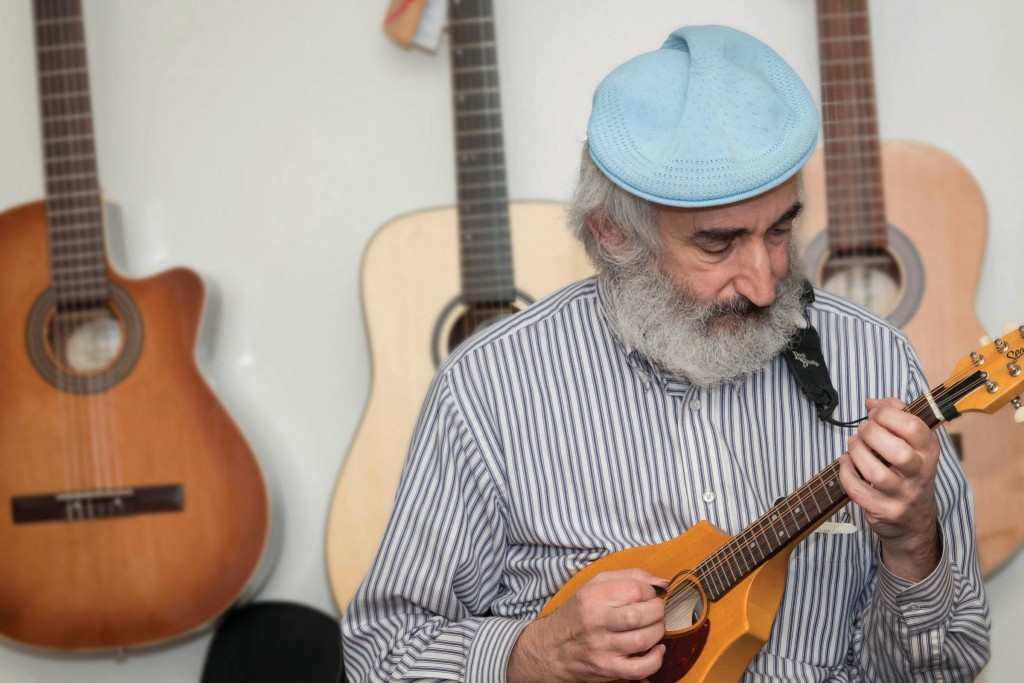
Perched atop a produce market, Guitars of Pikesville overlooks a busy stretch of Reisterstown Road. It’s a store you’ve likely driven past hundreds of times on your daily commute.
Perhaps you mistook Guitars of Pikesville as just another music store. But once inside, you were greeted by the finest acoustic instruments on the market – proprietor Joshua Polak is a licensed dealer of Larrivee and G&L guitars, two of the most celebrated guitar manufacturers in the world.
But after more than a decade at its current location, Guitars of Pikesville closed its doors on Oct. 31.
Polak said he plans to continue selling and working on instruments out of his car and from his Pikesville residence. He’ll also continue to stage open mic nights and shows at different venues in Northwest Baltimore.
“We’ll still be in business, better than ever,” he says. “We’re just no longer babysitting the shop. I’m going where the mountain is – that’s services. The retail’s just not there anymore.”
He looks back on the store’s evolution in a philosophical manner.
“Sometimes there is a feeling that the events of life are happening to you, and you’re just obeying,” says Polak. “There have been so many extraordinary connections and relationships made throughout the years. [The store’s closing] is a time for reflection.”
Polak can remember the exact moment his love affair with music began. “Every musician has a moment that hits their central nervous system,” he says. “I can remember very little from my early childhood, but I distinctly remember hearing British invasion rock for the first time.”
As a teenager, Polak devoured every genre of music from folk to rock, learning not just the tones and styles of the guitar but the mechanics of the instrument as well. But it wasn’t until his college years when Polak began studying classical guitar that his playing truly matured.
While performance has always been important to Polak, he prefers to look at himself as a facilitator for other people’s talents. The vision to create a grassroots musical community dates back to his college days, when he began attending, and later organizing, concerts at house parties.
“Music clubs were becoming very businesslike and calculated,” says Polak. He soon realized there was an opportunity to put the music back where it belonged — “In the community, in people’s houses.”
Over time, the house concerts and jam sessions became more frequent, as did the number of musicians asking Polak for lessons, instrument repairs or musical advice. Thus, Guitars of Pikesville was born.
“I put limitations on myself in the beginning,” says Polak. “I thought, ‘I’ll only open a store if I can find an affordable store on a main drag, or if Larrivee Guitars wants to do business with me.’”
For a while, Polak bested every obstacle; then came the Great Recession.
Players once eagerly purchased premium acoustic guitars from retailers like Polak. But when the economy collapsed, many local music shops closed their doors.
Guitars of Pikesville succeeded where others failed because its brick-and-mortar store was always a vessel for something greater than instrument sales.
“There was always a commitment to creativity,” says Polak. “Guitars of Pikesville created an artistic culture, not just of music but of craft.”
Even while Guitars of Pikesville’s retail sales declined, players continued to gravitate to Polak’s vision for an artistic community.
Throughout the years, many people propelled Guitars of Pikesville forward, but few were more involved than Rick Sambuco, a retiree who helped organize the store’s open mic nights and legendary Sunday night jam sessions.
“When we started, there were no open mics or jam sessions in Pikesville,” says Polak. “Players who connected with one another through the store have begun to pay it forward.”
The emergence of an organic musical community in Pikesville is a sign of a job well done.
“As a Jewish and geographic community, we must bring music culture into our homes,” says Polak.
The business realities are now what they are. Musicians look to the internet or corporate chains to buy and sell their instruments, effectively pricing out local shops from the market. But retail was never the primary focus for Polak.
“The corporate world will never give our local music community what we need,” says Polak. “It’s our responsibility to develop an artistic culture for ourselves.”
As a young musician, Polak dreamed of a place where young players could meet experienced musicians and shoot the breeze about instruments, qualities and styles.
Polak made his vision a reality.
“There’s a certain depth to life that didn’t exist before the store,” says Polak. “All it takes is one concert.”
For information, contact Joshua Polak at 410-415-5400.
Brandon Chiat is a Baltimore-based freelance writer.
Caption: Photo of Joshua Polak by Harry Bosk

Filmmaker Justin Schein looks at wealth and inequality through the very real story of his late father.
For 35 years, the late Deborah Brodie, aka Bubbie Cookie, amassed a collection of over 200 Jewish ritual objects, which she used to teach her Hebrew school students with special needs.
Conceived by Columbia resident Benjamin Kintisch, "Life Review: The Hospice Musical" offers a thought-provoking and occasionally amusing perspective on mortality.

Steve Hofstetter, who will perform at Soundstage next week, recently made headlines for his social media post ridiculing some fans' warnings about Charm City's safety.