
Americans love their cars. Indeed, we own an estimated 260 million of them! Still, many of us take our vehicles for granted, rarely considering what life would be like without them or the gasoline that makes them run.
“Fueling the Automobile Age,” a new and original long-term exhibition at the Baltimore Museum of Industry, sheds light on how a pair of locally owned oil companies — American Oil and Crown Central Petroleum — fueled America’s celebrated automobile era. It also asks visitors to consider what technologies and innovations will guide transportation in the future.
“Fueling the Automobile Age” takes visitors on a journey that began at the turn of the 20th century when chemists discovered that gasoline could be extracted from petroleum and used to power internal combustion engines. Baltimorean Louis Blaustein, a kerosene salesman for John D. Rockefeller’s Standard Oil Co., recognized that gas-powered automobiles were the wave of the future. Blaustein and his son, Jacob, founded the American Oil Co. in 1910.
“[Louis] Blaustein was really a pioneer,” says BMI Executive Director Anita Kassof. “He was a Lithuanian [Jewish] immigrant who personified the American Dream, rising from kerosene peddler to the founder of the American Oil Company.”
The Blausteins started out delivering gasoline with two horse-drawn tank engines, but by 1918 they sold Amoco Gas — which became the company’s signature product — through 46 independent dealers at garages and motor companies around Baltimore.
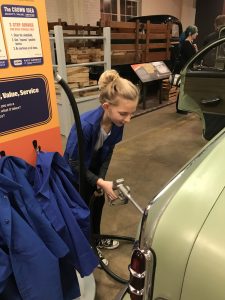
In the mid-1920s, drive-through filling stations became more pervasive and the Blausteins embraced the new business model. The invention of “visible” pumps showed customers how much gasoline they received based on how much they paid. An example of an early gas pump is on display in the exhibition; children can dress up in attendant uniforms and pretend to pump gas.
“Americans had an insatiable appetite for automobile ownership, and the explosion of the industry was dramatic,” says Dean Krimmel, the exhibition’s curatorial consultant.
There were 8,000 registered vehicles in 1900, but that number ballooned to 9.2 million by 1920 and almost 27 million in 1930, says Krimmel.
“We may take this industry for granted, but it reshaped our world in so many ways, affecting our mobility, where we lived, where we worked and even our sense of time,” he says.
In 1930, the Blausteins acquired Houston-based Crown Central Petroleum. The purchase made Crown one of the first fully integrated “ground-to-pump” oil companies.
(Louis Blaustein’s grandson, Henry Rosenberg, the BMI’s 2015 Industrialist of the Year, was instrumental in bringing his family’s story to the museum. As Crown’s chairman, president and CEO, Rosenberg, now 87, grew his grandfather’s company into one of the country’s largest regional independent petroleum corporations.)
From the 1930s through the 1950s, Crown gas stations evolved from filling stations to full-service stations with repair services, and the company grew into one of the nation’s largest regional independent petroleum outfits.
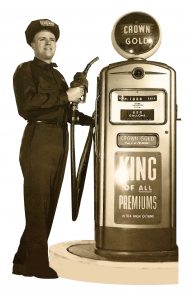
Crown opened gas stations along the East Coast, including 200 in the Baltimore-Washington corridor. Since gas prices varied little between brands, Crown built customer loyalty by investing in advertising promotions touting the company’s outstanding customer service. The exhibition features marketing materials, logos and a video presentation about Crown and American Oil’s promotional paraphernalia.
After World War II, gas stations became more than simply places to fuel one’s vehicle. They were also hangouts for suburban youngsters who stopped by to fill bicycle tires and purchase candy bars.
“This was the age of car culture,” says Kassof. “Cities were ripping up streetcar lines, suburbs were built, drive-ins were big and getting a car was a teenager’s rite of passage.”
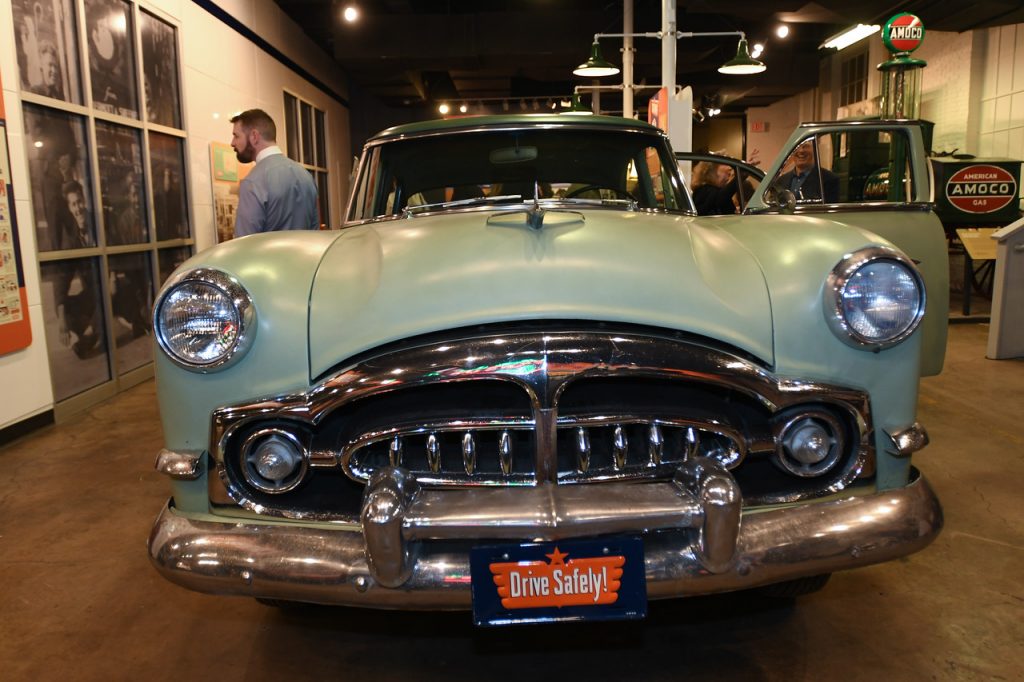
An aqua-colored 1953 Packard with green velvet seats is a highlight of the exhibition. “Everyone gets excited about the car,” says BMI Development Director Deborah Cardin. “Visitors can sit inside, listen to Crown ads on the radio, watch a video presentation and take photographs. All these adults want to sit in it, and the kids love it because it’s not like any car they’ve ever seen.”
In the another section of the exhibition, a mural depicting gas lines forming at 25th Street and Greenmount Avenue takes visitors back to the energy crisis of the early 1970s. Visitors are asked to share memories of that time, using sticky notes that can be attached to a board.
“People have visceral reactions to the section about the gas crisis. They remember the signs from when they were children,” says Cardin.
This section raises questions about American dependence on foreign oil that the nation still grapples with. A little-known fact conveyed during the exhibition is that electric vehicles are not a new concept. The first “EVs” were developed in the 1890s, and the gas crisis of the ‘70s led to renewed interest in those cars.
“The oil crisis was really disruptive,” says Krimmel. “This part [of the exhibition] really plays with the notion that it takes disruption to shift society. We have an ambivalent relationship with cars. We have an insatiable appetite for them, but there’s been a lot of harm to the environment. So what can we do differently?”
The exhibition’s final section calls on visitors to think about the future of transportation. “We ask people to think about their relationships to cars and driving,” says Kassof. Visitors learn about contemporary electric cars and contemplate the roles that ride-sharing public transportation companies and self-driving vehicles will play now and in the future.
In addition, they can play games such as “Fuels of the Future Match Game.”
“What we realized when planning the exhibition was that early adopters of gasoline-fueled cars were dealing with a lot of the same questions we’re dealing with now,” says Kassof. “They were at the dawn of the gasoline-fueled automobiles, and here we are at the dawn of electric cars.”
Krimmel hopes “Fueling the Automobile Age” will compel visitors to think about transportation holistically. “The BMI could easily be a place just to celebrate the industrial past,” he says, “but museums are more than that. They’re places where we connect the past and present, where we have important conversations about our lives, to talk about where we came from and where we’re going.”
For information, visit thebmi.org.

The Jerusalem Orchestra East & West, which arranged the program for young musicians, blends Western orchestral music with Middle Eastern traditions.

Pikesville resident and entrepreneur Luna Rosendorff discusses what she's seeing these days in the world of contemporary interior design.

Jewish Community Services' upcoming "Future-Ready Workplace" event will feature a keynote address from workplace expert and bestselling author Liz Fosslien.

The BCO, founded in 1984, will perform the works of Frank Zappa, Beethoven, Mason Bates and Karena Ingram.